

10 Best-Governed Countries in the World
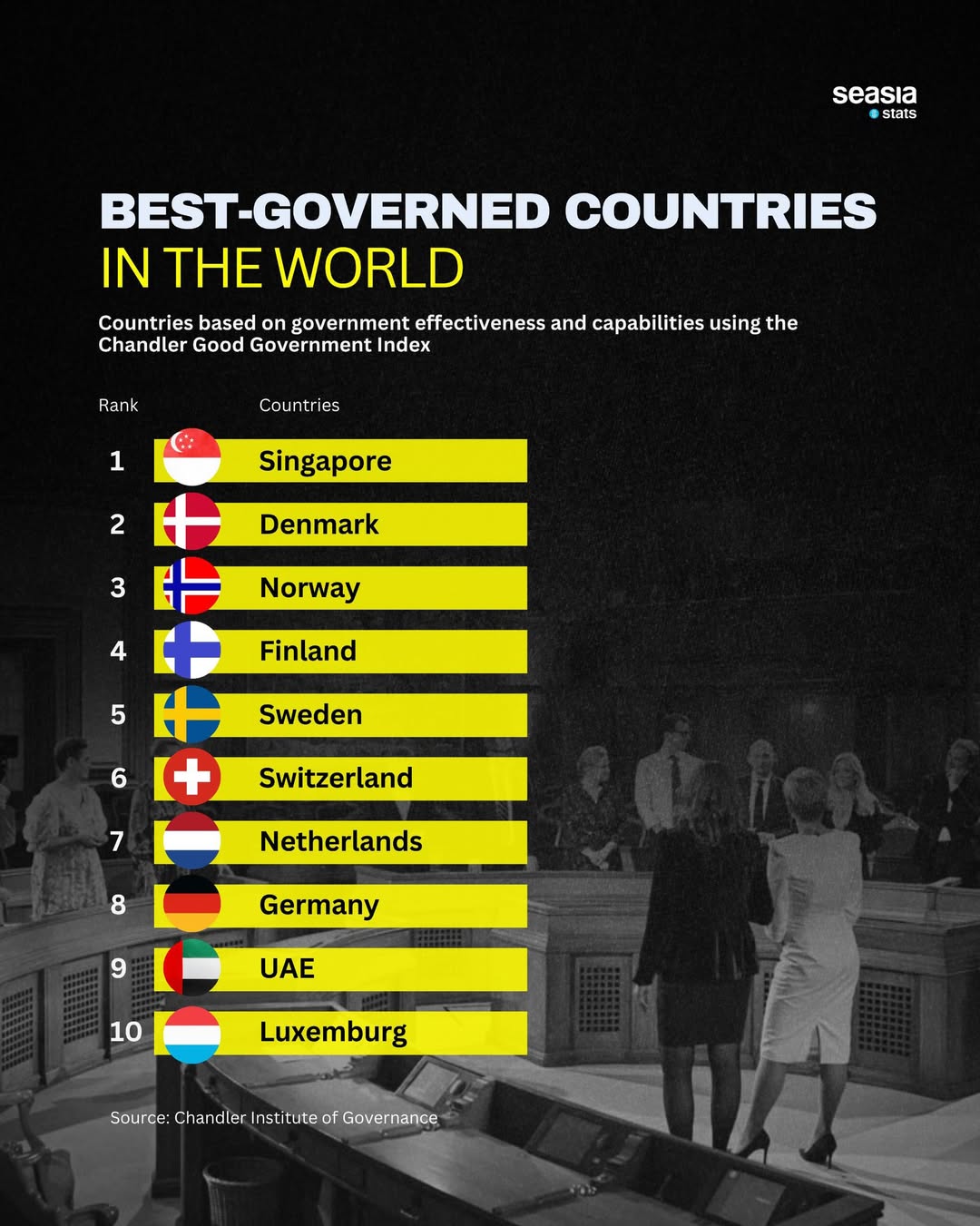
Singapore is currently the best-governed country in the world.

Effective governance plays a crucial role in shaping a nation's prosperity, stability, and quality of life.
The Chandler Good Government Index (CGGI), developed by the Chandler Institute of Governance, evaluates countries based on factors such as leadership, public service quality, strong institutions, financial management, and the ability to help citizens achieve positive outcomes.
According to the index, several nations consistently stand out for their exceptional governance and effective public administration.
Leading the rankings is Singapore, widely recognized for its efficient government, long-term planning, and high-quality public services. The city-state has built a reputation for transparency, economic competitiveness, and policy effectiveness, making it a global benchmark for governance excellence.
Among European nations, four nordic countries Denmark, Norway, Finland, and Sweden occupy prominent positions in the rankings. These countries are known for strong democratic institutions, low levels of corruption, robust social welfare systems, and high levels of public trust.
Their governments consistently perform well in delivering healthcare, education, and social services while maintaining fiscal responsibility.
Switzerland also ranks among the world's best-governed countries. Its decentralized political system, direct democracy mechanisms, and stable institutions contribute to high levels of accountability and citizen participation. The country is frequently praised for balancing economic prosperity with political stability.
The Netherlands and Germany further demonstrate the strengths of effective governance in Europe. Both countries benefit from strong public institutions, efficient regulatory frameworks, and well-developed infrastructure.
Their governments emphasize innovation, sustainability, and long-term economic resilience, helping them maintain high standards of living for their populations.
Outside Europe and Asia, the United Arab Emirates (UAE) has emerged as a notable example of governance success. Through strategic planning, investment in technology, and economic diversification, the UAE has strengthened public services and improved government effectiveness.
Its rapid development over recent decades highlights the impact of focused leadership and institutional capacity.
Completing the top ten is Luxembourg, a small but highly prosperous nation with strong institutions and effective public administration. The country's governance model emphasizes financial stability, economic openness, and high-quality public services, contributing to its consistently strong performance in international rankings.
While each of these countries has its own political structure and policy priorities, they share several common characteristics: competent leadership, strong institutions, transparent decision-making, and a commitment to serving citizens effectively.
Their success demonstrates that good governance is not defined by geography or size but by the ability of governments to deliver results, maintain public trust, and adapt to evolving challenges. As countries around the world seek to improve governance, these top-ranked nations offer valuable examples of effective and accountable leadership.