

10 Best Rated Curries in the World
Few foods inspire loyalty like curry. It is comfort food, celebration food, street food, home food—and, across Asia especially, it is also identity.

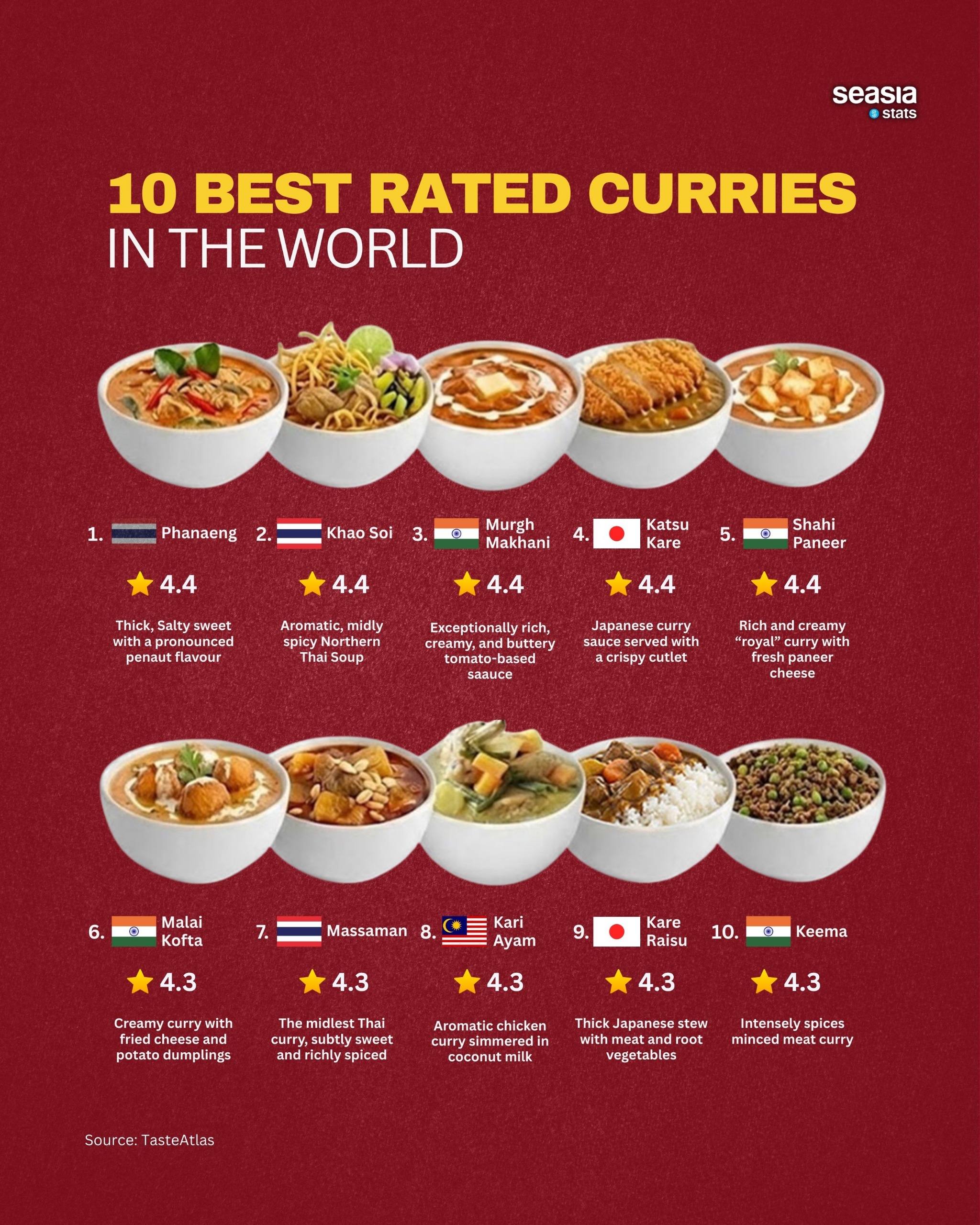
Few foods inspire loyalty like curry. It is comfort food, celebration food, street food, home food—and, across Asia especially, it is also identity. So when TasteAtlas’ latest ranking of the world’s best-rated curries places Thailand, India, Japan, and Malaysia at the center of the conversation, it feels less like a surprise and more like confirmation of what millions of people already know: curry is one of Asia’s greatest culinary gifts to the world.
Thailand Sets the Pace
At the top of the ranking sits Phanaeng curry from Thailand, tied on a 4.4 rating and described by TasteAtlas as thick, rich, salty-sweet, and intensely aromatic. Thailand also claims the No. 2 spot with Khao Soi, the beloved northern dish that balances creamy coconut broth, spice, noodles, and crunch in one bowl.
That double win says a lot about Thailand’s culinary range. Thai curry is often stereotyped abroad as just “red, green, or yellow,” but in reality it spans royal court cuisine, regional mountain cooking, Muslim-influenced southern flavors, and centuries of trade-driven spice exchange.
It is also no coincidence that Southeast Asia performs so strongly here. The region’s curries are shaped by an extraordinary meeting point of Indian spice traditions, local herbs, Arab trade routes, Chinese migration, and indigenous ingredients like lemongrass, galangal, turmeric, candlenut, and coconut milk. That makes Southeast Asian curry not just delicious—but historically layered.
Southeast Asia’s Quiet Power on the Curry Table
While Thailand dominates the top tier, Malaysia also makes a notable appearance with Kari Ayam at No. 8. That is important, because Malaysian curry often receives less global attention than Thai or Indian curries despite being one of the most complex curry traditions in Asia.
Malaysian curry sits at a crossroads: Malay, Indian, Chinese, and Peranakan influences all leave their mark. Kari Ayam, in particular, captures that hybrid richness—warm spices, creamy coconut milk, and a balance that feels both deeply Southeast Asian and unmistakably connected to the broader Indian Ocean world.
And beyond the ranking itself, Southeast Asia’s curry map is even wider than this top 10 suggests. Indonesia’s gulai and rendang-adjacent gravies, Singapore’s fish head curry, Brunei’s rich stewed curries, and the Philippines’ regional Muslim curries in Mindanao and Sulu all reflect a curry culture that is far more expansive than international lists usually capture.
That is part of the region’s culinary strength: it rarely relies on one signature alone. Southeast Asia doesn’t just have “a curry”—it has hundreds of them.
India and Japan Prove Curry Is Endlessly Adaptable
The ranking also highlights how curry has evolved into different emotional registers across Asia. India, unsurprisingly, appears several times, with Murgh Makhani (Butter Chicken), Shahi Paneer, Malai Kofta, and Keema all making the list. These dishes represent curry as richness, hospitality, and layered spice mastery.
Japan, meanwhile, reminds the world that curry can also be comforting, mild, and deeply domestic. Katsu Kare and Kare Raisu are not “traditional Indian curries” in the classic sense, but they are among the most beloved curry dishes anywhere. Their inclusion shows how curry is not a fixed category—it is a living, adaptable form.
As the BBC once observed in a feature on curry’s global history, curry has become “a dish that belongs everywhere and nowhere at once.” That is precisely what makes it so powerful. It travels, transforms, and still remains rooted in memory. (bbc.com)
More Than a Ranking
Of course, no ranking can settle a question as emotional as “the best curry in the world.” Someone will always argue for a grandmother’s recipe, a roadside stall, or a forgotten neighborhood spot over any glossy list—and they are probably right.
But what rankings like this do capture is something broader: where culinary admiration is flowing. And right now, Southeast Asia is firmly in that current.
From Phanaeng’s velvety intensity to Khao Soi’s soulful complexity and Kari Ayam’s aromatic depth, the region is not just contributing to the world’s curry culture—it is helping define it.
And perhaps that is the real takeaway: curry is not one dish, one nation, or one tradition. It is a whole geography of flavor. And Southeast Asia sits right at its heart.