

10 Countries Dominating the Global Spice Trade
India and Vietnam are dominating the spice trade with combined 67% of global exports.

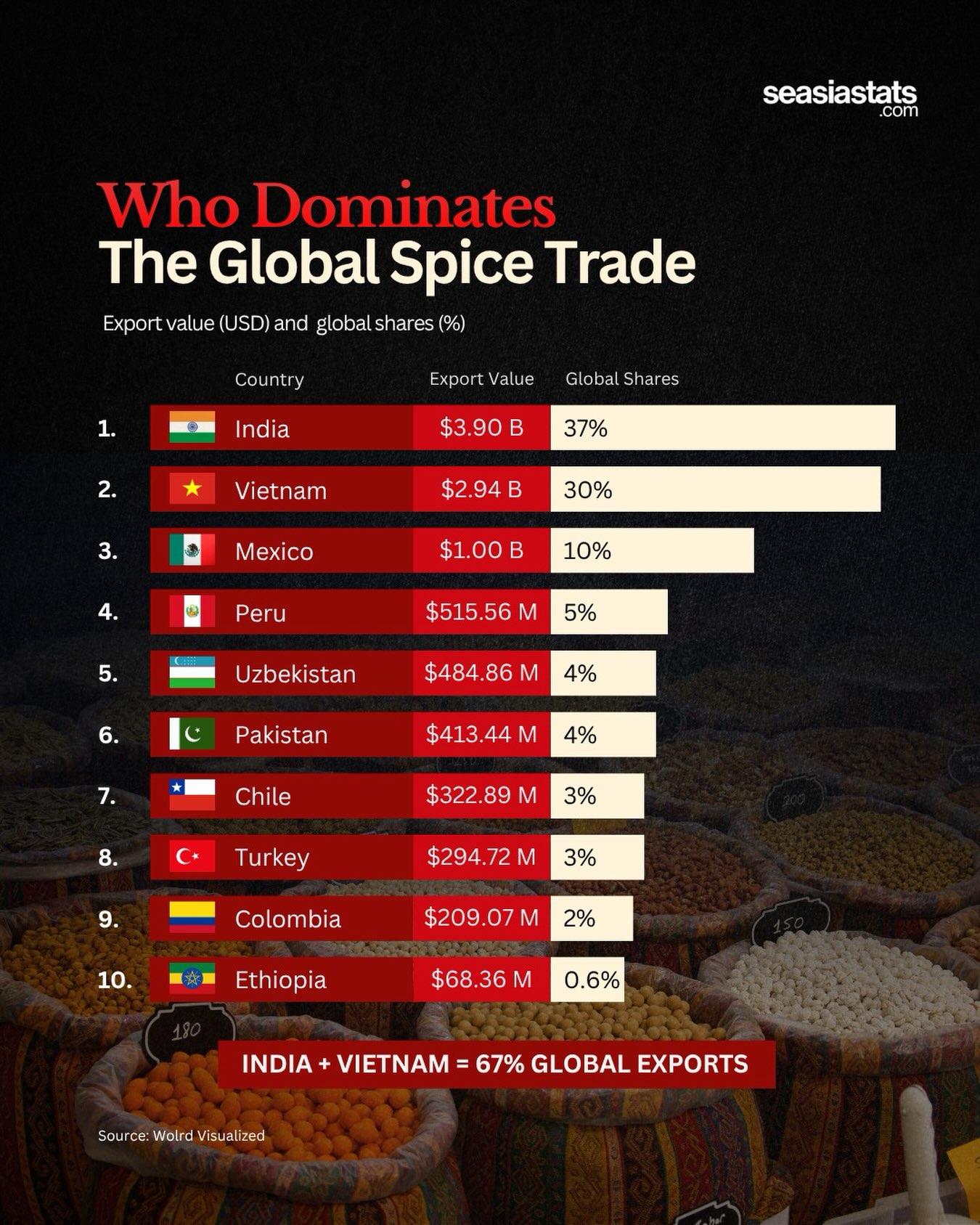
Spices have been traded across continents for centuries, and today they remain an important part of global agriculture, food processing and international commerce. A group of major exporting countries dominates the modern spice trade, with India and Vietnam alone accounting for 67% of global exports in the dataset used for this ranking.
India leads the global spice trade with exports valued at approximately $3.90 billion, representing 37% of global exports. Its position is supported by a vast and diverse production base that includes chilli, cumin, turmeric, pepper, cardamom and coriander.
India exports spices and spice products to more than 200 destinations worldwide, reinforcing its role as a major supplier to international markets.
Vietnam ranks second, with $2.94 billion in exports and a 30% global share. The country is particularly influential in pepper, while also supplying products such as cinnamon and star anise. Vietnam's strength demonstrates how specialization in high-demand spices can create substantial export power.
Mexico occupies third place with $1.00 billion, accounting for 10% of global exports. It is followed by Peru, which records $515.56 million and a 5% share. These Latin American producers have become important participants in global spice supply chains.
Uzbekistan ranks fifth, exporting $484.86 million, equivalent to 4% of the global market. Pakistan follows with $413.44 million and another 4% share, reflecting the importance of South and Central Asia in international spice production and trade.
Further down the ranking, Chile contributes $322.89 million, representing 3% of global exports, while Turkey records $294.72 million, also accounting for 3%. Colombia ranks ninth with $209.07 million and a 2% share, followed by Ethiopia, whose $68.36 million in exports represents approximately 0.6% of the global market.
Together, these ten countries illustrate the geographical diversity of the global spice industry. Asia remains the dominant force, particularly through India and Vietnam, while Latin America, Central Asia, the Middle East and Africa provide important sources of competition and supply.
Although export values vary considerably, each country contributes distinctive crops, production expertise and trade networks to a market that continues to expand. Recent industry analysis indicates that global spice trade volumes have grown dramatically over the past two decades, highlighting the sector's continuing economic importance.