

10 Countries Projected to Have the Largest Muslim Populations in 2070
Pakistan is projected to have the largest Muslim population in the world in 2070.

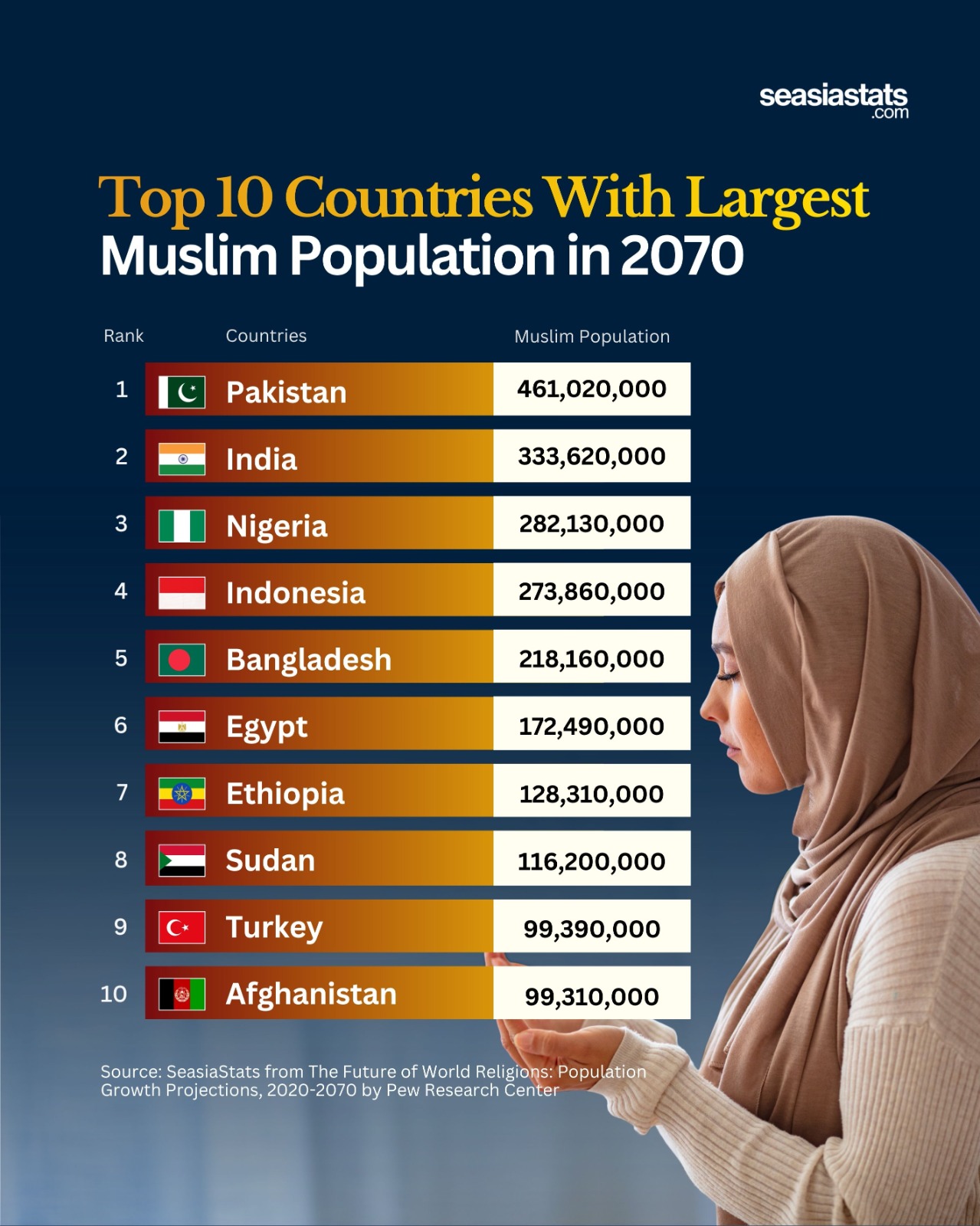
The global Muslim population is expected to continue growing over the coming decades, reflecting demographic changes, population growth, and evolving religious patterns across different regions.
According to projections attributed to the Pew Research Center, several countries in Asia and Africa are expected to have the world's largest Muslim populations by 2070. These projections highlight the growing demographic importance of Muslim-majority nations as well as countries with large religiously diverse populations.
Leading the ranking is Pakistan, which is projected to have approximately 461.02 million Muslims by 2070, making it the country with the largest Muslim population in the world. Its strong population growth is expected to reinforce its position as a major center of the global Muslim community.
Coming in second is India, with a projected Muslim population of 333.62 million. Although Muslims represent a minority of India's overall population, the country is expected to have one of the world's largest Muslim communities, reflecting its enormous population size and religious diversity.
In third place, Nigeria is projected to have approximately 282.13 million Muslims. Located in West Africa, Nigeria has a rapidly growing population, and its Muslim community is expected to expand significantly, strengthening the country's position as an important center of Islam in Africa.
Meanwhile, Indonesia, currently home to the world's largest Muslim population, is projected to have approximately 273.86 million Muslims by 2070. Despite ranking fourth in these projections, the country will remain one of the most influential centers of the Muslim world, with Islam deeply embedded in its cultural and social life.
Bangladesh follows in fifth place, with an estimated 218.16 million Muslims. Its predominantly Muslim population is expected to remain one of the largest globally. In sixth place, Egypt is projected to reach 172.49 million, maintaining its importance as a major center of Islamic history, education, and culture in North Africa.
The African continent also features prominently through Ethiopia, which is expected to have 128.31 million Muslims, and Sudan, with a projected population of 116.20 million. Both countries demonstrate the growing demographic significance of Islam across Africa.
Further down the ranking, Turkey is projected to have approximately 99.39 million Muslims, reflecting its longstanding Islamic heritage and strategic position between Europe and Asia. Finally, Afghanistan completes the top ten with an estimated 99.31 million Muslims.
Overall, these projections illustrate how the center of the global Muslim population is expected to remain concentrated in Asia and increasingly prominent across Africa by 2070. They also highlight the importance of demographic trends in shaping the future religious landscape of the world.