

10 Countries That Are Spending the Least on Education
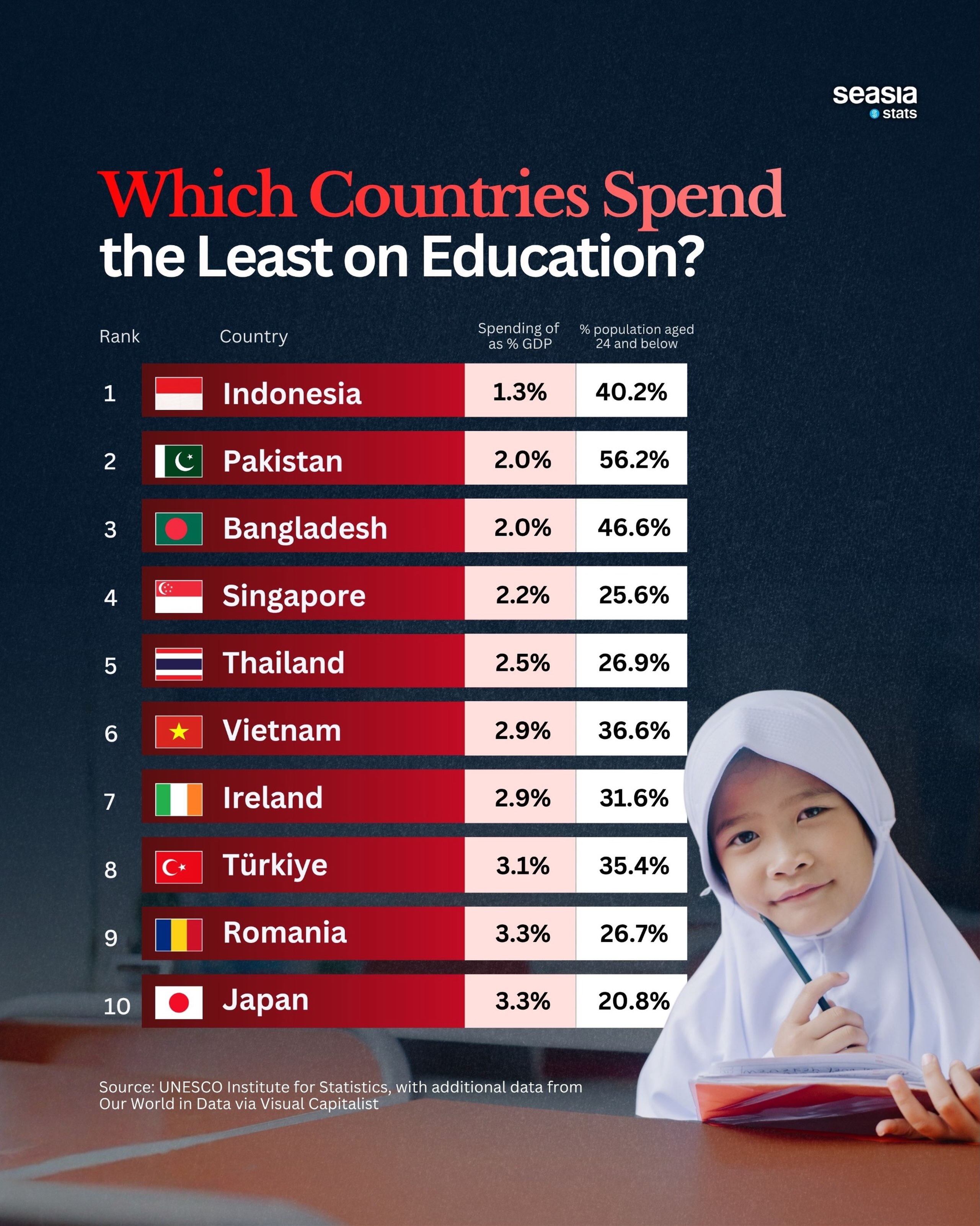
Indonesia has 40.2% of its population aged 24 and below, but only spend 1.3% of its GDP on education.

Government investment in education is often measured as a percentage of gross domestic product (GDP), providing insight into a country's commitment to developing human capital.
However, education spending should also be viewed alongside demographic factors, particularly the proportion of the population aged 24 and below, as younger populations typically require greater investment in schools, teachers, and educational infrastructure.
Among the countries with relatively low public education expenditure, Indonesia records the lowest education spending at 1.3% of GDP while having a remarkably young population, with 40.2% of its residents aged 24 or below.
This combination suggests significant pressure on the education system to serve a large number of students despite comparatively limited public spending.
Pakistan and Bangladesh each allocate 2.0% of GDP to education. Pakistan has the youngest population in this comparison, with 56.2% of its citizens aged 24 and below, while Bangladesh follows with 46.6%. These youthful demographics present substantial challenges in expanding access to quality education.
Singapore, despite spending only 2.2% of GDP on education, has a much older population profile, with 25.6% aged 24 or below. Likewise, Thailand spends 2.5% of GDP on education and has 26.9% of its population in the younger age group.
Their relatively smaller youth populations reduce the overall demand for educational services compared with younger nations.
Several countries spend just under 3% of GDP on education. Vietnam allocates 2.9%, with 36.6% of its population aged 24 and below, reflecting a relatively youthful demographic. Ireland, also at 2.9%, has a younger population than many European countries, with 31.6% aged 24 or below.
Turkey spends 3.1% of GDP on education while 35.4% of its population is aged 24 or younger, indicating continued demand for educational investment. Romania allocates 3.3%, accompanied by a youth population of 26.7%.
Finally, Japan also spends 3.3% of GDP on education but has the oldest population profile among the countries compared, with only 20.8% of its residents aged 24 or below. Its lower share of young people reflects decades of low birth rates and population aging.
This comparison demonstrates that education spending cannot be evaluated in isolation. Countries with larger youth populations generally face greater demands for educational resources, making demographic context an important consideration when assessing the adequacy of public investment in education.