

10 Countries That Use the Most Energy Per Person
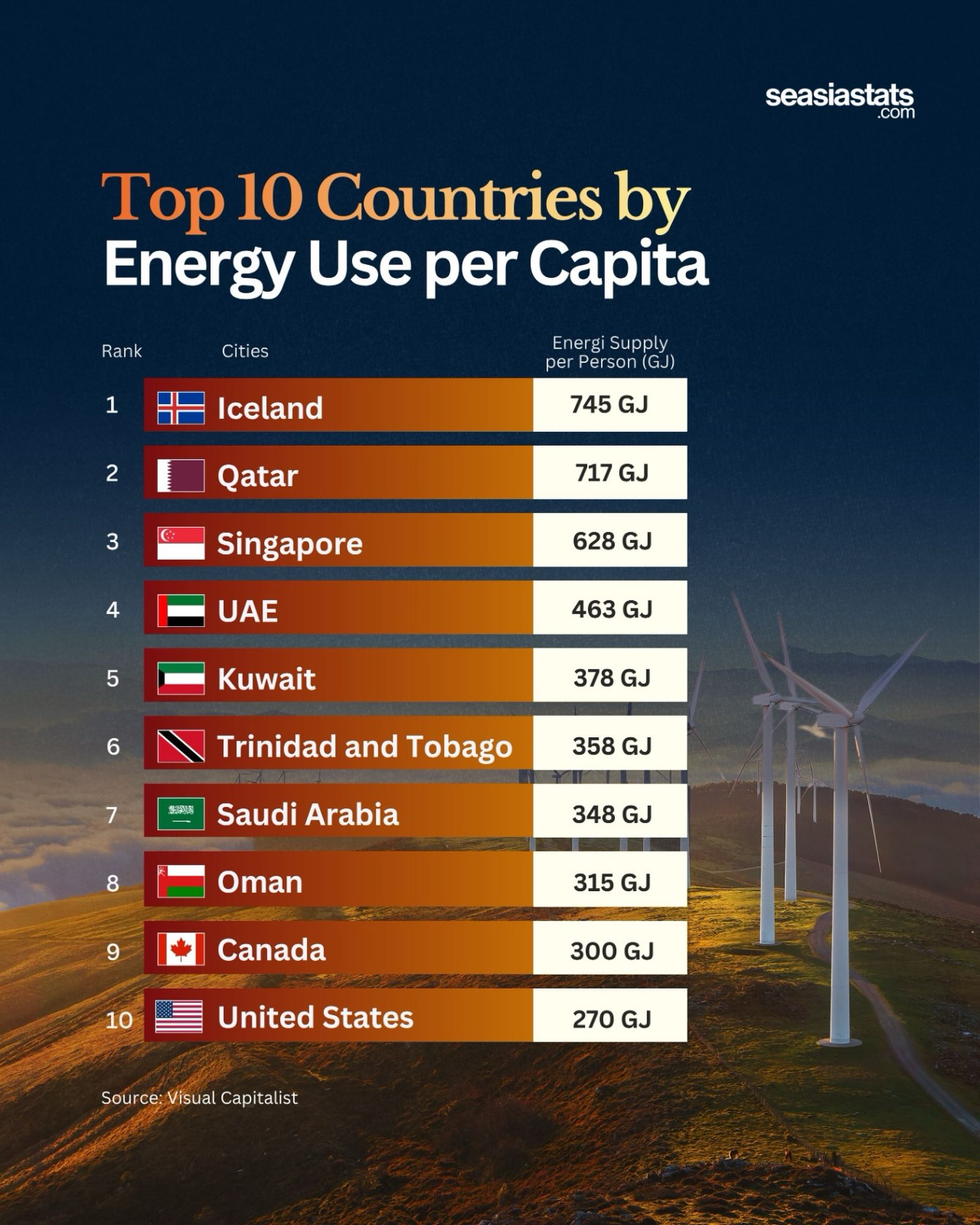
Icelanders are using the most energy per person with 745 GJ.

Energy is an essential part of modern life, powering homes, transportation, industries, businesses, and infrastructure. However, energy consumption varies greatly from one country to another.
One useful way to compare countries is by measuring energy use per person, expressed in gigajoules (GJ). According to figures presented by Visual Capitalist, several countries stand out for their exceptionally high levels of energy consumption per capita.
Iceland ranks first, using approximately 745 GJ per person. Its high energy consumption is partly associated with its energy-intensive industries and the widespread availability of electricity from renewable sources, particularly geothermal and hydropower.
Qatar follows closely with 717 GJ per person. As a major producer of oil and natural gas, Qatar has a highly energy-intensive economy. Its hot climate also creates substantial demand for air conditioning and electricity.
In third place is Singapore, at 628 GJ per person. Despite its small geographical size and lack of significant domestic energy resources, Singapore has a highly developed economy, major industrial facilities, and an important global shipping and business sector, all of which contribute to high energy consumption.
The United Arab Emirates (UAE) uses around 463 GJ per person, while Kuwait consumes approximately 378 GJ. Both countries have hot climates and energy-intensive economies, with significant petroleum industries and high demand for cooling and transportation.
Trinidad and Tobago ranks sixth at 358 GJ per person. Its relatively high consumption is strongly connected to its energy and petrochemical industries. Saudi Arabia, another major energy-producing country, uses approximately 348 GJ per person, followed by Oman at 315 GJ.
Among the world's largest economies, Canada and the United States also have very high per-person energy consumption. Canada uses about 300 GJ per person, while the United States uses approximately 270 GJ. Large geographic areas, transportation needs, industrial activity, and energy-intensive lifestyles all contribute to their high consumption levels.
These figures highlight an important point: being a major energy producer does not necessarily mean a country consumes little energy, and being energy-rich can sometimes coincide with particularly high domestic use. Climate, industrial structure, transportation, population density, energy prices, and living standards all influence consumption.
Looking at energy use per person provides a different perspective from total national consumption. While countries such as the United States and China consume enormous amounts of energy overall because of their large populations, smaller countries can rank much higher when energy use is measured per individual.