

10 Countries Using With the Online Translator the Most
In a world increasingly connected by digital platforms, language remains one of the last major barriers to truly global communication.

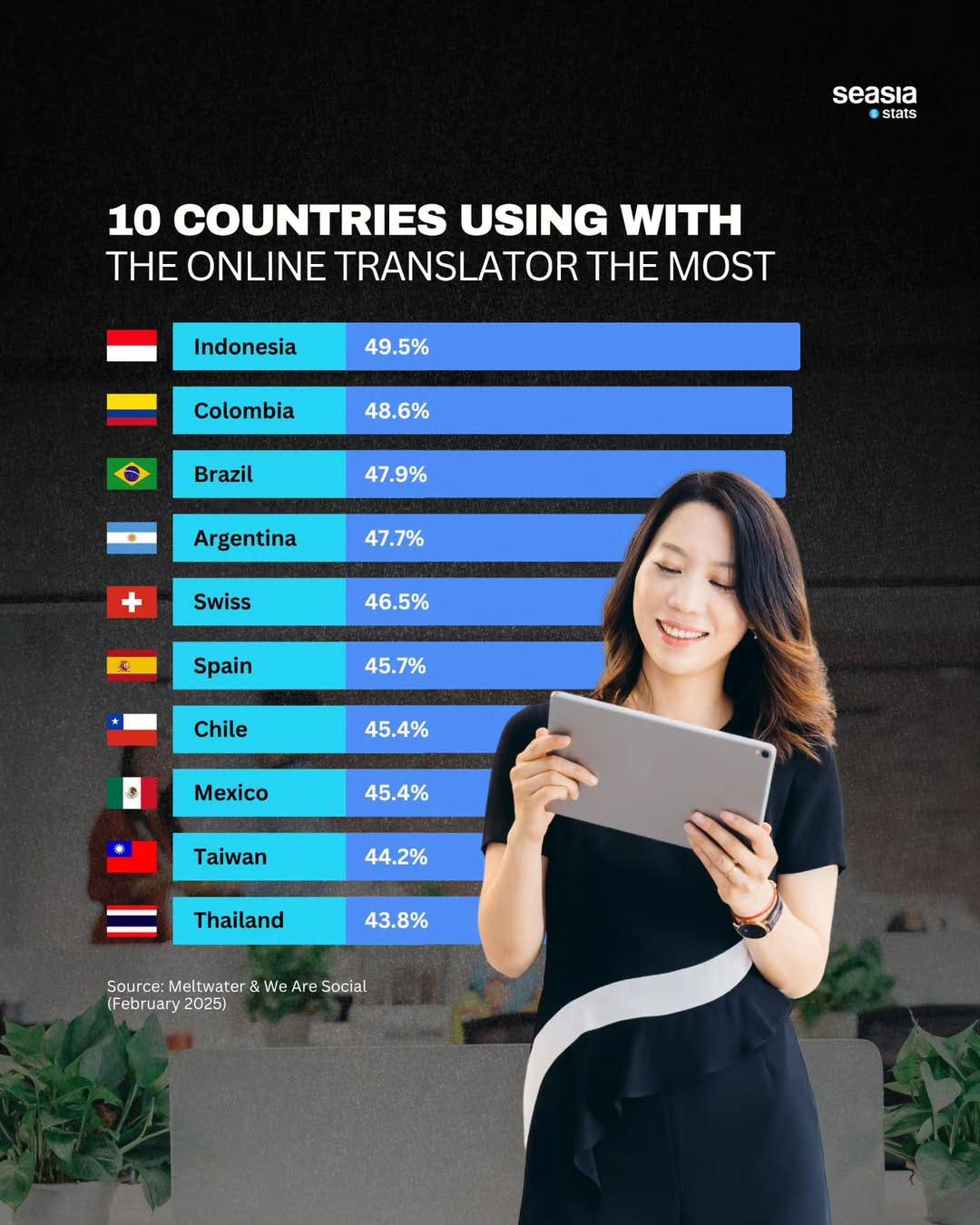
In a world increasingly connected by digital platforms, language remains one of the last major barriers to truly global communication. From reading international news to shopping on overseas websites or collaborating with colleagues abroad, people now rely heavily on online translation tools to bridge linguistic gaps. According to data compiled by Meltwater and We Are Social as of February 2025 and highlighted by Seasia Stats, several countries stand out for their widespread use of online translators—led by one of Southeast Asia’s largest digital societies.
Indonesia Leads the Global Translation Trend
Indonesia ranks first globally in the use of online translation tools, with 49.5% of internet users reporting that they regularly rely on these services. This statistic reflects the country’s unique digital landscape. With more than 270 million people and one of the world’s fastest-growing internet populations, Indonesians frequently engage with global content written in English, Korean, Japanese, Chinese, and other languages.
Translation tools such as Google Translate, DeepL, and built-in browser translators have become essential daily utilities. Indonesians use them to access international entertainment, learn new skills, communicate with overseas partners, and shop on global e-commerce platforms.
Another factor driving usage is Indonesia’s strong presence in global digital culture. Whether engaging with Korean dramas, Japanese anime, Western tech tutorials, or international social media discussions, translation tools allow users to move seamlessly across linguistic borders.
Latin America’s Strong Presence in the Rankings
The second tier of countries shows a strong concentration from Latin America. Colombia ranks second globally with 48.6% of internet users relying on online translation tools. Brazil follows closely at 47.9%, while Argentina records 47.7%.
Chile and Mexico also appear in the top ten, both with 45.4%. The high usage across this region reflects the need to bridge the gap between Spanish or Portuguese and English—the dominant language of global digital content, business, and technology.
For many Latin American users, translation tools are not just a convenience but a necessity for accessing international information, education resources, and global job opportunities.
Europe and Asia in the Global Mix
Europe also contributes notable entries to the ranking. Switzerland appears in fifth place with 46.5% usage. As a multilingual country with four official languages—German, French, Italian, and Romansh—translation tools naturally play an important role in everyday communication.
Spain ranks sixth with 45.7%, reflecting similar patterns of engagement with English-language content online.
In Asia, Taiwan appears in ninth place at 44.2%, while Thailand rounds out the top ten with 43.8%. In both countries, translation tools are commonly used to access international business information, global news, and entertainment content.
Southeast Asia’s Growing Digital Linguistic Bridge
Beyond Indonesia and Thailand, Southeast Asia is becoming one of the world’s most multilingual internet regions. Countries such as Vietnam, Malaysia, and the Philippines have rapidly growing digital populations that regularly engage with foreign-language content.
In the Philippines, English proficiency is relatively high, but translation tools still help users interact with regional languages and international communities online. In Vietnam, translators assist users navigating foreign technical content and international trade platforms. Malaysia’s multilingual society—where Malay, English, Mandarin, and Tamil coexist—also creates natural demand for translation tools.
As Southeast Asia’s digital economy expands, these tools are becoming essential infrastructure for communication, commerce, and education.
Technology Breaking Language Barriers
The growing use of online translation tools illustrates a larger transformation in how people interact with the internet. Language barriers that once limited global participation are rapidly dissolving thanks to AI-powered translation technology.
For millions of users around the world—from Jakarta to Bogotá—translation apps are no longer just helpful extras. They are everyday companions that unlock access to the global conversation, making the internet more inclusive, accessible, and interconnected than ever before.