

10 Countries with the Highest Debt-to-GDP Ratio
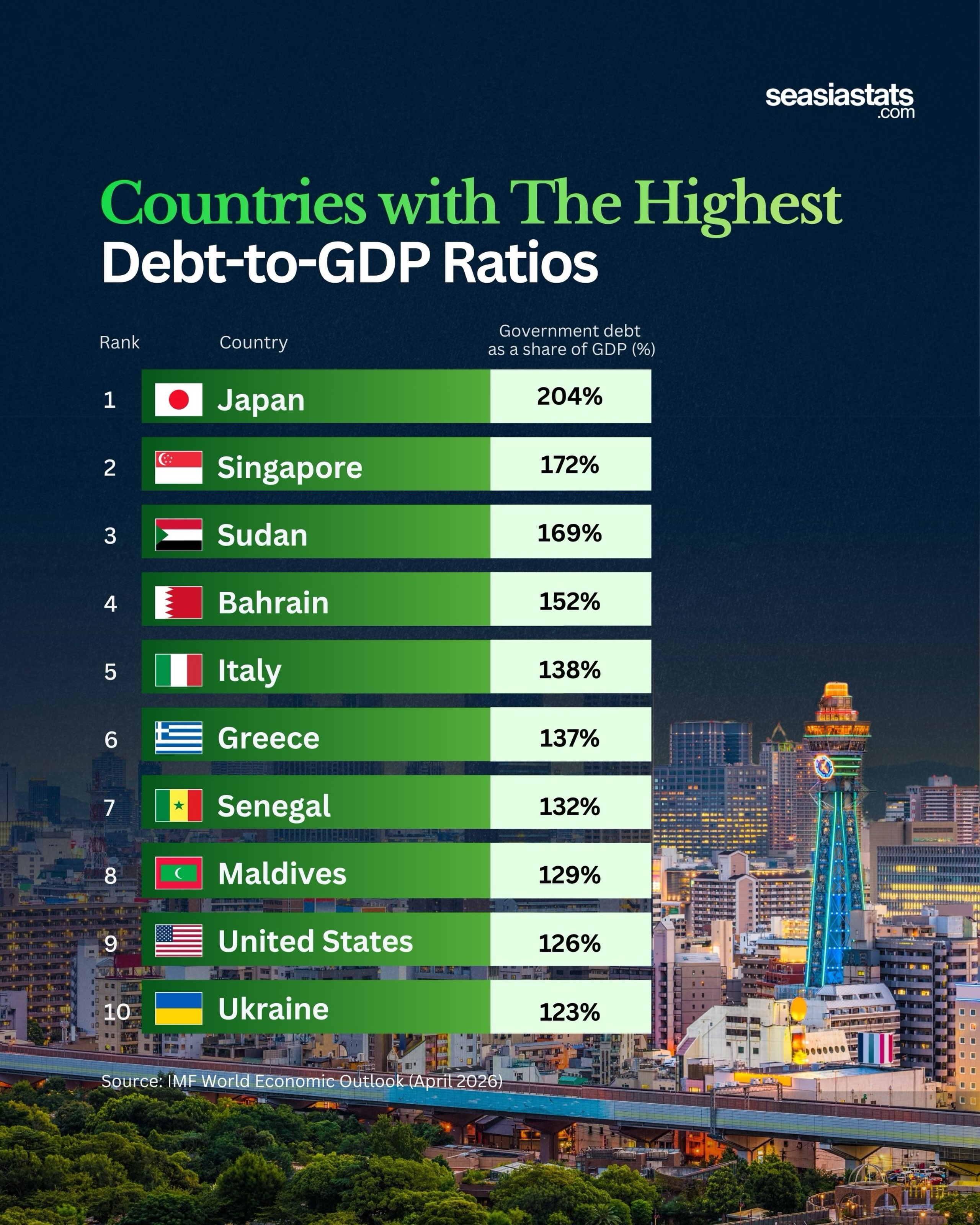
With 204%, Japan still has the highest debt-to-GDP ratio in the world.

Government debt is a key indicator of a country's fiscal health. One of the most widely used measures is the debt-to-GDP ratio, which compares a nation's total public debt to the size of its economy. A high ratio does not necessarily indicate an economic crisis, but it may signal greater fiscal challenges, especially if borrowing costs rise or economic growth slows.
According to the International Monetary Fund (IMF) and the World Economic Forum (WEF), the countries with the highest debt-to-GDP ratios as of April 2026 are Japan, Singapore, Sudan, Bahrain, Italy, Greece, Senegal, the Maldives, the United States, and Ukraine.
Japan tops the list with a debt-to-GDP ratio of 204%, maintaining its position as the world's most indebted advanced economy. Despite its exceptionally high debt level, Japan continues to benefit from low borrowing costs and strong domestic demand for government bonds.
Singapore ranks second at 172%. While its gross public debt is substantial, much of it is issued to support domestic financial markets and is backed by significant government assets, making its fiscal position different from many other highly indebted nations.
Sudan follows with 169%, reflecting years of political instability, economic hardship, and limited fiscal capacity. Bahrain stands at 152%, as the Gulf nation continues to face pressure from budget deficits and fluctuating energy revenues.
Italy and Greece remain among Europe's most indebted economies, with debt-to-GDP ratios of 138% and 137%, respectively. Although both countries have strengthened their fiscal management in recent years, high debt levels remain a long-term economic concern.
In Africa, Senegal records a debt ratio of 132%, while the Maldives reaches 129%, driven in part by extensive infrastructure investments and reliance on tourism revenues. Both countries face challenges in balancing development needs with debt sustainability.
The United States, the world's largest economy, has a debt-to-GDP ratio of 126%. Persistent fiscal deficits, increased government spending, and higher interest costs have contributed to its growing debt burden.
Meanwhile, Ukraine records 123%, reflecting the severe economic impact of the ongoing conflict and the significant borrowing required to finance government operations and reconstruction efforts.
Although high debt levels can increase financial risks, they should be evaluated alongside economic growth, interest rates, fiscal policy, and institutional strength.
Countries with strong economic fundamentals may sustain higher debt more effectively than those facing political or economic instability. Therefore, debt-to-GDP ratios provide valuable context but should not be viewed as the sole measure of a nation's economic health.