

10 Countries with the Highest Fire Carbon Emissions in 2026
Russia contributes the most fire carbon emissions in 2026.

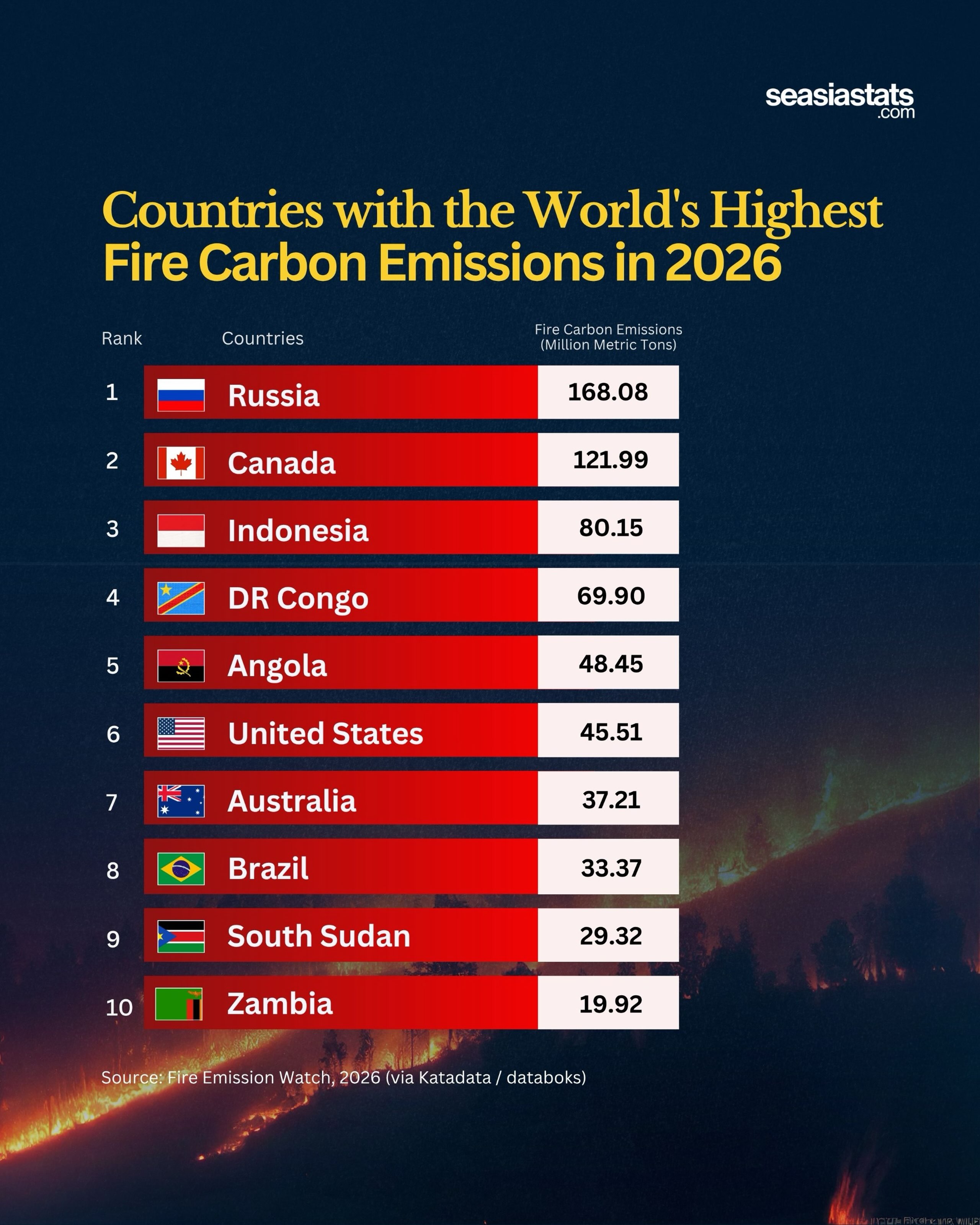
Wildfires and landscape fires released substantial volumes of carbon into the atmosphere in 2026, underscoring the growing role of fire in the global carbon cycle. Data on fire carbon emissions reveal a clear hierarchy among nations, with a handful of countries accounting for the bulk of these releases.
The figures highlight both boreal and tropical regions as major sources, driven by climate conditions, vegetation types, and land-use patterns.
Russia led the world with 168.08 million tons of fire carbon emissions. Vast boreal forests and tundra landscapes, combined with extended fire seasons and dry conditions in remote areas, contributed to this dominant total.
Canada ranked second at 121.99 million tons. Intense wildfire activity across its expansive forested provinces, fueled by warmer temperatures and prolonged drought, produced emissions on a scale second only to Russia. Together, these two northern nations released nearly 290 million metric tons, illustrating the outsized impact of high-latitude fires.
Indonesia followed with 80.15 million tons. Peatland and forest fires, often linked to agricultural clearing and dry-season conditions, remained a persistent source of carbon release in Southeast Asia. The Democratic Republic of Congo recorded 69.90 million tons, reflecting widespread burning across its tropical forests and savannas.
Angola contributed 48.45 million tons, while the United States registered 45.51 million tons, largely from western and other regional wildfires. Australia’s total stood at 37.21 million tons, Brazil at 33.37 million tons, South Sudan at 29.32 million tons, and Zambia at 19.92 million tons.
These rankings reveal distinct geographic patterns. Boreal countries such as Russia and Canada dominate absolute emissions due to the sheer scale of their forests and the intensity of recent fire seasons.
Tropical nations in Africa and Southeast Asia, including the Democratic Republic of Congo, Angola, Indonesia, South Sudan, and Zambia, show significant contributions tied to savanna and forest burning. The presence of the United States, Australia, and Brazil further demonstrates that fire carbon emissions span continents and climate zones.
The environmental consequences are far-reaching. Fire-released carbon adds to atmospheric greenhouse gas concentrations, intensifying climate feedbacks that can lengthen fire seasons and increase burn severity in subsequent years.
Smoke from large fires also affects air quality across regions and continents, while the loss of forest and peat carbon stocks reduces long-term carbon sequestration capacity.
Monitoring these emissions remains essential for understanding the evolving relationship between climate change, land management, and the global carbon budget. The 2026 totals reaffirm that fire is a major, and in some regions intensifying, pathway for carbon release.