

10 Countries with the Highest Unfavorable Views of Israel
Several countries around the world have the highest unfavorable views of Israel.

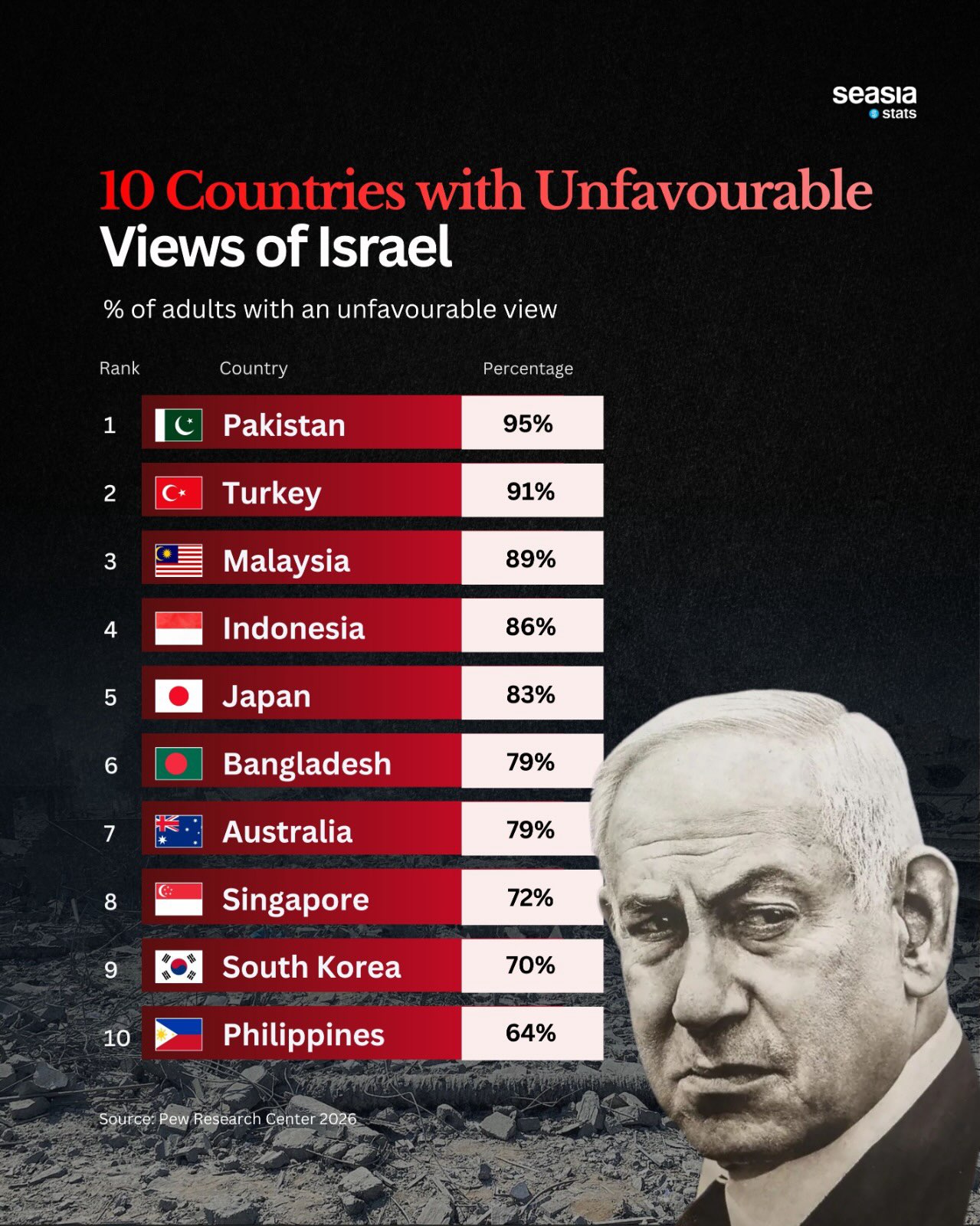
Public opinion surveys provide valuable insights into how people around the world perceive other countries and international affairs. According to the Pew Research Center's 2026 survey, several countries reported high levels of unfavorable views toward Israel.
These attitudes reflect a range of historical, political, cultural, and geopolitical factors that differ from one society to another and should not be interpreted as representing the views of every individual within each country.
Pakistan recorded the highest level of unfavorable opinion toward Israel, with 95% of respondents expressing a negative view. Turkey followed closely at 91%, while Malaysia ranked third with 89%. These countries have long histories of public support for the Palestinian cause, which has significantly influenced public sentiment regarding Israel.
Indonesia ranked fourth, with 86% of respondents holding an unfavorable opinion of Israel. As the world's largest Muslim-majority nation, Indonesia's public opinion has also been shaped by longstanding support for Palestinian statehood and humanitarian concerns related to the Israeli-Palestinian conflict.
Japan ranked fifth with 83%, demonstrating that unfavorable perceptions of Israel are not limited to Muslim-majority countries. Bangladesh and Australia each recorded 79%, although the historical, political, and media environments influencing public opinion in these two countries differ considerably.
Singapore reported 72% unfavorable views, while South Korea followed with 70%. Both countries maintain diplomatic and economic relationships with numerous partners across the Middle East while their populations continue to form opinions based on international news coverage, regional developments, and domestic perspectives.
Completing the top ten is the Philippines, where 64% of respondents expressed an unfavorable opinion of Israel. Although this figure is lower than those recorded in the other countries on the list, it still represents a majority of survey participants.
It is important to recognize that public opinion surveys measure attitudes at a specific point in time and may change as international events evolve.
Opinions can be influenced by ongoing conflicts, diplomatic developments, media coverage, humanitarian issues, and national political discourse. Furthermore, survey results describe overall public sentiment and do not necessarily reflect government policies or the perspectives of every citizen.
The 2026 Pew Research Center findings illustrate the diversity of global public opinion regarding Israel. They also underscore how international events can shape perceptions across different regions and cultures.
Understanding these differences contributes to a broader appreciation of global public opinion and highlights the importance of dialogue, diplomacy, and informed discussion in addressing complex international issues.