

10 Countries with the Largest Capacity of Geothermal Power Generation
Geothermal is one of the most promising renewable energy sources with 10 countries leading the way.

Geothermal energy has emerged as a reliable and sustainable source of electricity, especially in regions with strong volcanic and tectonic activity. Unlike solar or wind, geothermal power can operate continuously, making it a dependable “baseload” renewable energy.
Today, a small group of countries dominates global geothermal production, with the top ten accounting for the vast majority of installed capacity worldwide.
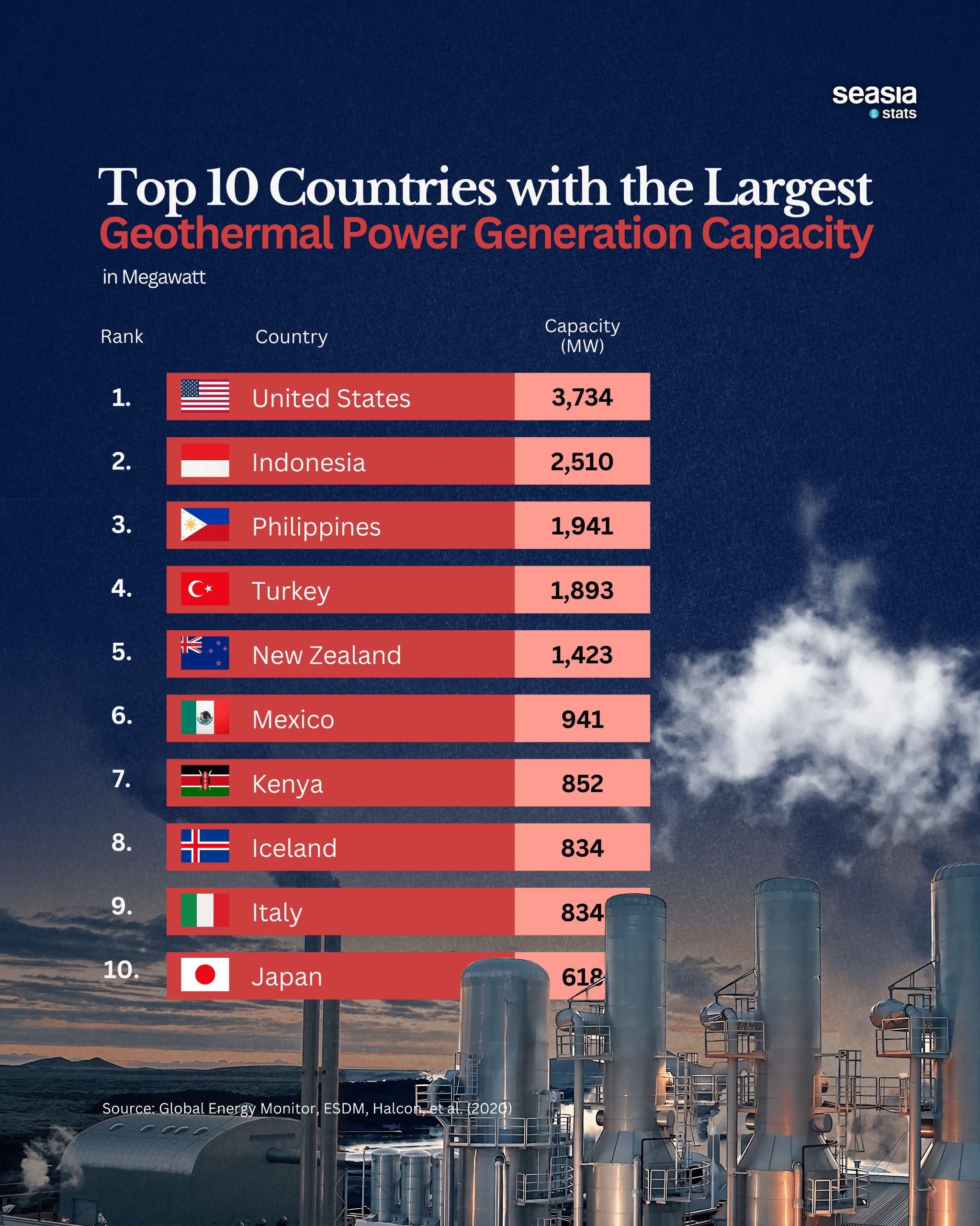
Leading the world is the United States, with an installed geothermal capacity of 3,734 MW, making it the largest producer globally. Its dominance comes from extensive geothermal fields, particularly in California. Following in second place is Indonesia, with 2,510 MW, benefiting from its position along the Pacific Ring of Fire, which provides abundant geothermal resources.
The Philippines ranks third with 1,941 MW, reflecting its long-standing investment in geothermal technology. Close behind is Turkey at 1,893 MW, which has rapidly expanded its geothermal sector in recent years.
New Zealand, another volcanically active country, holds fifth place with 1,423 MW, utilizing geothermal energy as a key component of its renewable mix.
In sixth position is Mexico, generating 941 MW, largely from geothermal fields such as Cerro Prieto. Kenya follows with 852 MW, standing out as Africa’s leader in geothermal power, driven by development in the Great Rift Valley.
Europe is represented by Iceland and Italy, each with 834 MW of capacity. Iceland is particularly notable for its extensive use of geothermal energy not only for electricity but also for heating, supplying a large portion of its population’s energy needs. Italy, historically one of the pioneers of geothermal power, continues to maintain a strong presence in the sector.
Rounding out the top ten is Japan, with 618 MW, where geothermal development is influenced by both its volcanic geography and environmental considerations.
Overall, these countries highlight how geography plays a crucial role in geothermal development. Most are located along tectonic plate boundaries, where underground heat is more accessible.
Although geothermal energy currently contributes only a small share of global electricity, ongoing technological advancements are expected to expand its reach and efficiency in the coming decades.