

10 Countries with the Largest Currency Reserves
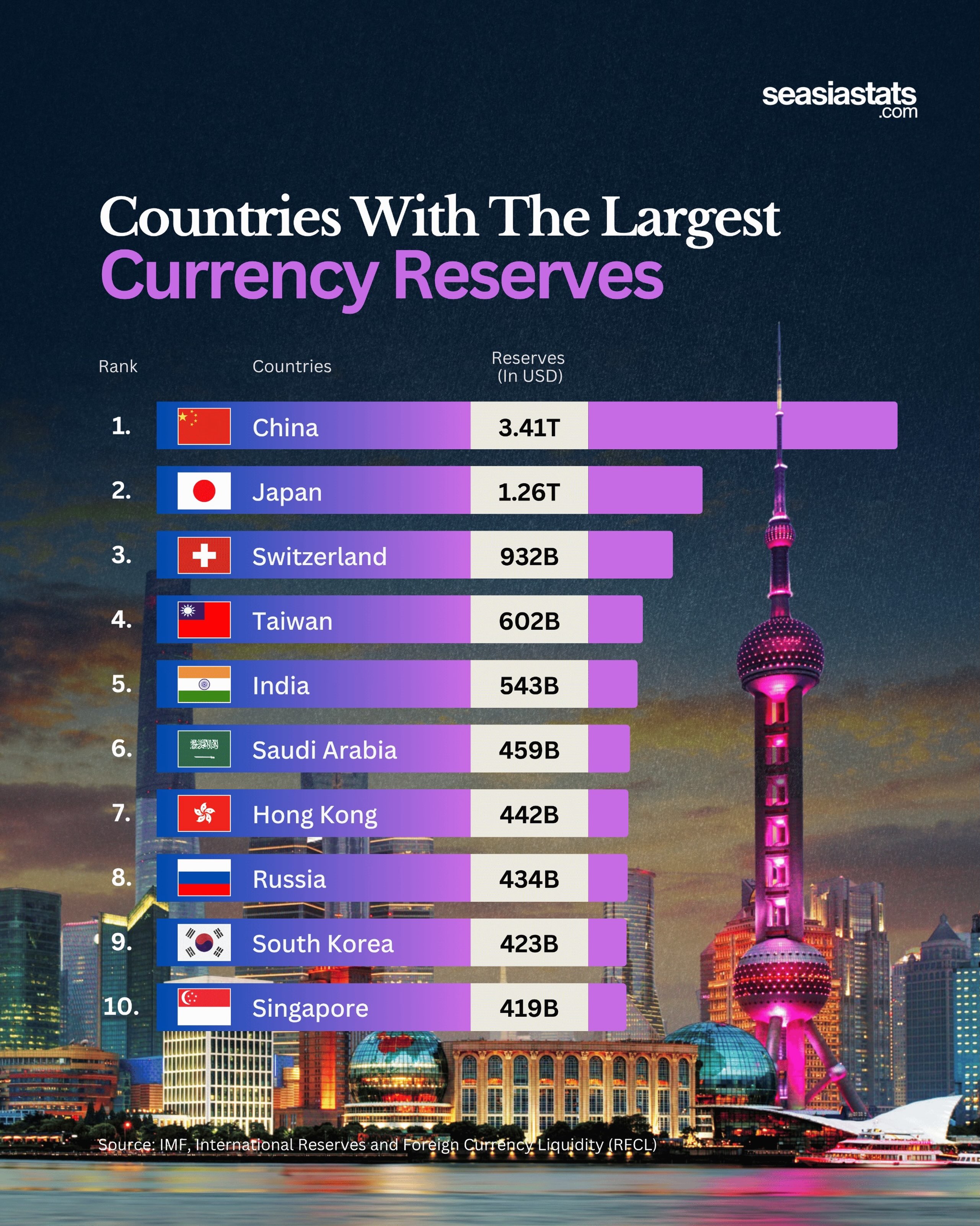
China has the largest currency reserve in the world with US$3.41 trillion.

Foreign currency reserves are assets held by central banks in foreign currencies, primarily in US dollars, along with gold and other reserve assets.
These reserves help countries maintain financial stability, support their currencies, facilitate international trade, and respond to economic crises. Countries with large reserves are generally better prepared to withstand financial shocks and fluctuations in global markets.
China holds the world's largest currency reserves, totaling approximately US$3.41 trillion. The country's massive export sector and consistent trade surpluses have enabled it to accumulate an enormous stockpile of foreign exchange reserves. These reserves play a vital role in supporting China's financial system and international trade.
Japan ranks second with US$1.26 trillion in reserves. As one of the world's leading economies, Japan maintains substantial reserves to stabilize the yen, manage financial risks, and ensure liquidity during periods of economic uncertainty.
Switzerland is third with US$932 billion. Despite its relatively small population, Switzerland has accumulated significant reserves through its strong financial sector and the Swiss franc's status as a global safe-haven currency.
Taiwan holds US$602 billion in foreign exchange reserves. Its export-oriented economy, particularly in high-technology manufacturing and semiconductor production, has contributed to its substantial reserve holdings.
India ranks fifth with US$543 billion. The country's reserves provide a financial cushion against external shocks, help stabilize the Indian rupee, and support confidence in one of the world's fastest-growing major economies.
Saudi Arabia possesses US$459 billion in reserves, largely generated through oil exports. These reserves help finance government spending, stabilize the economy, and support the Saudi riyal's exchange rate.
Hong Kong follows closely with US$442 billion. As one of the world's leading international financial centers, Hong Kong maintains large reserves to support the stability of its currency under the linked exchange rate system.
Russia holds US$434 billion in foreign currency reserves. These reserves have historically helped strengthen the country's financial position and provide protection against fluctuations in global commodity prices and economic uncertainty.
South Korea ranks ninth with US$423 billion. Its reserves reflect decades of strong export growth and prudent financial management, providing stability for the Korean won and the broader economy.
Singapore completes the top ten with US$419 billion in reserves. As a major global financial and trading hub, Singapore maintains substantial reserves to promote monetary stability and strengthen investor confidence.
Together, these ten countries account for a significant share of the world's foreign currency reserves. Their large reserve holdings reflect strong economic performance, active participation in global trade, and prudent financial management, making them important players in the international financial system.