

10 Countries with the Most Babies Born
Where many countries are facing population decline, these countries are seeing their population numbers grow.

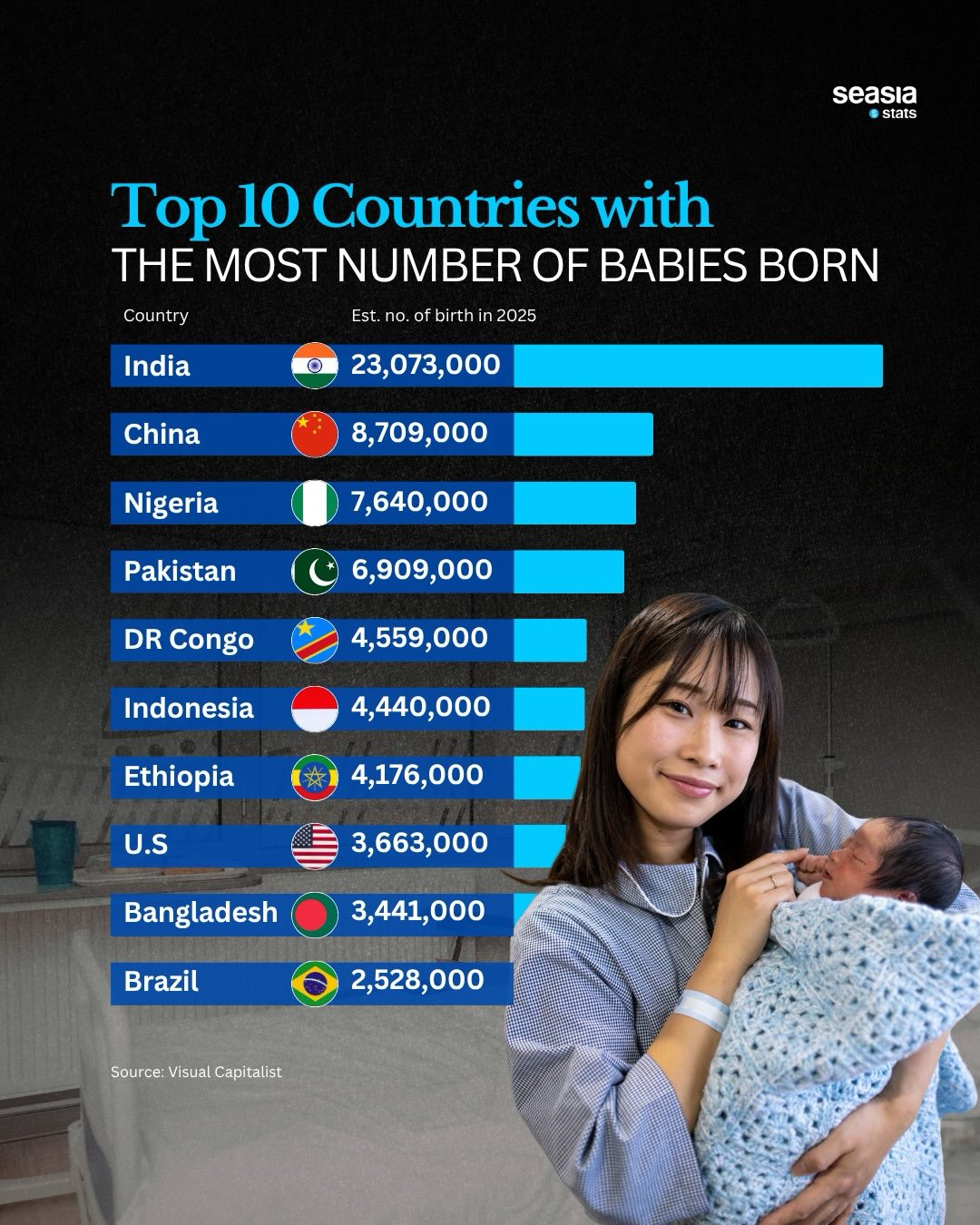
Global birth trends highlight how population growth is increasingly concentrated in a relatively small number of countries. According to Visual Capitalist’s latest compilation, the top ten countries with the most babies born in a single year collectively account for a substantial share of global births, reflecting demographic momentum, fertility rates, and population size.
Leading the world by a wide margin is India, with approximately 23,073,000 births. Its large population base and relatively high fertility rate continue to drive significant natural population growth. In contrast, China ranks second with 8,709,000 births, a much lower figure due to declining fertility rates and an aging population despite its vast size.
Africa plays a major role in global birth numbers, with several countries in the top ten. Nigeria recorded around 7,640,000 births, making it the highest in Africa. It is followed by Democratic Republic of the Congo with 4,559,000 and Ethiopia with 4,176,000.
These figures reflect high fertility rates and rapidly growing populations across the continent, which are expected to shape global demographics in the coming decades.
In South Asia, Pakistan and Bangladesh also rank prominently, with 6,909,000 and 3,441,000 births respectively. These countries continue to experience steady population increases, supported by both cultural and socioeconomic factors influencing family size.
Southeast Asia’s largest economy, Indonesia, recorded approximately 4,440,000 births. While fertility rates have gradually declined, its large population ensures it remains among the top contributors to global births.
Among developed nations, the United States stands out with 3,663,000 births, the only high-income country in the top ten. Its population growth is supported not only by births but also by immigration, distinguishing it from other developed economies with lower birth rates.
Finally, Brazil represents Latin America with 2,528,000 births. Although fertility rates have declined significantly over recent decades, its population size keeps it within the global top ten.
Overall, the distribution of births underscores a broader demographic shift: growth is increasingly centered in developing regions, particularly in Asia and Africa. These trends carry important implications for global economic development, urbanization, education, and resource allocation.
As populations expand in these regions, governments and international organizations will need to address both the opportunities and challenges associated with rapid population growth.