

10 Countries with the Most Forest Coverage
Forests are playing a critical role in supporting lives by absorbing carbon dioxide, regulate climate, and protecting biodiversity.

Forests are among the world’s most valuable natural resources, playing a critical role in absorbing carbon dioxide, protecting biodiversity, regulating climate, and supporting millions of livelihoods.
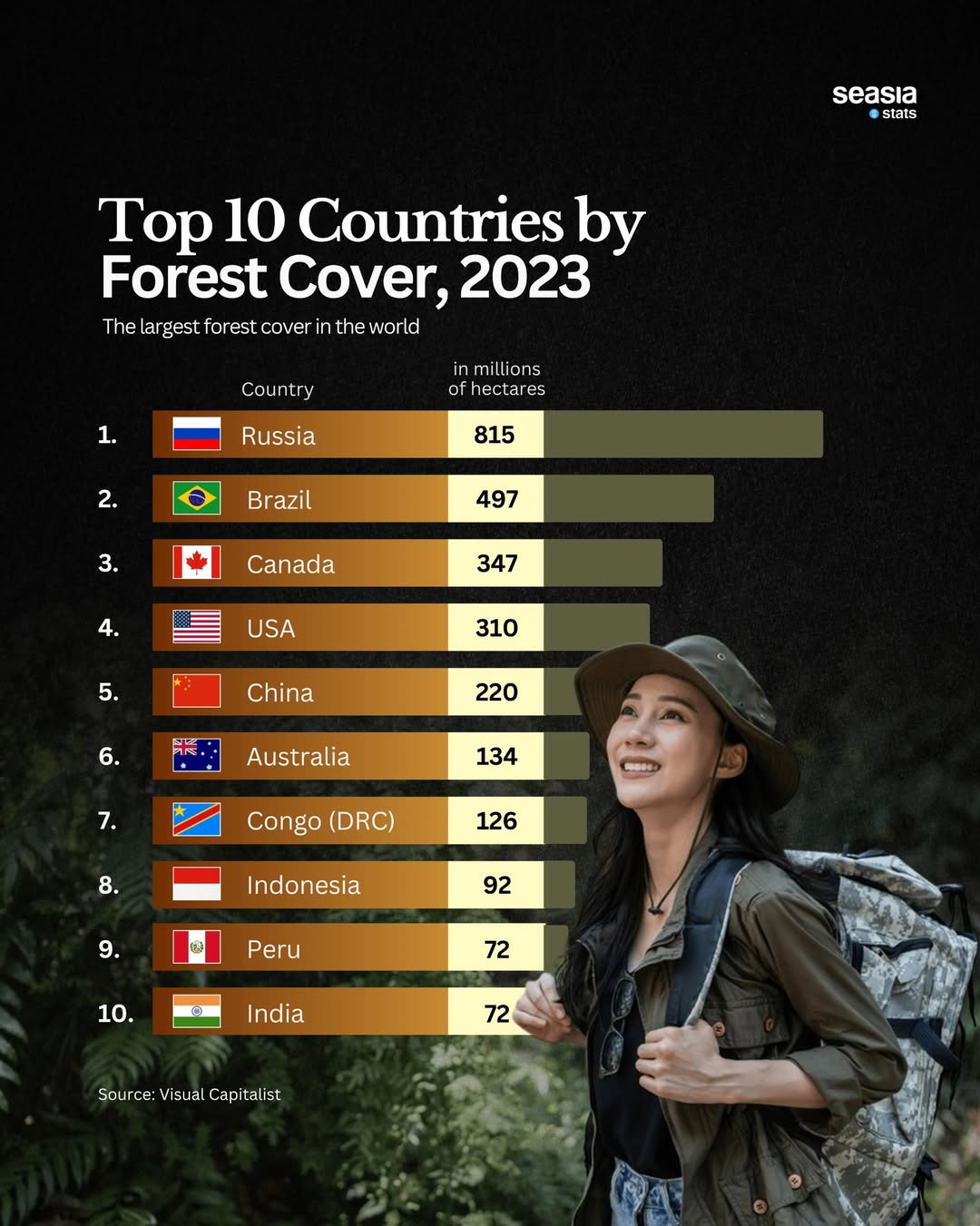
In 2023, data highlighted by Visual Capitalist showed that a small group of countries contains the majority of the planet’s forested land. These forests range from tropical rainforests to boreal woodlands and are essential in the global fight against climate change.
Russia ranked first in the world with approximately 815 million hectares of forest coverage. The country alone contains around one-fifth of the Earth’s forests, most of which are vast boreal forests stretching across Siberia.
Brazil followed in second place with 497 million hectares, largely thanks to the Amazon rainforest, the largest tropical rainforest on Earth. Canada ranked third with 347 million hectares, while the United States came fourth with 310 million hectares of forests.
China occupied fifth place with 220 million hectares of forest area. Over recent decades, China has carried out massive reforestation programs to combat desertification and environmental degradation.
Australia ranked sixth with 134 million hectares, although much of its forest area consists of dry forests and woodland ecosystems adapted to harsh climates. The Democratic Republic of the Congo came seventh with 126 million hectares, containing one of the world’s largest tropical rainforest regions in Central Africa.
Indonesia ranked eighth globally with 92 million hectares of forest coverage. The country is home to rich tropical rainforests spread across islands such as Sumatra, Kalimantan, and Papua. These forests contain extraordinary biodiversity, including endangered species like orangutans and Sumatran tigers.
Peru and India completed the top ten rankings, each with around 72 million hectares of forests. Peru’s forests are mainly concentrated in the Amazon Basin, while India’s forests include tropical, subtropical, and mountain ecosystems.
Together, these ten countries account for the majority of the world’s forest area. Their forests are vital for maintaining ecological balance, preserving wildlife habitats, and reducing greenhouse gas emissions.
However, many of these regions continue to face serious threats from deforestation, wildfires, mining, and agricultural expansion. Environmental experts emphasize that stronger conservation efforts and sustainable forest management are essential to protect these ecosystems for future generations.