

10 Countries with the Most Freshwater
These 10 countries have the largest amounts of the most important resource in the world: freshwater.

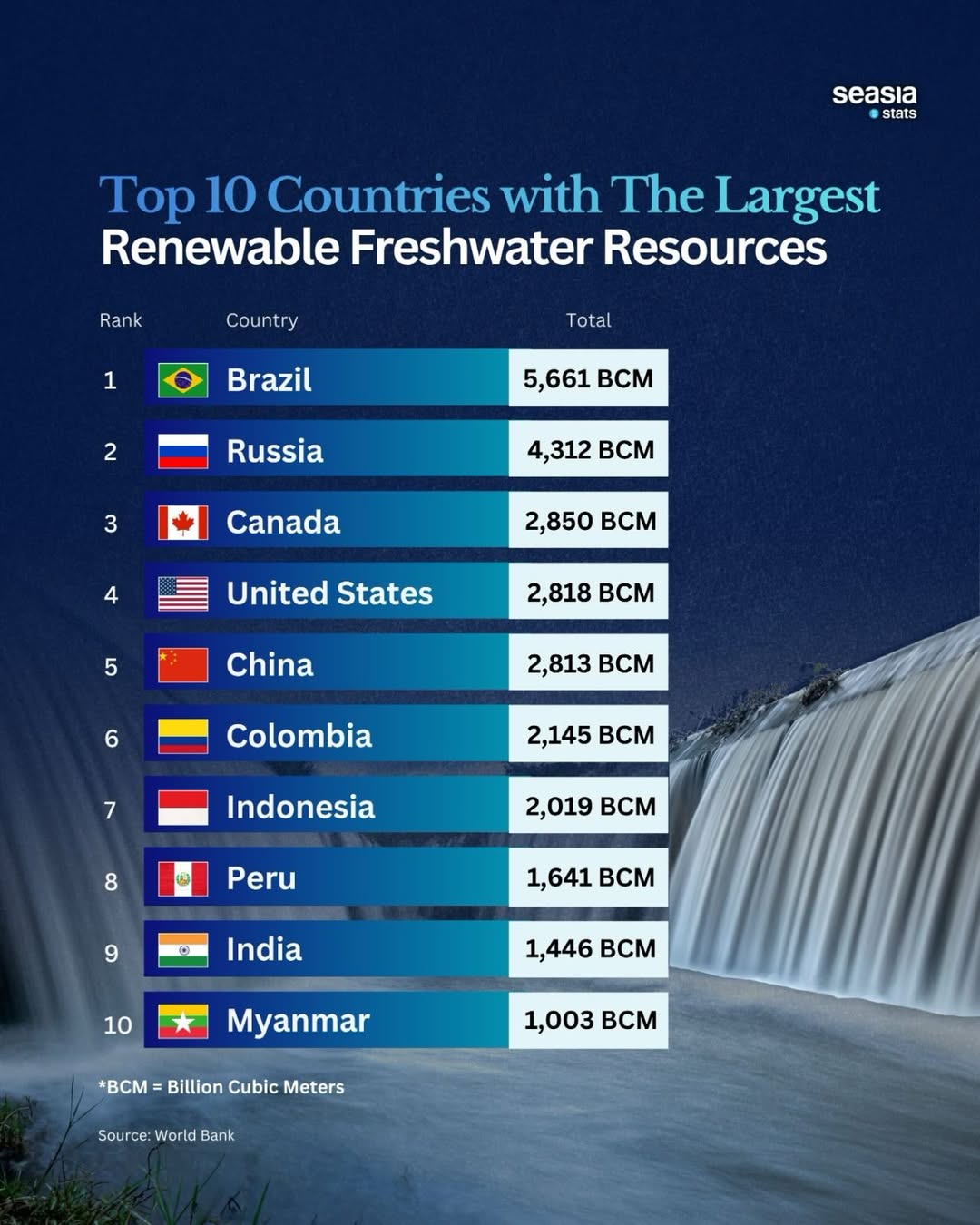
Freshwater is one of the world's most valuable natural resources, supporting agriculture, industry, energy production, and human life. Renewable freshwater resources refer to the total volume of water generated through the natural water cycle, including rainfall, rivers, lakes, and groundwater recharge.
Several countries possess exceptionally large freshwater reserves, giving them a significant advantage in terms of water security and economic development.
Leading the world is Brazil, with approximately 5,661 billion cubic meters (BCM) of renewable freshwater resources. Much of this water comes from the vast Amazon River Basin, which contains the largest river system on Earth and plays a crucial role in the global water cycle.
Russia ranks second with 4,312 BCM. The country's enormous territory contains thousands of rivers and lakes, including Lake Baikal, the world's deepest freshwater lake. These resources contribute significantly to Russia's water wealth.
Canada holds third place with 2,850 BCM. Its abundance of lakes, rivers, and snow-fed watersheds provides one of the highest per-capita freshwater supplies in the world. Closely following is the United States with 2,818 BCM, supported by major river systems such as the Mississippi, Missouri, and Colorado.
China ranks fifth with 2,813 BCM of renewable freshwater resources. Despite its large total volume, China's enormous population creates significant pressure on water availability, making water management a critical national priority.
In South America, Colombia possesses an impressive 2,145 BCM. The country's tropical climate, extensive rainfall, and Andean river systems contribute to its abundant water resources. Indonesia follows with 2,019 BCM, benefiting from heavy rainfall and thousands of rivers spread across its vast archipelago.
Peru ranks eighth with 1,641 BCM. The country receives substantial freshwater from the Andes Mountains and the Amazon Basin, making it one of South America's most water-rich nations.
India, with 1,446 BCM, has extensive river networks fed by monsoon rains and Himalayan glaciers. However, its large population places considerable demands on available water supplies.
Completing the top ten is Myanmar with 1,003 BCM of renewable freshwater resources. Major rivers such as the Ayeyarwady and Salween support agriculture, transportation, and economic activities throughout the country.
Together, these ten nations possess some of the world's most significant freshwater reserves. While abundant water resources provide important advantages, effective management remains essential to ensure long-term sustainability.
Climate change, population growth, pollution, and increasing demand highlight the importance of protecting and responsibly utilizing these valuable freshwater resources for future generations.