

10 Countries with the Most Freshwater
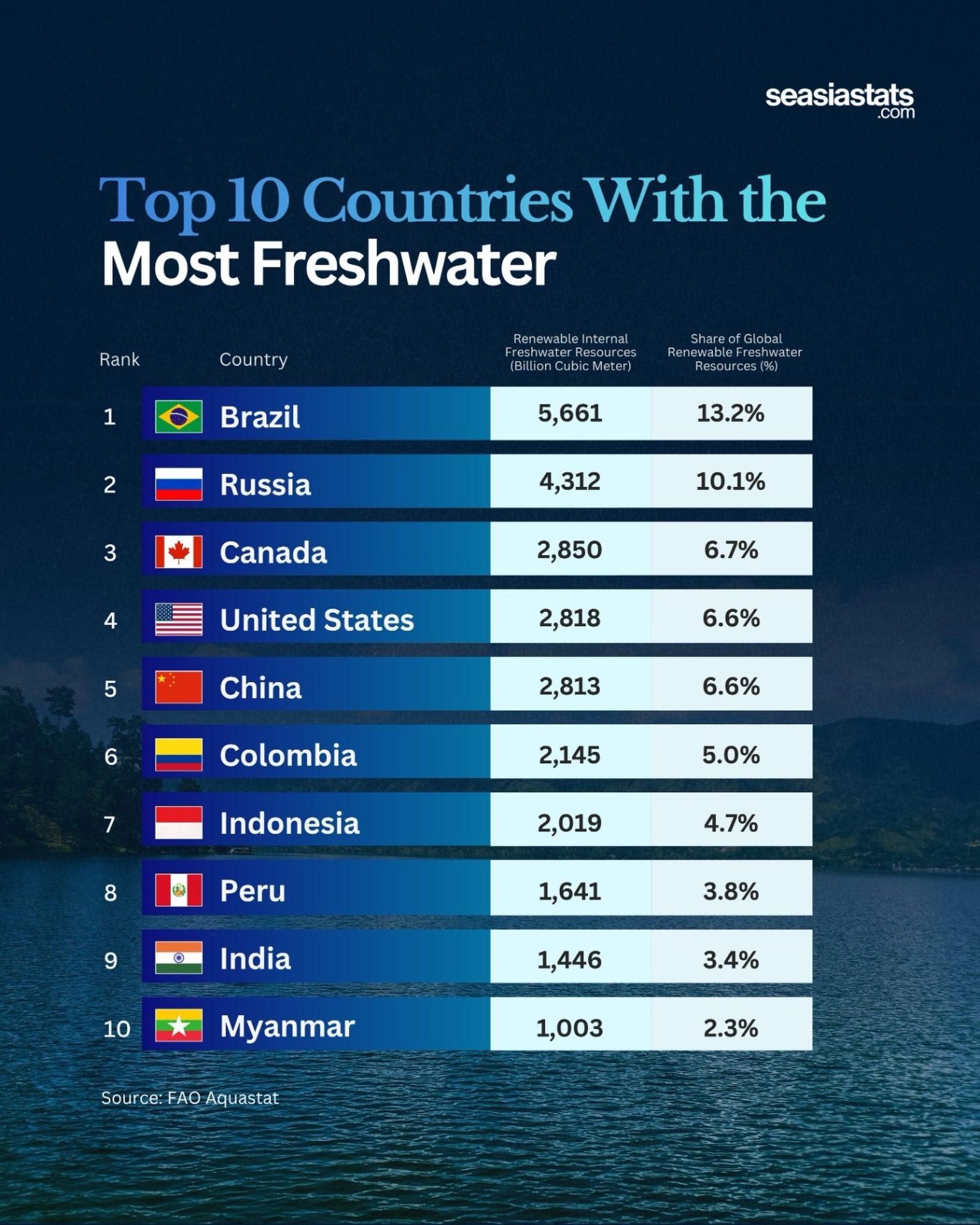
Brazil has the most freshwater with 5,661 billion cubic meters or 13.2% of global freshwater.

Freshwater is one of the world’s most valuable natural resources, supporting human life, agriculture, industry, ecosystems, and economic development.
According to data from the Food and Agriculture Organization (FAO) AQUASTAT, countries differ greatly in the amount of renewable internal freshwater resources they possess. AQUASTAT defines these resources as freshwater generated within a country through internal river flows and groundwater recharge from rainfall.
Brazil ranks first, with approximately 5,661 billion cubic meters (billion m³) of internal freshwater resources, representing 13.2% of global freshwater resources. Its enormous river systems, particularly the Amazon Basin, contribute substantially to its exceptional water availability.
Russia follows with 4,312 billion m³, accounting for 10.1% of the global total. Its vast territory, numerous rivers, lakes, and extensive freshwater ecosystems make it one of the world's most water-rich countries.
Canada ranks third with 2,850 billion m³, or 6.7%, while the United States is fourth with 2,818 billion m³, representing 6.6%. Both countries benefit from extensive river networks, lakes, precipitation, and groundwater resources.
China, with 2,813 billion m³ and 6.6%, ranks fifth. Despite its large freshwater endowment, China's water resources are unevenly distributed, creating significant differences in water availability between regions.
Colombia occupies sixth place with 2,145 billion m³, equivalent to 5.0% of global resources. Its high rainfall and extensive river systems contribute to its abundant freshwater supply. Indonesia, an archipelago with a tropical climate, follows with 2,019 billion m³, or 4.7%.
In eighth place, Peru possesses 1,641 billion m³, representing 3.8%. India ranks ninth with 1,446 billion m³, or 3.4%, while Myanmar completes the top ten with 1,003 billion m³, accounting for 2.3%.
Together, these ten countries account for roughly 62.4% of the global freshwater resources represented by the figures provided. The ranking demonstrates that freshwater is highly concentrated geographically.
However, having abundant resources does not automatically mean that water is equally accessible or secure for every population. Seasonal rainfall, geography, infrastructure, pollution, climate change, and population distribution can all influence actual water availability.
AQUASTAT emphasizes that its water-resource figures are long-term estimates and that country comparisons should be interpreted carefully because water availability varies geographically and seasonally.