

10 Countries with the Most National Parks
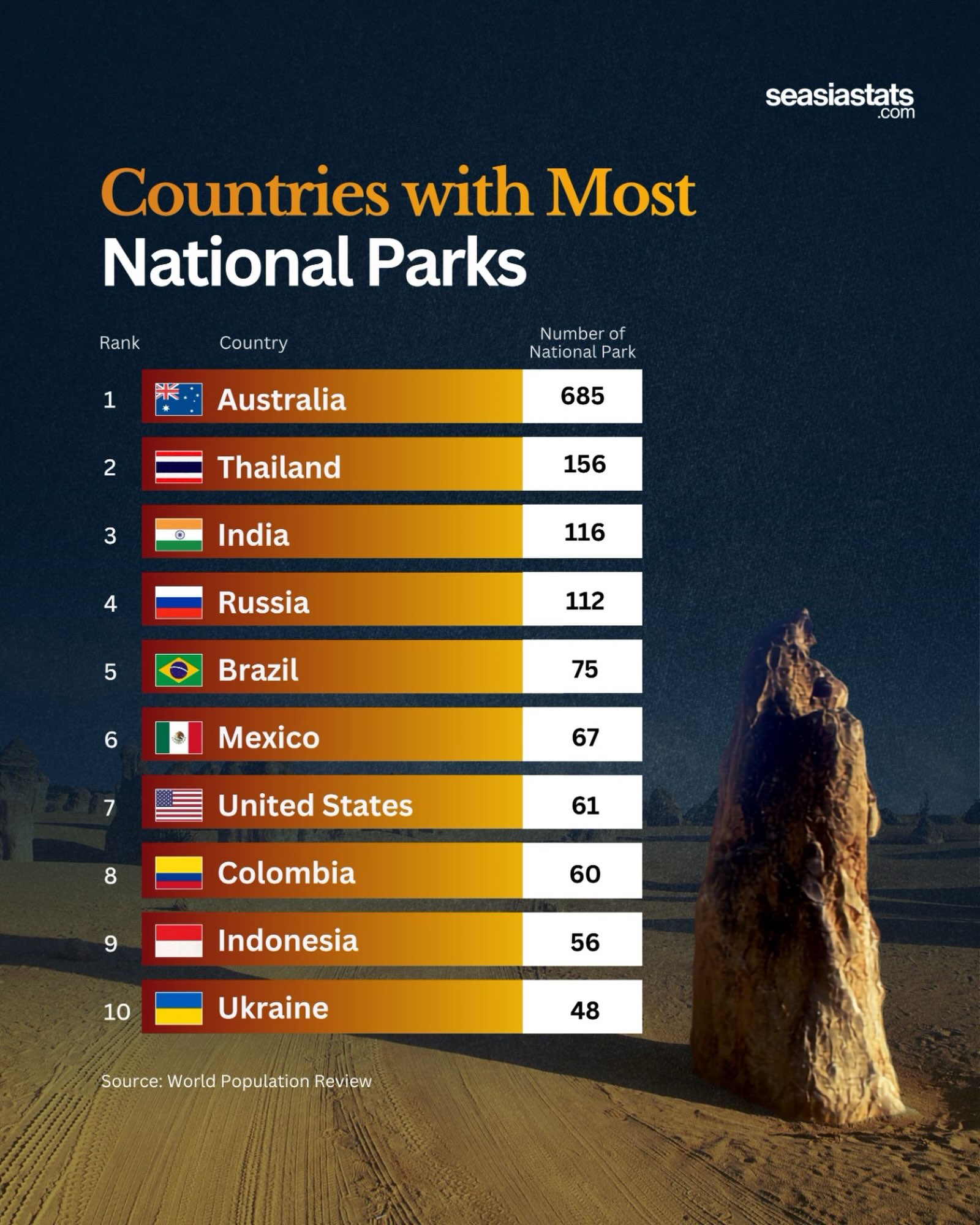
Australia has the most national parks in the world with 685, far ahead Thailand on second spot with 156.

National parks play a vital role in protecting biodiversity, preserving natural landscapes, and promoting sustainable tourism. Around the world, governments establish national parks to conserve ecosystems, safeguard endangered wildlife, and provide opportunities for recreation and environmental education.
Among the countries with the highest number of national parks, Australia leads by a considerable margin, reflecting its commitment to conserving its diverse natural heritage.
Australia ranks first with an impressive 685 national parks. The country is home to a wide range of unique ecosystems, from tropical rainforests and deserts to coastal landscapes and mountain ranges. These protected areas preserve countless endemic species and attract millions of domestic and international visitors every year.
Thailand occupies second place with 156 national parks, demonstrating its strong dedication to environmental conservation. The country's parks protect lush forests, waterfalls, limestone mountains, and marine ecosystems that are rich in biodiversity.
India follows closely with 116 national parks, which serve as critical habitats for iconic wildlife such as Bengal tigers, Asian elephants, rhinoceroses, and lions. These protected areas are central to India's conservation efforts and ecotourism industry.
Russia ranks fourth with 112 national parks, covering vast expanses of forests, tundra, mountains, and lakes across the world's largest country.
Brazil comes next with 75 national parks, many of which are located within the Amazon rainforest and other biologically important regions. These parks play a crucial role in protecting one of the planet's richest concentrations of biodiversity.
Mexico has established 67 national parks, preserving volcanic landscapes, deserts, forests, and coastal ecosystems. The United States follows with 61 national parks, many of which are internationally renowned for their spectacular scenery, including canyons, mountains, forests, and geothermal features.
Colombia ranks eighth with 60 national parks, protecting rainforests, coral reefs, wetlands, and high-altitude ecosystems that support remarkable wildlife diversity.
Indonesia holds 56 national parks, spread across thousands of islands. These parks protect tropical rainforests, coral reefs, mangroves, and habitats for endangered species such as orangutans, Komodo dragons, Sumatran tigers, and Javan rhinos.
Ukraine completes the top ten with 48 national parks, conserving forests, wetlands, rivers, and mountain landscapes that contribute to the country's natural heritage.
The number of national parks reflects each country's approach to conserving natural resources and maintaining ecological balance. While the size and characteristics of these protected areas vary significantly, they all contribute to preserving biodiversity, supporting scientific research, and encouraging sustainable tourism.
As environmental challenges such as climate change, habitat loss, and biodiversity decline continue to grow, national parks will remain essential for protecting the world's natural treasures for future generations.