

10 Countries with the Most Public Universities
The United States has the most public universities in the world, followed by China.

Public universities play an important role in providing accessible and affordable higher education to millions of students worldwide. These institutions are generally funded or supported by governments and offer various academic programs, research opportunities, and professional training.
Across the world, some countries have established extensive public university systems to meet the growing demand for higher education. The United States, China, and India are among the countries with the largest numbers of public universities.
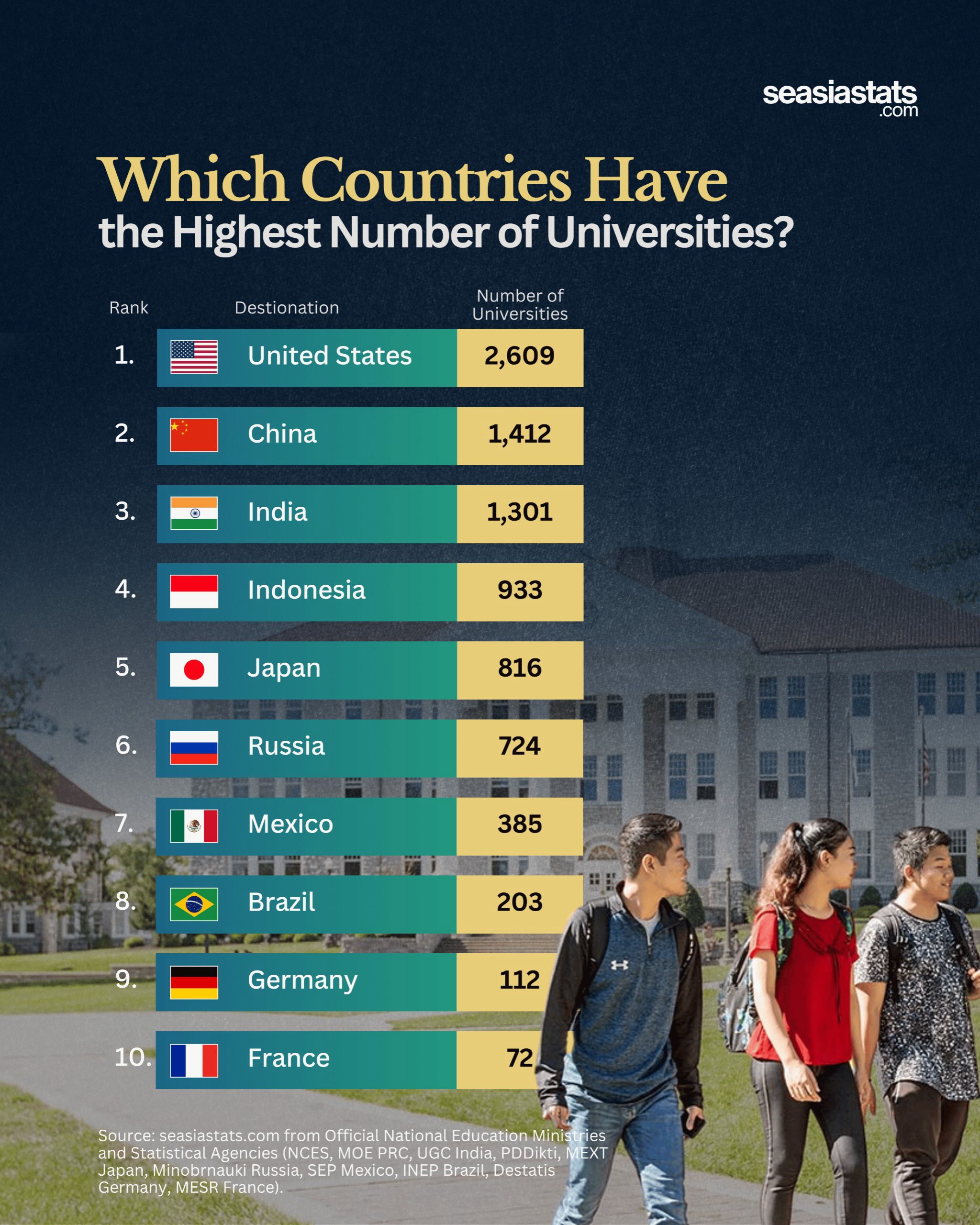
According to the provided figures, the United States ranks first, with an impressive 2,609 public universities. This makes it the country with the highest number of public universities among the ten countries listed. China takes second place with 1,412 institutions, followed by India in third place with 1,301 public universities.
Indonesia ranks fourth, with a total of 933 public universities. Its position highlights the country's extensive higher education system, which serves students across its many islands and regions. Japan follows in fifth place with 816 institutions, while Russia occupies sixth place with 724 public universities.
Meanwhile, Mexico ranks seventh, recording 385 public universities. Brazil follows in eighth place with 203 institutions. Although their numbers are considerably lower than those of the leading countries, both nations maintain important public higher education systems that contribute to education, research, and national development.
European countries also appear on the list. Germany ranks ninth, with 112 public universities, while France completes the top ten with 72 institutions. Despite having fewer public universities compared with the other countries listed, both countries have established higher education systems with internationally recognized academic and research institutions.
Overall, the figures reveal significant differences in the number of public universities across countries. The United States has nearly twice as many public universities as China, which occupies second place.
Meanwhile, the presence of several Asian countries, including China, India, Indonesia, and Japan, demonstrates the considerable scale of public higher education across the region.
The number of public universities, however, does not necessarily determine the quality of education or the academic performance of a country's institutions. Factors such as educational funding, research facilities, teaching quality, accessibility, and international collaboration also play important roles.
Nevertheless, these figures provide an interesting overview of how different countries organize and expand their public higher education systems. Public universities remain essential institutions for developing skilled workers, encouraging innovation, supporting scientific research, and creating opportunities for future generations.