

10 Countries with the Most Renewable Freshwater Resources
Brazil has the largest freshwater resources in the world with most of them located in the Amazon River basin.

Freshwater is one of the Earth's most valuable natural resources. It is essential for drinking, agriculture, industry, energy production, sanitation, and the survival of ecosystems. Although water covers most of the planet, only a small portion is freshwater that can be readily used by humans.
Renewable freshwater resources are therefore particularly important because they are naturally replenished through rainfall, rivers, groundwater recharge, and other parts of the water cycle.
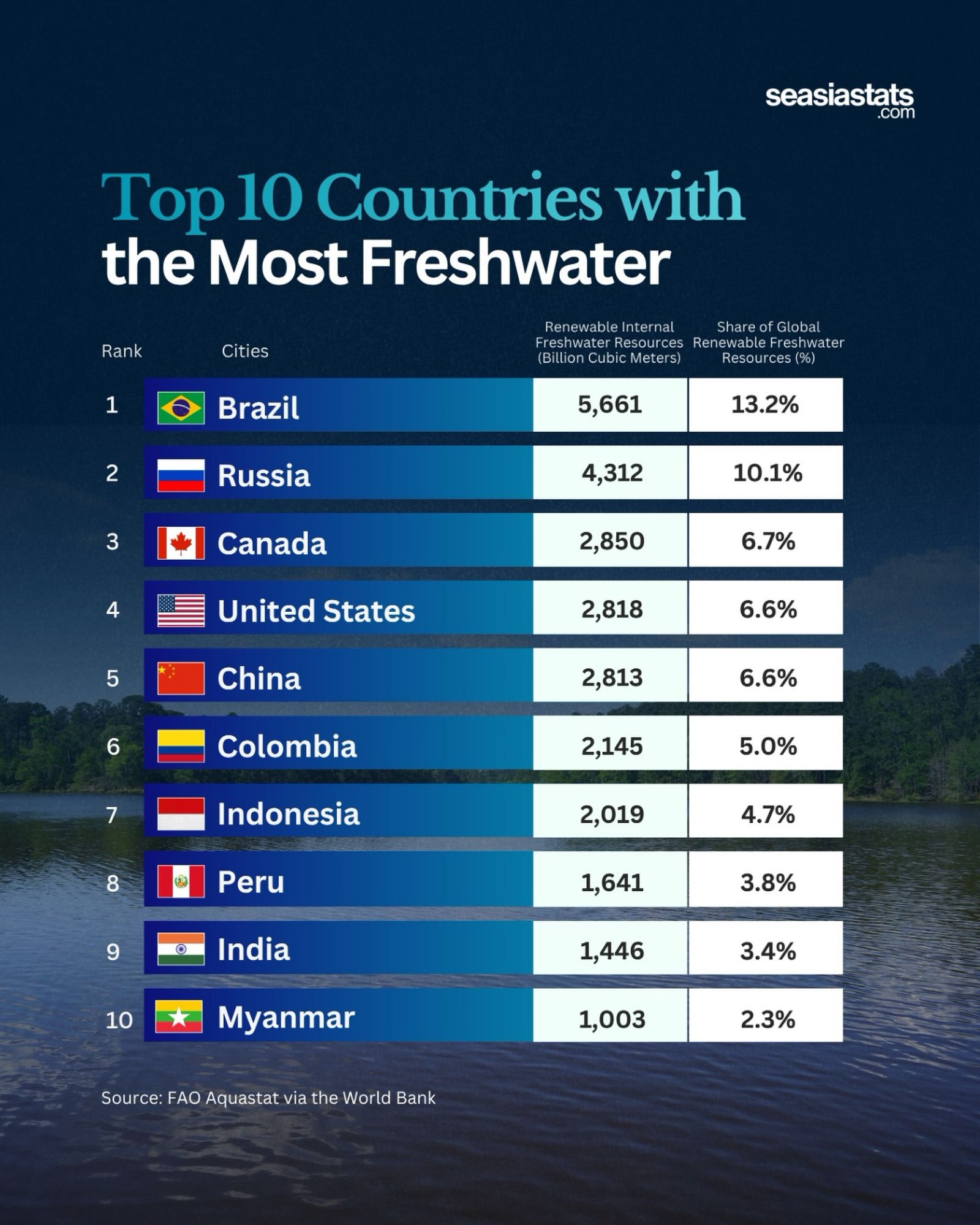
Brazil has the largest amount of renewable freshwater resources in the world, with approximately 5,661 billion cubic meters, representing 13.2% of global resources. The country's enormous freshwater supply is closely associated with its extensive river systems and the Amazon Basin, which contains one of the world's largest concentrations of freshwater.
Russia ranks second, with about 4,312 billion cubic meters, or 10.1% of the world's renewable freshwater. Its vast territory contains numerous rivers and lakes, including Lake Baikal, which holds a remarkable amount of the world's unfrozen freshwater.
Canada has approximately 2,850 billion cubic meters, accounting for 6.7% of global resources. Its abundant lakes, rivers, and precipitation contribute to its substantial freshwater reserves. The United States, with 2,818 billion cubic meters, represents another 6.6% of global renewable freshwater resources.
China follows closely with 2,813 billion cubic meters, also making up 6.6% of the global total. However, China's freshwater resources are unevenly distributed, with some regions receiving considerably more rainfall than others.
In South America, Colombia possesses approximately 2,145 billion cubic meters, or 5.0% of the world's renewable freshwater. Its tropical climate and extensive river networks help provide a plentiful water supply. Peru, another South American country on the list, has around 1,641 billion cubic meters, equivalent to 3.8% of global resources.
Indonesia has approximately 2,019 billion cubic meters, representing 4.7% of global renewable freshwater. Its tropical climate and thousands of islands contribute to its substantial water resources. Meanwhile, India has about 1,446 billion cubic meters, or 3.4%, and Myanmar has around 1,003 billion cubic meters, accounting for 2.3%.
Together, these ten countries possess a significant share of the world's renewable freshwater resources. However, having abundant water does not necessarily mean that every citizen has easy access to clean water.
Population size, climate, infrastructure, geography, and water management all influence how effectively countries can use their freshwater. Protecting these resources is therefore crucial for both present and future generations.