

10 Largest Airport Operators in the World
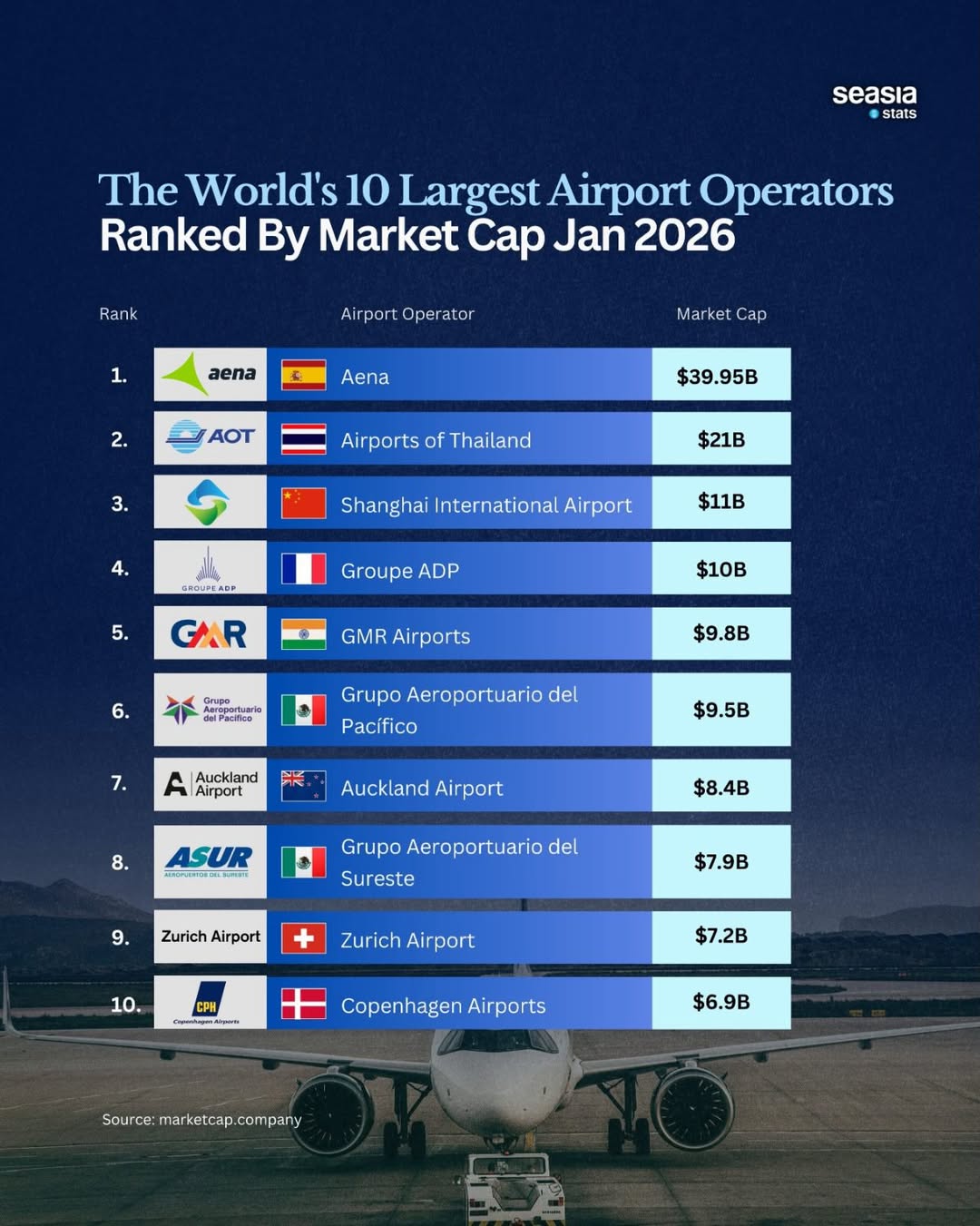
Spain's Aena is leading as the world's largest airport operator by market cap.

The global airport industry has become one of the most strategically important sectors in transportation infrastructure, driven by rising passenger demand, tourism growth, and international trade.
As of January 2026, the world’s largest airport operators by market capitalization reflect a geographically diverse mix of European, Asian, and Latin American companies that manage some of the busiest aviation hubs on the planet.
According to market data, Aena leads the industry with a market capitalization of approximately $39.95 billion, reinforcing its dominance as the world’s most valuable airport operator.
Spain-based Aena operates dozens of airports across Spain and Latin America, benefiting from Europe’s tourism boom and increasing passenger volumes. Reuters also reported that the company expanded further in Brazil through the acquisition of Rio de Janeiro’s Galeao Airport concession, strengthening its international footprint.
Second on the list is Airports of Thailand with a market capitalization of around $21 billion. The company oversees Thailand’s major airports, including Bangkok’s Suvarnabhumi Airport, which continues to benefit from Southeast Asia’s tourism recovery and regional air traffic growth.
China’s Shanghai International Airport ranks third at approximately $11 billion, supported by the rapid rebound of Chinese domestic and international aviation demand. France’s Groupe ADP follows closely with a market value near $10 billion, operating Paris Charles de Gaulle and Orly airports, two of Europe’s most important aviation gateways.
India’s GMR Airports, valued at about $9.8 billion, highlights the growing importance of emerging markets in global aviation. The company manages major Indian airports including Delhi International Airport, one of the busiest hubs in Asia.
Meanwhile, Mexico remains a major force in airport operations through Grupo Aeroportuario del Pacifico at $9.5 billion and Grupo Aeroportuario del Sureste at $7.9 billion, both benefiting from strong tourism flows and expanding regional connectivity.
Rounding out the top ten are Auckland Airport with $8.4 billion, Zurich Airport with $7.2 billion, and Copenhagen Airports with $6.9 billion. Together, these companies demonstrate how airport operators have evolved into critical global infrastructure businesses with strong long-term investment appeal.