

10 Largest Muslim Economies in the World
These 10 Muslim majority countries are having some of the largest economies in the world.

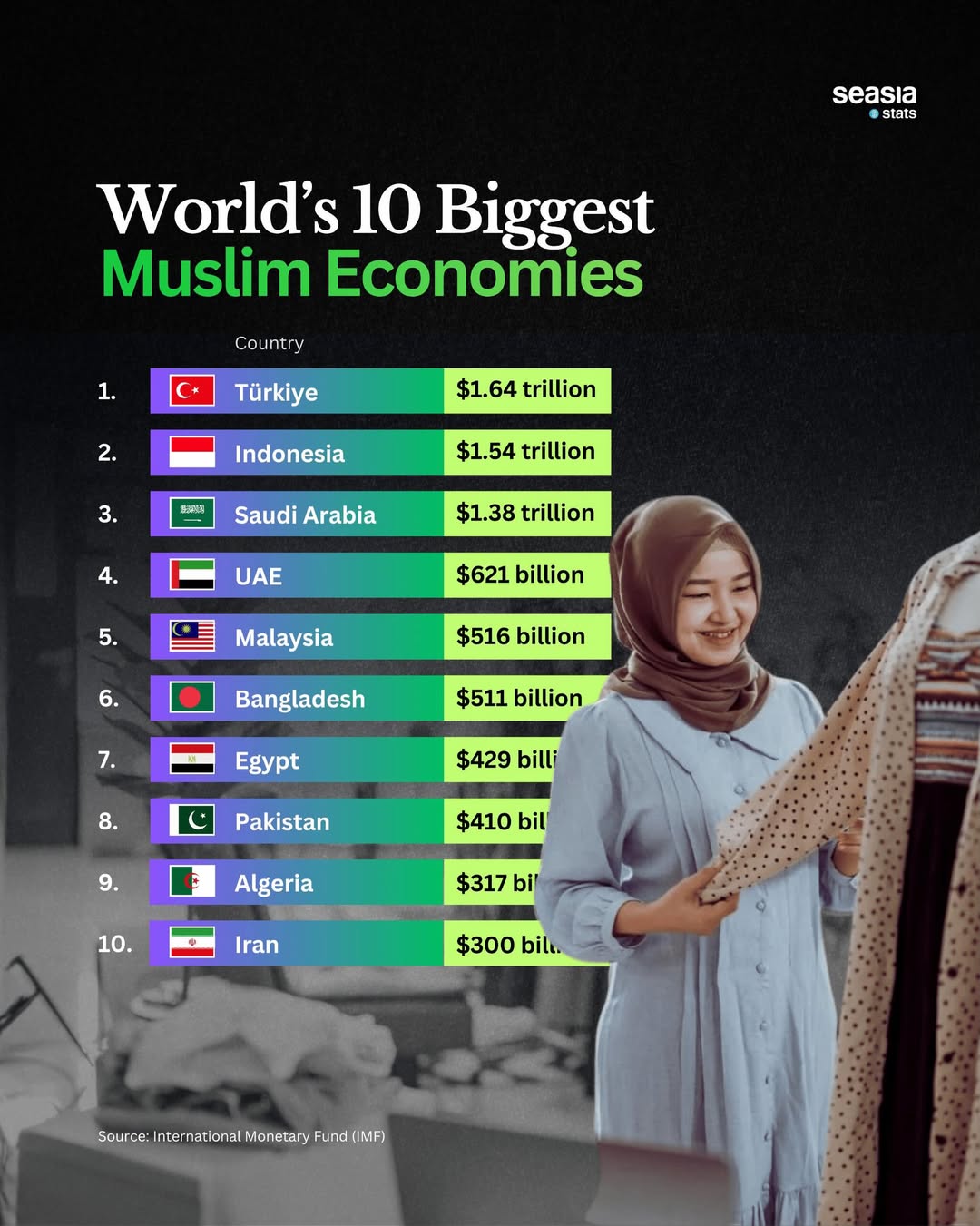
The Muslim world is home to some of the fastest-growing and most influential economies on the planet. According to International Monetary Fund (IMF) estimates, several Muslim-majority countries now rank among the world’s largest economies, driven by industry, trade, natural resources, manufacturing, technology, and expanding consumer markets.
Leading the list is Turkey with an economy valued at approximately $1.64 trillion. Turkey benefits from its strategic location between Europe and Asia, supported by strong manufacturing, tourism, defense industries, and infrastructure development.
Close behind is Indonesia with $1.54 trillion. As the largest economy in Southeast Asia and the world’s most populous Muslim-majority country, Indonesia continues to grow through natural resources, digital industries, manufacturing, and domestic consumption.
Saudi Arabia ranks third with $1.38 trillion. Long known as a global energy powerhouse, Saudi Arabia is now diversifying its economy through the Vision 2030 program, investing heavily in tourism, entertainment, sports, and technology.
The United Arab Emirates follows with $621 billion. Dubai and Abu Dhabi have become major global hubs for finance, aviation, logistics, and luxury tourism, helping transform the UAE into one of the Middle East’s most modern economies.
Malaysia recorded a GDP of $516 billion. Malaysia’s economy is powered by electronics manufacturing, palm oil exports, Islamic finance, and a strong services sector.
Meanwhile, Bangladesh reached $511 billion, fueled by its booming textile and garment industries. Over the past two decades, Bangladesh has emerged as one of Asia’s fastest-growing economies.
In North Africa, Egypt achieved a GDP of $429 billion. Egypt’s economy benefits from tourism, the Suez Canal, agriculture, and growing urban development projects.
Pakistan follows with $410 billion. With a population exceeding 240 million people, Pakistan possesses significant economic potential through agriculture, manufacturing, and technology sectors.
Algeria posted a GDP of $317 billion, supported mainly by oil and natural gas exports, which remain vital to its economy.
Finally, Iran recorded $300 billion despite years of economic sanctions. Iran maintains strong industrial and energy sectors, alongside a large domestic market.
Together, these ten nations demonstrate the growing economic influence of the Muslim world. With large populations, abundant resources, and expanding industries, they continue to shape global trade, investment, and economic development in the 21st century.