

10 Largest Temple Structures in Southeast Asia
Southeast Asia is home to massive temple structures with Angkor Wat holding the crown.

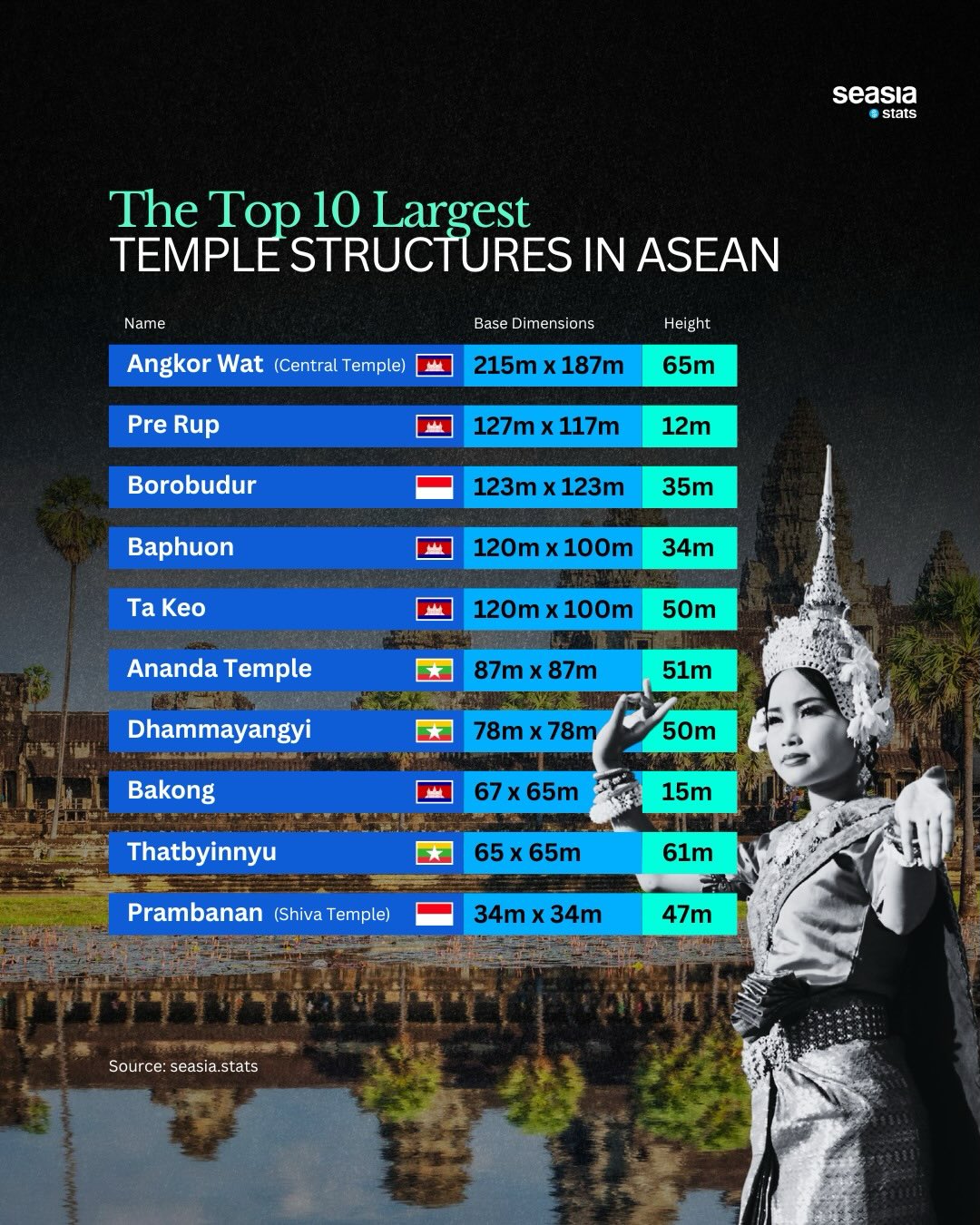
Southeast Asia is home to some of the most impressive temple structures in the world, reflecting centuries of religious devotion, architectural innovation, and imperial ambition. Across Cambodia, Indonesia, and Myanmar, these monuments showcase the grandeur of ancient civilizations and their mastery of large-scale construction.
At the top of the list stands Angkor Wat, the largest religious monument in the region. Its central temple rises about 65 meters high, built on a massive base measuring 215 by 187 meters. Originally constructed in the 12th century, it symbolizes the peak of Khmer architecture and remains a global icon.
Another major Khmer structure is Pre Rup, with a base of 127 by 117 meters and a height of 12 meters. Though smaller in height, its wide footprint emphasizes its role as a state temple.
Similarly, Baphuon and Ta Keo both feature large rectangular bases of 120 by 100 meters, with heights of 34 and 50 meters respectively, demonstrating the evolution of temple-mountain design in the Angkor period.
In Indonesia, Borobudur stands as the world’s largest Buddhist temple. Its square base of 123 by 123 meters supports a 35-meter-high structure adorned with intricate reliefs and stupas, reflecting both spiritual symbolism and architectural precision.
Another Indonesian masterpiece is Prambanan, particularly its Shiva temple, which rises 47 meters tall on a 34 by 34 meter base, emphasizing vertical elegance over sheer size.
Myanmar contributes several monumental temples as well. Ananda Temple features a symmetrical 87 by 87 meter base and rises to 51 meters, combining elegance with spiritual symbolism.
Nearby, Dhammayangyi Temple and Thatbyinnyu Temple highlight different architectural approaches: Dhammayangyi is massive and fortress-like at 78 by 78 meters and 50 meters tall, while Thatbyinnyu reaches 61 meters in height on a 65 by 65 meter base, making it one of the tallest in Bagan.
Finally, Bakong, with a base of 67 by 65 meters and a height of 15 meters, represents one of the earliest temple-mountains of the Khmer Empire, laying the foundation for later monumental designs.
Together, these ten temple structures illustrate the diversity and scale of Southeast Asian sacred architecture. From expansive bases to towering spires, they reflect not only religious devotion but also the engineering capabilities and artistic vision of their time, continuing to inspire awe centuries after their construction.