

10 Major Languages That Are Not National Languages
These languages have massive number of speakers, but not serving as national languages.

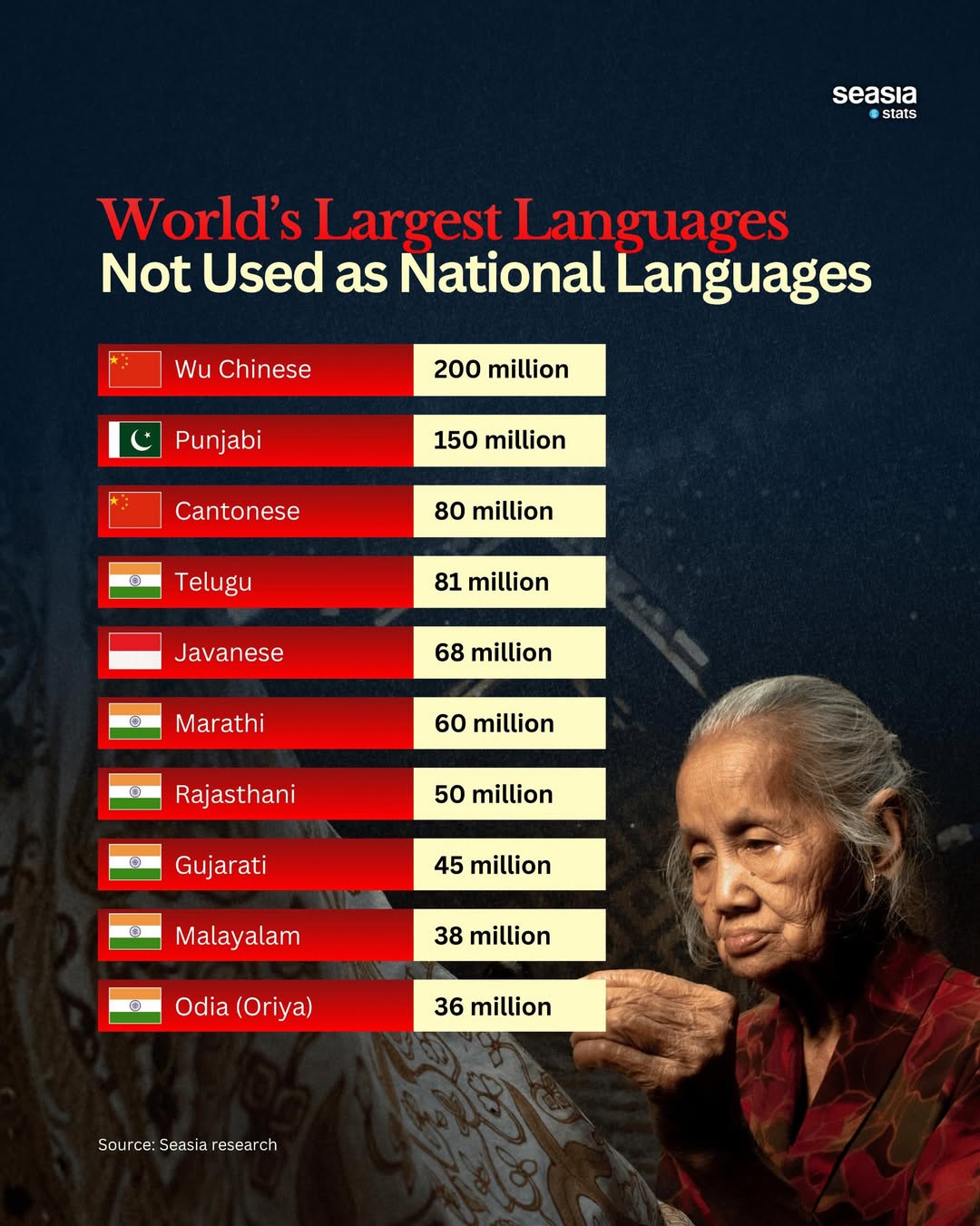
Language diversity is one of humanity’s greatest cultural assets. While many of the world’s most widely spoken languages enjoy official or national status, several major languages with tens of millions of speakers do not serve as national languages of sovereign states.
Despite their enormous speaker populations, these languages often coexist with other official languages or are classified as regional, provincial, or state languages.
The largest example is Wu Chinese, spoken by approximately 200 million people, primarily in eastern China, including Shanghai and surrounding regions. Although it is one of the largest language groups in the world, it does not hold national status, as Standard Mandarin serves as China’s official language.
Punjabi, with around 150 million speakers across India and Pakistan, is another major language without national-language status. It is widely spoken and has a rich literary tradition, but neither country designates it as the sole national language. In India, it is recognized at the state level, while in Pakistan it remains a major regional language.
Among the languages of India, Telugu is spoken by about 81 million people, Marathi by 60 million, Gujarati by 45 million, Malayalam by 38 million, and Odia (formerly known as Oriya) by approximately 36 million.
These languages enjoy official recognition within their respective states and possess vibrant literary and cultural traditions, yet they are not national languages of India.
Cantonese, spoken by roughly 80 million people, is another significant language without national status.
It is widely used in southern China, particularly in Guangdong Province and Hong Kong, and has played a major role in Chinese cinema, music, and international commerce. Nevertheless, Mandarin remains the dominant official language at the national level.
Indonesia’s Javanese language is spoken by around 68 million people, making it one of the largest languages in Southeast Asia. Despite its vast number of speakers and deep cultural influence, Indonesia’s national language is Indonesian, which serves as a unifying language among the country’s many ethnic groups.
Rajasthani, with approximately 50 million speakers, represents a group of closely related languages and dialects spoken mainly in northwestern India. Although widely used in everyday life, it lacks the national recognition enjoyed by Hindi and English at the federal level.
These languages demonstrate that a language’s importance is not determined solely by official status. Together, they are spoken by hundreds of millions of people and contribute enormously to literature, media, education, commerce, and cultural identity. Their continued vitality highlights the richness of linguistic diversity in an increasingly interconnected world.