

11 Countries Where Most People Have Never Traveled Abroad
Traveling abroad is a luxury for most the citizens of these countries.

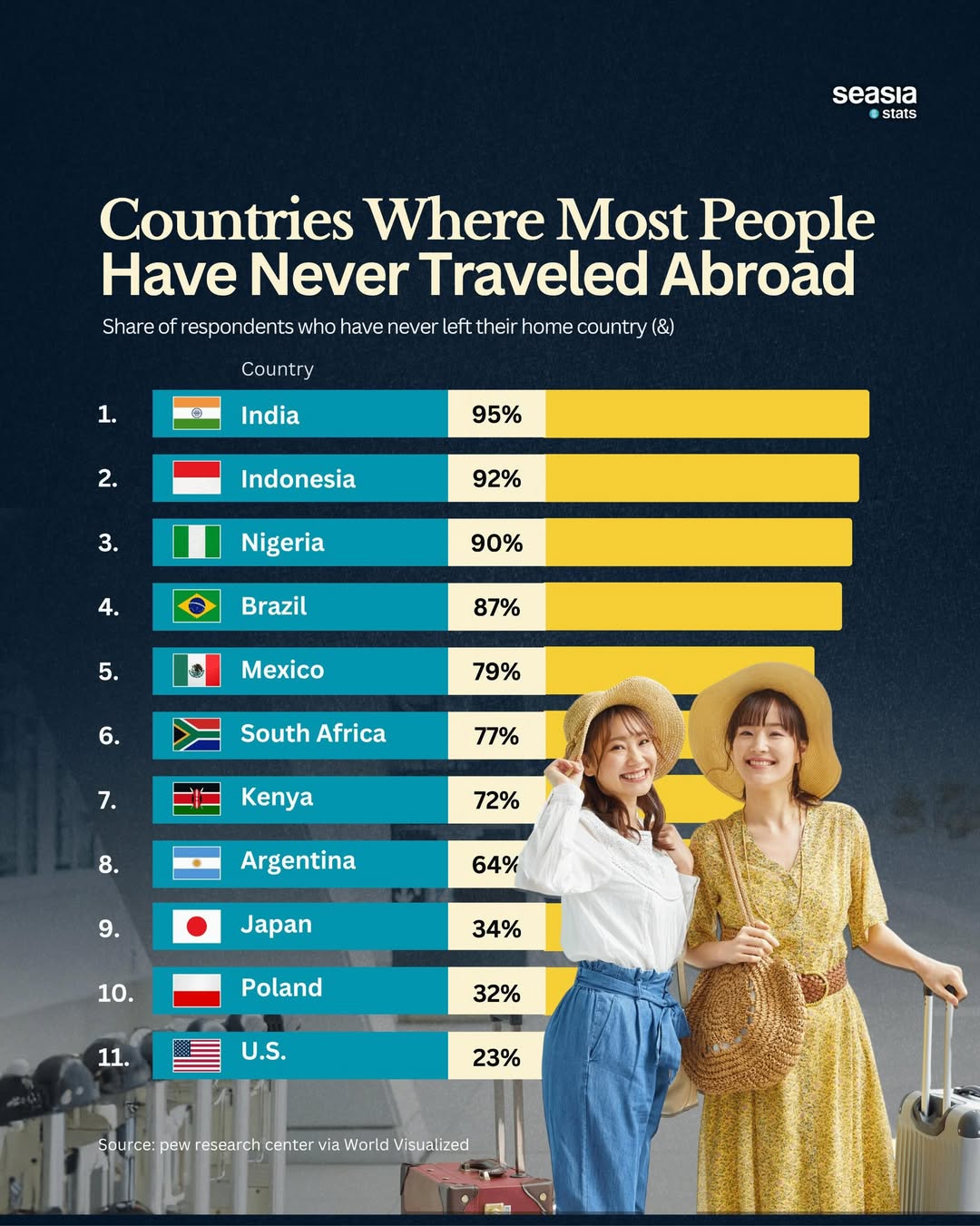
International travel has become increasingly accessible in many parts of the world, yet a large share of the global population has never crossed an international border.
Economic conditions, geographic size, passport access, transportation costs, and cultural factors all influence how likely citizens are to travel abroad. In several countries, the overwhelming majority of residents have never taken an international trip.
India ranks first on this list, with 95% of its citizens having never traveled abroad. Despite its rapidly growing economy and expanding middle class, international travel remains out of reach for many Indians due to financial constraints and the country's vast domestic travel opportunities.
Indonesia follows closely at 92%. As the world's largest archipelagic nation, Indonesia offers enormous geographic and cultural diversity within its own borders, reducing the necessity for many citizens to travel internationally.
Similarly, Nigeria records 90%, reflecting the impact of income levels, travel costs, and limited access to international tourism for much of the population.
In Latin America, Brazil has 87% of citizens who have never traveled abroad. The country's continental size allows residents to experience a wide variety of destinations without leaving national borders. Mexico follows at 79%, where domestic tourism remains more common than international travel for many households.
South Africa and Kenya report rates of 77% and 72%, respectively. In both countries, economic factors play a significant role in limiting international mobility. While international tourism industries are important to their economies, outbound travel remains relatively uncommon among the general population.
Argentina stands at 64%, a lower figure than many other developing economies. The country's proximity to neighboring South American nations and a tradition of regional travel contribute to greater international mobility among its citizens.
Among developed economies, the percentages are considerably lower. Japan records 34%, meaning roughly one-third of its population has never traveled abroad. Despite high income levels, factors such as language barriers, work culture, and strong domestic tourism options have historically influenced outbound travel patterns.
Poland reports 32%, reflecting increasing international mobility since joining the European Union. Access to neighboring countries and affordable travel options have encouraged more Poles to travel internationally.
The United States has the lowest percentage on this list at 23%. Although the country is geographically large and offers extensive domestic travel opportunities, a majority of Americans have traveled abroad at least once, aided by higher average incomes and broad access to international transportation.
These figures highlight the significant differences in global travel experiences and demonstrate how economic, geographic, and social factors shape international mobility around the world.