

12 Countries Colonized by the Netherlands
The Dutch Empire is one of the largest in the world with 12 countries have been colonized in some parts or in its entirety.

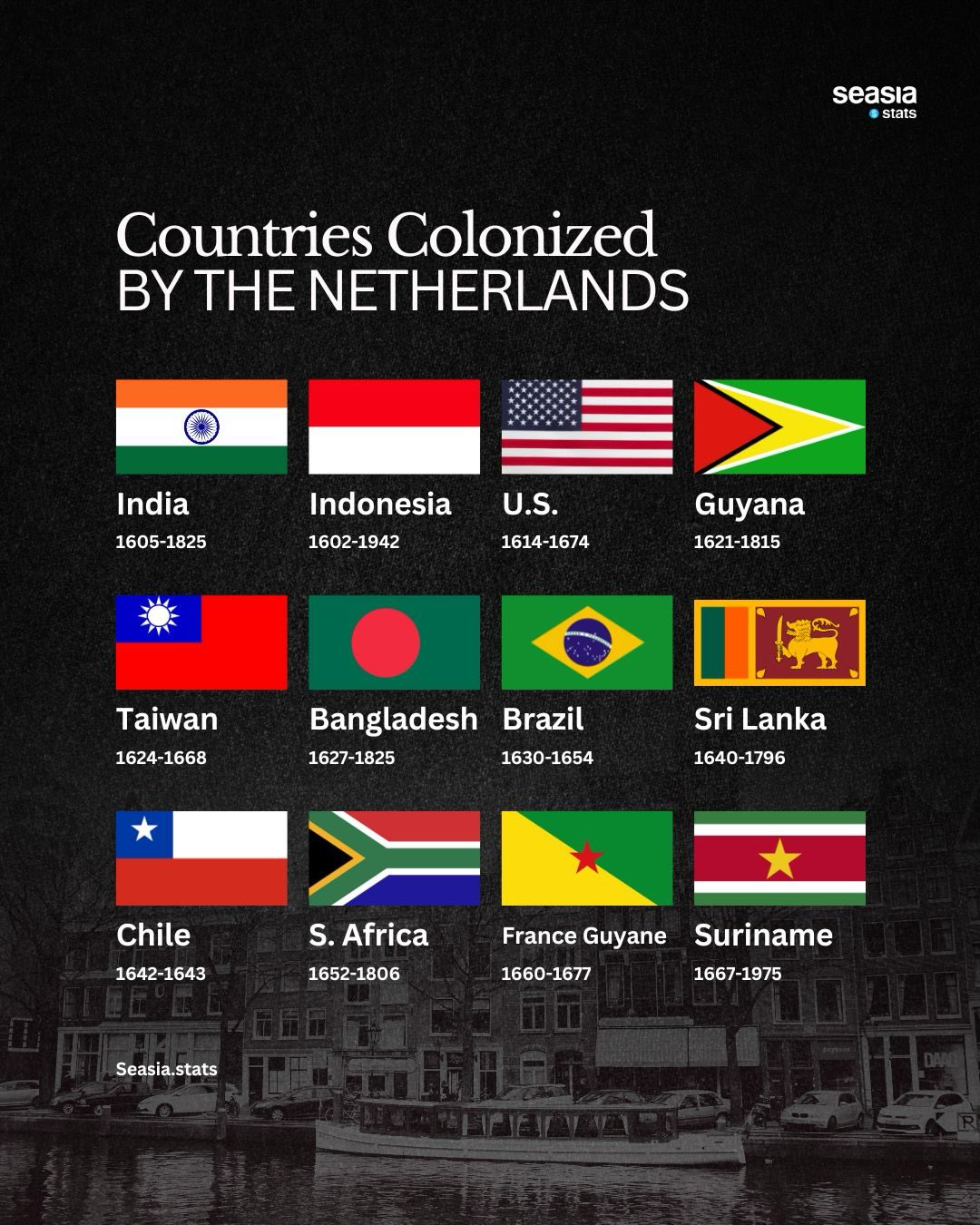
The Netherlands was one of the most influential colonial powers during the Age of Exploration. Through the activities of the Dutch East India Company (VOC) and the Dutch West India Company (WIC), the Dutch established colonies and trading posts across Asia, Africa, and the Americas.
Their colonial presence helped shape the political, economic, and cultural development of many regions around the world.
In Asia, Dutch influence was particularly significant. In India, the Dutch maintained trading settlements from 1605 to 1825, competing with other European powers for control of valuable spices and textiles.
In present-day Indonesia, Dutch rule lasted from 1602 until 1942 and became the largest and most important Dutch colony. The Dutch controlled trade routes and natural resources, leaving a lasting impact on Indonesian society and governance. The Netherlands also established a colony in Taiwan from 1624 to 1668, using the island as a strategic trading center in East Asia.
In Bangladesh, then part of the Bengal region, Dutch merchants operated trading posts between 1627 and 1825. Dutch control also extended to Sri Lanka from 1640 to 1796, where they took over coastal areas previously controlled by the Portuguese.
In the Americas, the Dutch founded several colonies. Parts of the present-day United States were included in the colony of New Netherland from 1614 to 1674. This colony included the settlement of New Amsterdam, which later became New York City. In South America, the Dutch controlled areas of Guyana from 1621 to 1815 and Suriname from 1667 to 1975.
Suriname remained a Dutch colony for more than three centuries before gaining independence. The Dutch also occupied northeastern Brazil from 1630 to 1654, while smaller colonial ventures were established in French Guiana from 1660 to 1677 and in Chile from 1642 to 1643.
In Africa, the Dutch founded the Cape Colony in South Africa in 1652. Originally established as a supply station for ships traveling between Europe and Asia, it grew into an important settlement that remained under Dutch control until 1806.
The Dutch colonial empire was driven largely by trade, particularly in spices, sugar, and other valuable commodities.
Although many of these colonies eventually gained independence or were transferred to other powers, the Dutch legacy remains visible in language, architecture, legal systems, and cultural traditions. The history of Dutch colonization continues to be an important subject in understanding global interactions and the development of modern nations.