

15 Asian Countries with the Best English Speaking Ability
In Asia, Malaysians are the most fluent in English according to English First.

English has become an increasingly important skill in today's globalised world, particularly for education, international business, tourism, and communication. Across Asia, English proficiency varies considerably between countries, reflecting differences in education systems, language policies, and opportunities to use English in everyday life.
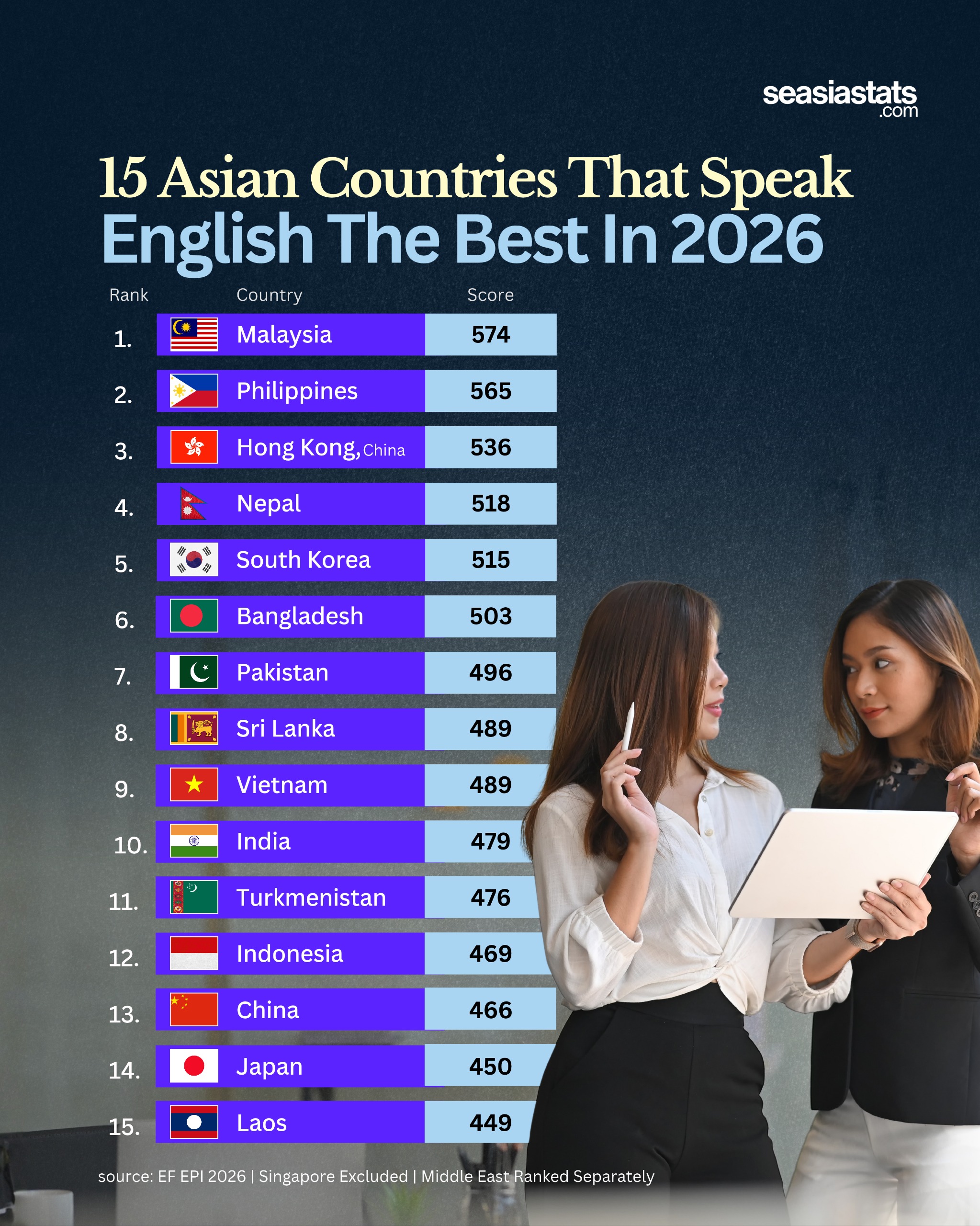
According to the EF English Proficiency Index (EF EPI) 2026, several Asian countries demonstrate relatively strong English-speaking abilities. Excluding Singapore and Middle Eastern countries, Malaysia takes the top position.
Malaysia ranks first with 574 points, making it the highest-scoring country on this list. English is widely used in business, education, and tourism, alongside the country's national language, Malay.
The Philippines follows closely in second place with 565 points. English plays an important role in Filipino society, particularly in education, media, government, and international communication.
Hong Kong ranks third with 536 points, benefiting from its international business environment and widespread use of English in professional settings. Nepal comes next with 518 points, followed by South Korea with 515 points. Both countries demonstrate growing importance in English education, particularly among younger generations and students.
Bangladesh occupies sixth place with 503 points, reflecting the importance of English in higher education, business, and professional opportunities.
Pakistan follows with 496 points, while Sri Lanka and Vietnam share the next position with identical scores of 489 points. English remains an important language for education, tourism, and international employment in these countries.
India ranks tenth with 479 points. Despite its considerable linguistic diversity, English has an established role in higher education, technology, business, and international communication.
Turkmenistan follows with 476 points, while Indonesia achieves 469 points, placing it twelfth. In Indonesia, English proficiency is increasingly valued as the country strengthens its international connections and develops its tourism and digital industries.
China comes next with 466 points. Although Mandarin remains the dominant language, English continues to be an important subject in schools and universities, particularly for international trade and business. Japan ranks fourteenth with 450 points, reflecting ongoing efforts to improve English communication skills in education and the workplace.
Finally, Laos completes the ranking with 449 points. English is becoming increasingly relevant in tourism, international cooperation, and regional business connections.
Overall, the EF EPI 2026 ranking highlights the diversity of English proficiency across Asia. Malaysia and the Philippines lead the list, while countries such as Indonesia, China, Japan, and Laos continue to develop their English-language capabilities.
Improving English proficiency can provide valuable opportunities for education, employment, international collaboration, and economic growth.