

15 Best Cities in the World for Public Transport in 2026
As expected, Tokyo has the best public transport system in the world.

An efficient public transport system is essential to making a city accessible, sustainable, and convenient for residents and visitors. From extensive metro networks to reliable buses and well-connected railway services, public transportation helps millions of people navigate urban life every day.
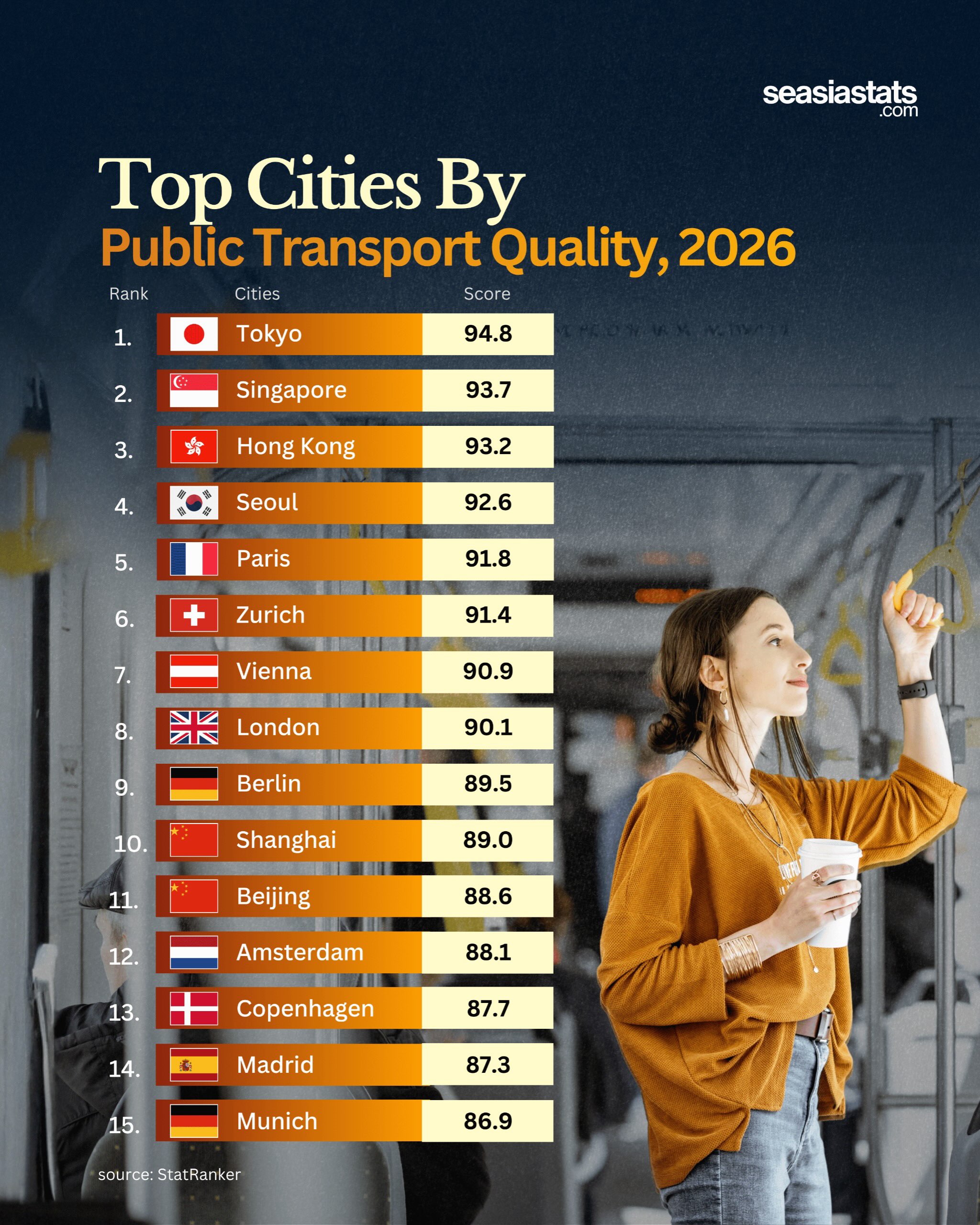
According to the 2026 rankings provided by StatRanker, these cities have the best public transport systems in the world.
Tokyo, Japan, takes first place with an impressive score of 94.8. Its extensive railway and subway networks, frequent services, and carefully coordinated connections make it possible for millions of passengers to travel across the metropolitan area daily.
Singapore follows in second place with 93.7, supported by its integrated Mass Rapid Transit system, comprehensive bus network, and convenient connections between residential neighborhoods and commercial districts.
Hong Kong ranks third with 93.2, reflecting the importance of its extensive rail network and efficient connections between urban centers.
Seoul, South Korea, takes fourth place with 92.6, offering a comprehensive subway and bus system that serves its densely populated metropolitan area. Paris, France, rounds out the top five with 91.8, benefiting from its extensive Métro network, regional rail connections, and numerous bus routes.
Zurich, Switzerland, ranks sixth with 91.4, demonstrating how a relatively compact city can provide convenient connections through trams, buses, and trains. Vienna, Austria, follows in seventh place with 90.9, supported by its integrated public transport network, which includes underground trains, trams, and buses.
London, United Kingdom, occupies eighth place with 90.1. Its Underground, buses, suburban rail services, and other transport connections provide extensive coverage across the capital.
Berlin, Germany, ranks ninth with 89.5, thanks to its combination of the U-Bahn, S-Bahn, trams, and buses. Shanghai, China, completes the top ten with 89.0, reflecting the scale of its extensive metro network and its importance as a major international metropolis.
The remaining cities also demonstrate strong public transport systems. Beijing, China, scores 88.6, followed by Amsterdam, Netherlands, with 88.1. Copenhagen, Denmark, earns 87.7, while Madrid, Spain, receives 87.3. Munich, Germany, completes the top fifteen with 86.9, supported by its interconnected underground, suburban rail, tram, and bus services.
Overall, these rankings highlight the importance of reliable, accessible, and well-integrated public transportation in modern cities. Although each destination has its own urban challenges and transport priorities, the cities listed demonstrate how comprehensive transit networks can support daily mobility, connect communities, and reduce dependence on private vehicles.
As urban populations continue to grow, investment in efficient public transportation will remain an important part of building more accessible and sustainable cities.