

15 Capital Cities with the Most Skyscrapers Measuring 150 Meters and Above
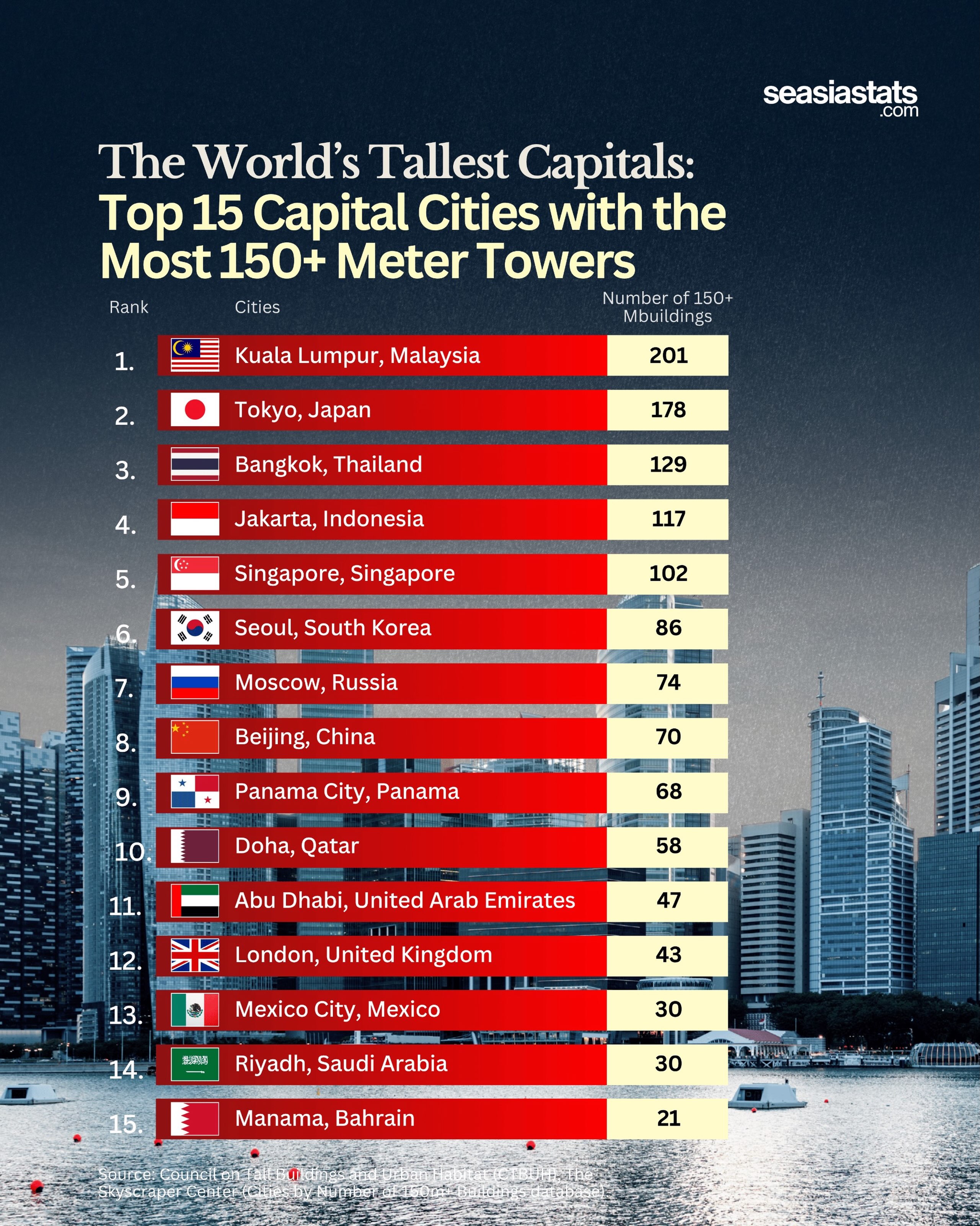
Kuala Lumpur has 201 skyscrapers towering more than 150 meters, the most in the world.

Skyscrapers are remarkable symbols of urban development, economic growth, and architectural innovation. Across the world, capital cities are building impressive skylines filled with towering structures that transform their landscapes. These 15 capital cities have some of the largest numbers of skyscrapers measuring 150 meters or taller.
Kuala Lumpur, Malaysia, ranks first with an impressive 201 skyscrapers. Its modern skyline reflects the country's rapid development and growing international influence.
Tokyo, Japan, follows in second place with 178 skyscrapers, showcasing its status as a major global economic and technological center. Bangkok, Thailand, ranks third with 129, highlighting the city's rapid urban expansion and commercial growth.
In fourth place, Jakarta, Indonesia, has 117 skyscrapers, reflecting its position as a major business hub in Southeast Asia. Singapore ranks fifth with 102, demonstrating how a relatively small city-state has developed a striking skyline through careful urban planning and economic progress.
Moving to sixth place, Seoul, South Korea, has 86 skyscrapers, representing its advanced economy and modern infrastructure. Moscow, Russia, ranks seventh with 74, combining contemporary high-rise developments with its historic urban landscape.
Beijing, China, follows in eighth place with 70 skyscrapers, reflecting its importance as a political, economic, and cultural center.
Panama City, Panama, ranks ninth with 68 skyscrapers. Its skyline stands out in Central America, shaped by commercial investment and the city's strategic position in international trade. In tenth place, Doha, Qatar, has 58 skyscrapers, illustrating the country's substantial investment in modern architecture and urban development.
The remaining five cities also feature impressive collections of tall buildings. Abu Dhabi, United Arab Emirates, has 47 skyscrapers, followed by London, United Kingdom, with 43. London's skyline blends historic landmarks with modern towers.
Mexico City, Mexico, and Riyadh, Saudi Arabia, each have 30 skyscrapers, reflecting their roles as major national capitals experiencing continued urban development. Finally, Manama, Bahrain, completes the list with 21 skyscrapers, highlighting its importance as a financial and commercial center in the Gulf region.
Their skylines demonstrate how cities across Asia, Europe, the Middle East, and the Americas are shaping modern urban environments. Although each capital has its own history, economy, and architectural identity, these towering buildings share a common role: representing ambition, investment, and the continuing transformation of cities around the world.