

20 Countries with the Largest Projected Increase in Muslim Population Share from 2020 to 2070
Albania is projected to see the largest increase in Muslim population from 2020 to 2070.

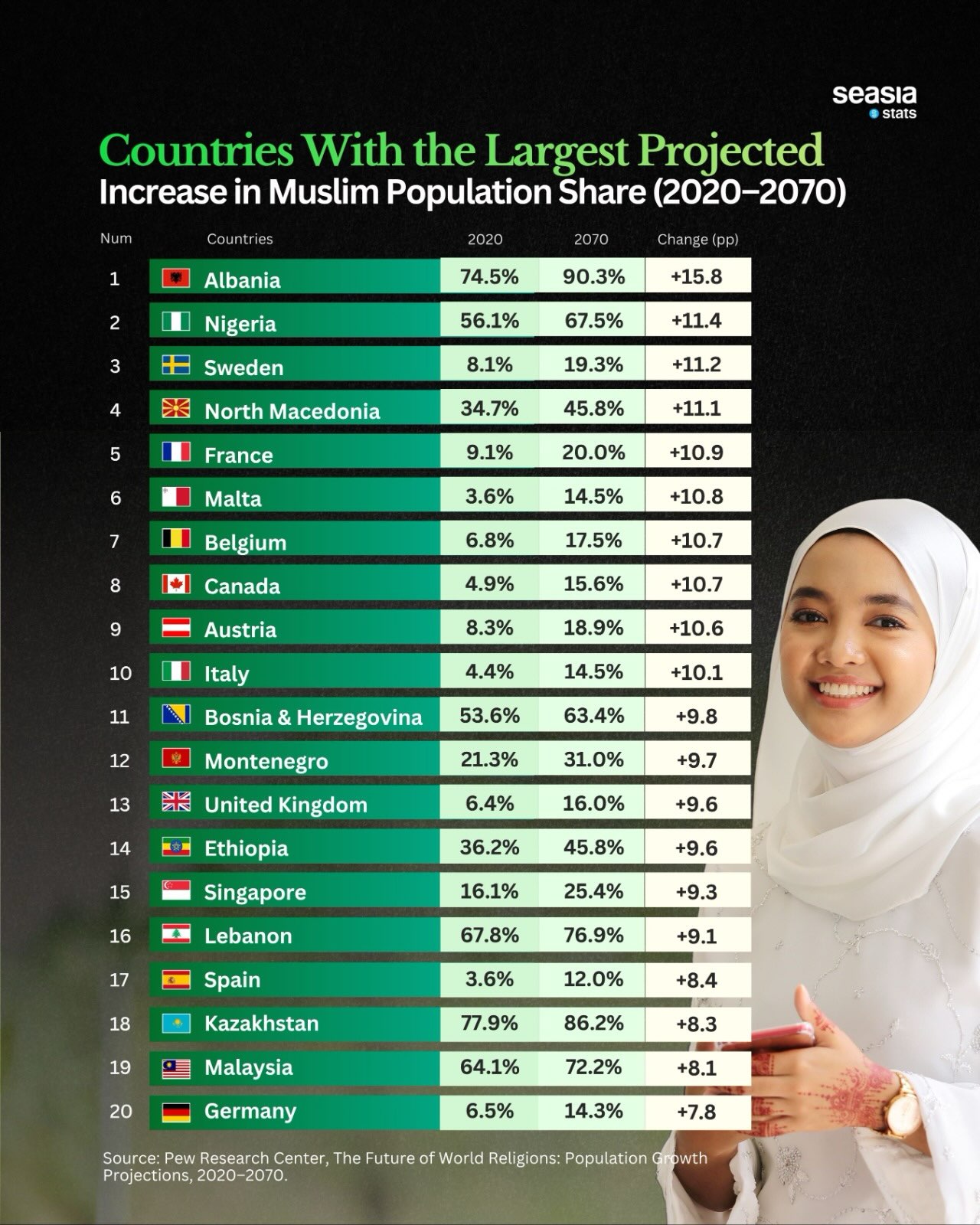
According to the Pew Research Center's report The Future of World Religions: Population Growth Projections, 2020–2070, several countries across Europe, Africa, Asia, and North America are projected to experience substantial increases in the proportion of their populations identifying as Muslim between 2020 and 2070.
These projections highlight significant demographic changes that may reshape the religious composition of societies over the next five decades.
Albania is expected to record the largest increase among the countries examined, with its Muslim population share projected to rise from 74.5% in 2020 to 90.3% in 2070, an increase of 15.8 percentage points.
Nigeria follows, with its Muslim share projected to grow from 56.1% to 67.5%, representing an increase of 11.4 percentage points. Sweden ranks third, with a notable rise from 8.1% to 19.3%, or 11.2 percentage points. North Macedonia and France are also expected to experience considerable increases, reaching 45.8% and 20.0%, respectively, by 2070.
Other European countries feature prominently in the projections. Malta's Muslim population share is expected to increase from 3.6% to 14.5%, while Belgium is projected to rise from 6.8% to 17.5%.
Canada is expected to experience a similar increase, from 4.9% to 15.6%. Austria and Italy are also projected to see their Muslim population shares reach 18.9% and 14.5%, respectively. Meanwhile, Bosnia and Herzegovina is expected to increase from 53.6% to 63.4%, and Montenegro from 21.3% to 31.0%.
The United Kingdom and Ethiopia are both projected to experience increases of 9.6 percentage points, reaching 16.0% and 45.8%, respectively. Singapore, Lebanon, and Spain are also expected to record notable growth, with projected Muslim population shares of 25.4%, 76.9%, and 12.0%.
Kazakhstan and Malaysia are projected to reach 86.2% and 72.2%, respectively, while Germany is expected to increase from 6.5% to 14.2%.
Overall, these projections suggest that Muslim population shares will increase across a diverse range of countries, although the scale of change varies considerably. They also illustrate the importance of demographic factors such as fertility, migration, age structure, and religious switching in shaping future religious populations.
However, these figures represent projections rather than guaranteed outcomes and should be understood as possible demographic scenarios based on assumptions about future population trends.