

5 Countries Planning to Move Their Capital Cities
There are five countries currently planning to move their capital cities.

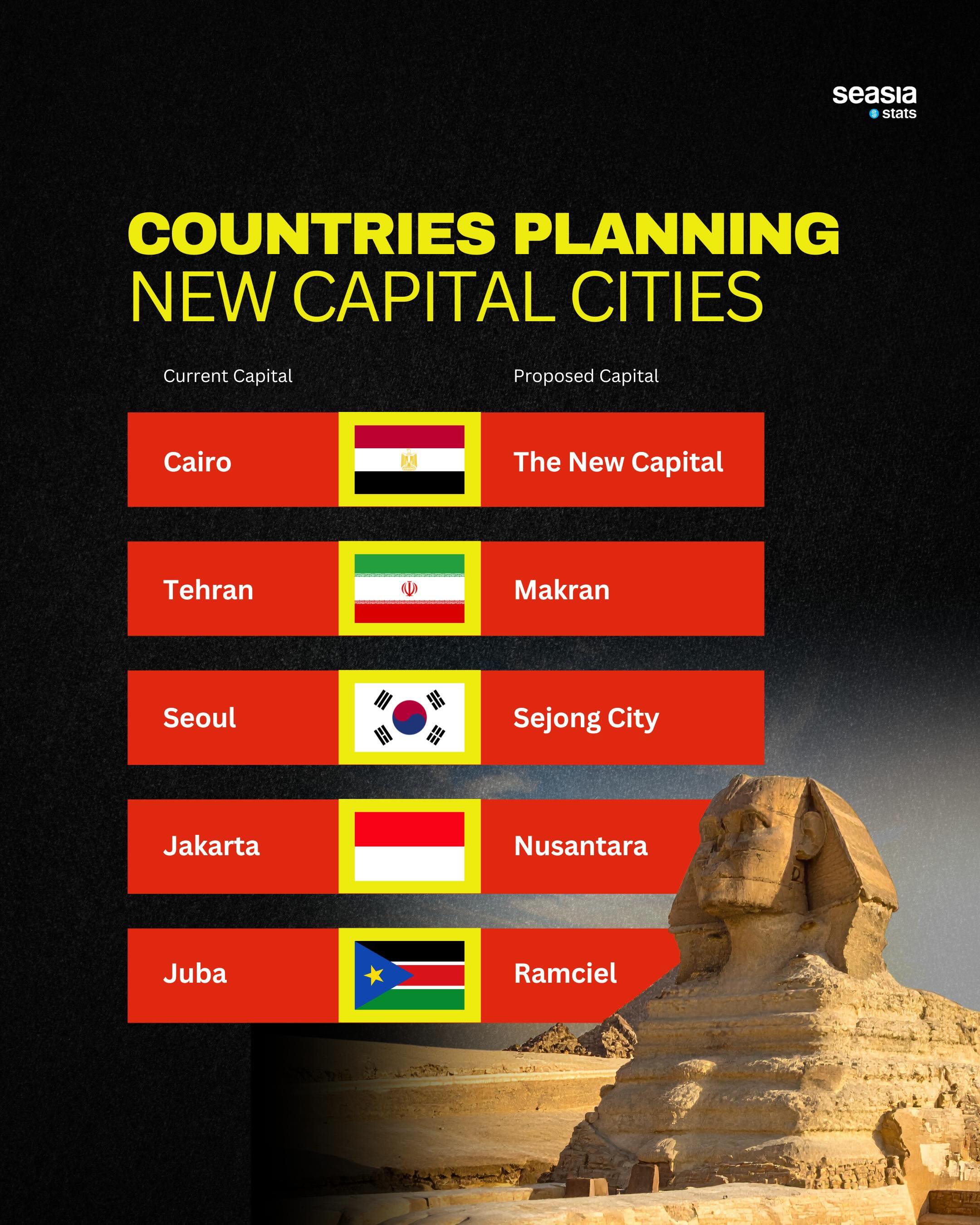
Throughout history, countries have relocated their capitals to promote balanced development, reduce congestion, improve national security, or create more efficient administrative centers. Today, several nations are pursuing ambitious plans to establish new capitals, reflecting their changing economic, political, and environmental priorities.
Egypt is gradually shifting its government functions from Cairo to The New Capital, a purpose-built city located about 45 kilometers east of the current capital. Announced in 2015, the project aims to relieve Cairo's severe traffic congestion, overcrowding, and urban pressure while creating a modern administrative and business hub.
Many government ministries and institutions have already relocated, making the new city the country's primary administrative center.
Iran has also proposed relocating its capital from Tehran to the Makran region along the country's southeastern coast. Tehran faces numerous challenges, including heavy traffic, air pollution, earthquake risks, and excessive population density.
Although the proposal has generated considerable discussion, officials have emphasized that the relocation remains under study and no final timetable has been established.
South Korea has pursued administrative decentralization by developing Sejong City, approximately 120 kilometers south of Seoul. Since its establishment in 2012, Sejong has become home to many government ministries and public agencies.
While Seoul remains the nation's official capital due to constitutional considerations, Sejong functions as South Korea's administrative capital and continues to expand as a smart city designed to promote balanced regional development.
Indonesia is constructing Nusantara in East Kalimantan on the island of Borneo to replace Jakarta as the country's political capital. The move addresses Jakarta's chronic traffic congestion, flooding, land subsidence, and overconcentration of economic activity on Java.
Nusantara is envisioned as a sustainable "forest city" featuring modern infrastructure and environmentally friendly urban planning. Although construction continues, the relocation is expected to occur in stages over the coming years.
South Sudan has long planned to relocate its capital from Juba to Ramciel, a more centrally located site intended to improve national unity and reduce pressure on the rapidly growing capital.
The proposal was first approved shortly after the country's independence in 2011. However, financial constraints and political challenges have delayed the project, and Juba remains the capital while plans for Ramciel remain on hold.
These capital relocation projects demonstrate how governments are using urban planning to address modern challenges. While each country faces unique obstacles, their efforts reflect a shared goal of building administrative centers that better serve future generations.