

9 Countries with the Largest Population Growth Since 1930
Mexico has the largest population growth from 1930 to 2026.

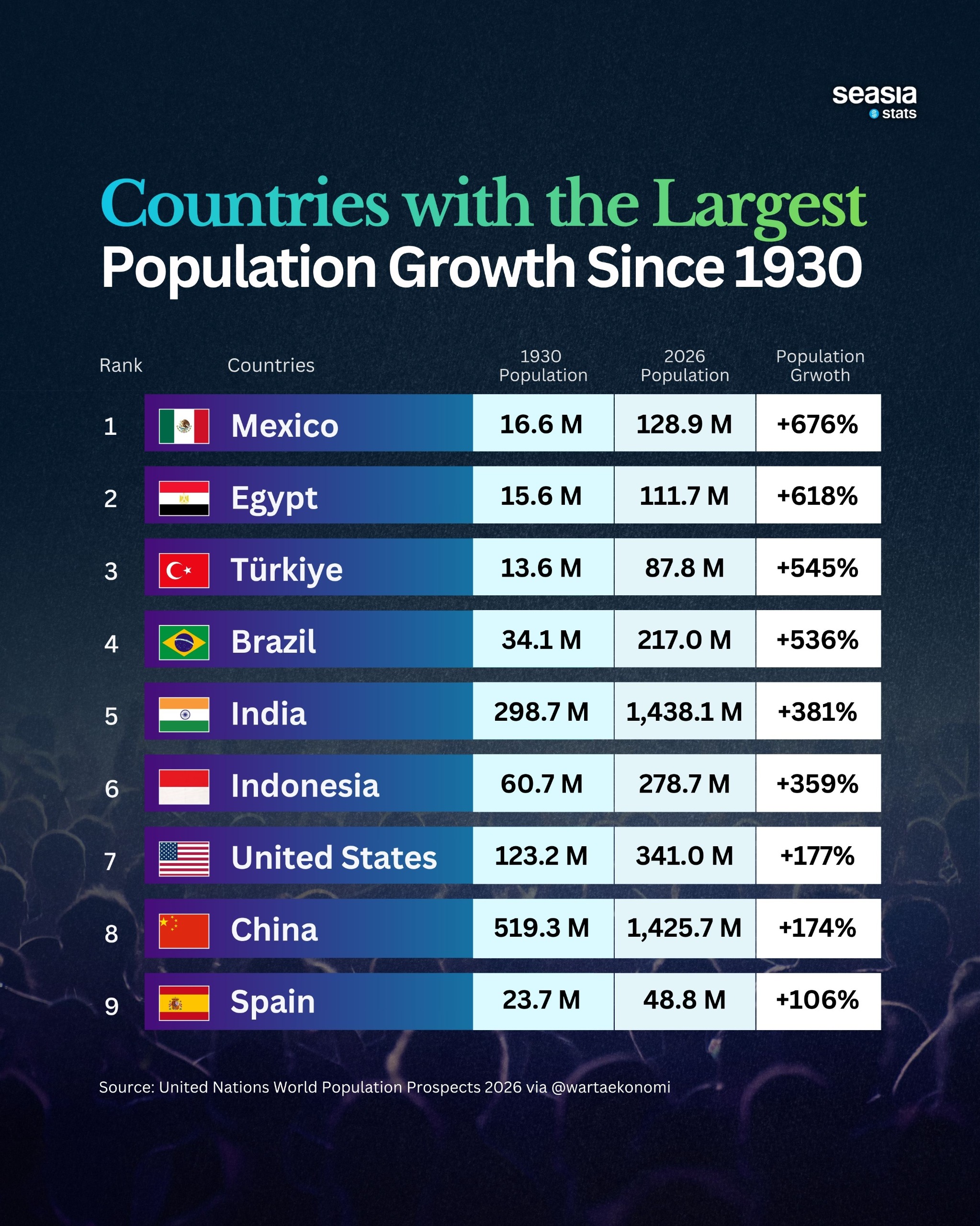
According to the United Nations World Population Prospects 2026, several of the world's largest countries have experienced remarkable population growth since 1930.
While every nation has followed its own demographic path, improvements in healthcare, declining mortality, economic development, and changing social conditions have contributed to substantial increases in population over the past 96 years.
Among the countries listed, Mexico recorded the fastest percentage growth. Its population expanded from 16.6 million in 1930 to 128.9 million in 2026, representing an impressive 676% increase. Rapid declines in mortality during the twentieth century, combined with decades of high fertility, fueled this extraordinary expansion.
Egypt ranks second, growing from 15.6 million to 111.7 million, a 618% increase. The country's population has continued to rise steadily due to sustained natural increase and improvements in life expectancy.
Turkey also experienced significant demographic growth, increasing from 13.6 million in 1930 to 87.8 million in 2026. This represents a 545% increase, reflecting decades of modernization, improved healthcare, and sustained population growth.
In South America, Brazil expanded from 34.1 million to 217.0 million, a remarkable 536% increase. Brazil's rapid urbanization and economic development accompanied one of the largest population increases in the Western Hemisphere.
Although its percentage increase was lower than several other countries, India added by far the largest number of people in absolute terms. Its population rose from 298.7 million in 1930 to 1.438 billion in 2026, a 381% increase, making it one of the most significant demographic transformations in human history.
Indonesia also recorded exceptional growth, rising from 60.7 million to 278.7 million, representing a 359% increase. Strong population momentum and improvements in public health have made Indonesia the world's fourth-most populous country.
The United States grew from 123.2 million to 341.0 million, an increase of 177%. This growth has been supported by both natural increase and sustained immigration over many decades.
Meanwhile, China expanded from 519.3 million to 1.425 billion, a 174% increase. Despite slower growth in recent decades due to declining fertility, China remains one of the world's two most populous nations.
Finally, Spain more than doubled its population, increasing from 23.7 million in 1930 to 48.8 million in 2026, a 106% increase. Although its growth has been more moderate, immigration and longer life expectancy have contributed to its demographic expansion.
These figures from the United Nations illustrate the profound demographic changes that have reshaped nations over nearly a century, highlighting both rapid population growth in developing regions and the long-term effects of demographic transition across the world.