

AI Adoption for Learning Around the World
Indonesians are the most open about using AI for learning purposes.

Artificial intelligence is becoming an increasingly important tool for education and learning, with people in countries around the world turning to AI applications to study, understand difficult subjects, conduct research, and improve their skills.
According to Statista Consumer Insights, the adoption of AI for learning varies considerably between countries, with developing economies recording some of the highest levels of use.
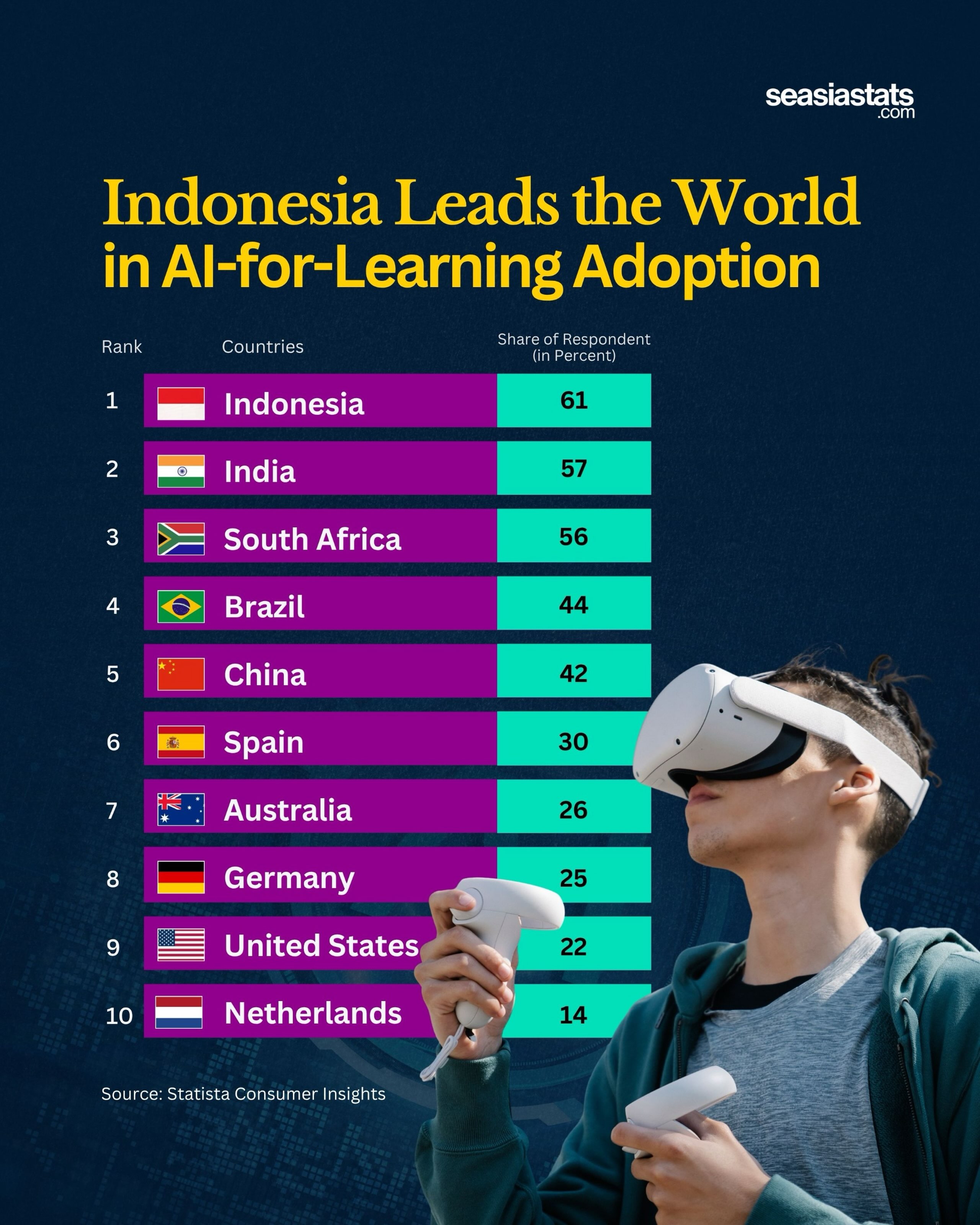
Indonesia ranks first among the countries measured, with 61 percent of respondents saying they use AI for education and learning. This places Indonesia well ahead of many developed economies and highlights the rapid integration of AI into everyday learning.
India follows closely at 57 percent, while South Africa ranks third at 56 percent. The strong results in these three countries demonstrate the particularly high interest in AI-powered learning tools among consumers in emerging markets.
Brazil comes next, with 44 percent of respondents using AI for learning. China records 42 percent, making it another major market where AI has become an important educational resource. These figures suggest that AI is increasingly being embraced not only for entertainment and productivity but also for acquiring knowledge and developing new skills.
The adoption rate drops further among several Western countries. Spain records 30 percent, followed by Australia at 26 percent and Germany at 25 percent. In the United States, 22 percent of respondents report using AI for education and learning. The Netherlands has the lowest figure among the countries listed, at 14 percent.
The differences may reflect variations in overall AI adoption, digital habits, educational systems, and attitudes toward emerging technologies.
Statista notes that education and learning is among the top three personal uses of AI tools in most of the countries surveyed. Interestingly, even in countries with relatively lower overall adoption, education remains an important reason for using AI.
The results also demonstrate how AI is changing the way people approach learning. Students and other learners can use AI tools to explain complex concepts, summarize information, practice languages, generate study materials, and receive assistance with research.
However, greater adoption also creates a need for responsible use. AI can support learning, but it should complement rather than replace critical thinking and independent understanding.
Overall, the figures show a clear global divide in AI-based learning adoption. Indonesia, India, and South Africa stand at the forefront, while countries such as the Netherlands, the United States, and Germany report substantially lower usage. As AI technology continues to develop, its role in education is likely to become increasingly significant worldwide.