

ASEAN Economic Growth in the First Half of 2026
Only Vietnam, Malaysia, and Singapore recorded GDP growth from Q1 and Q2 of 2026.

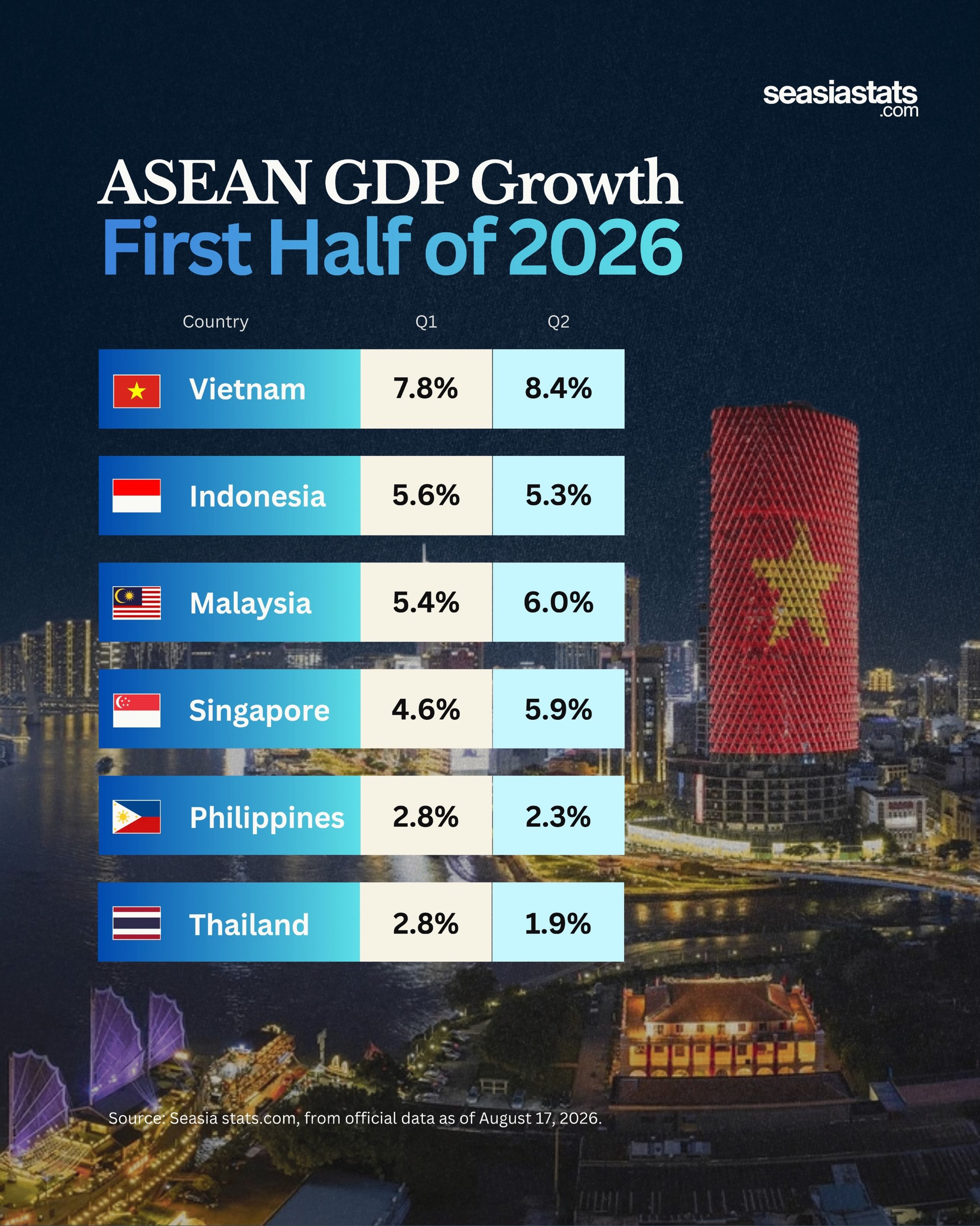
The first half of 2026 showed significant differences in economic performance among Southeast Asia’s major economies. Vietnam emerged as the fastest-growing economy among the six ASEAN countries considered, while Indonesia, Malaysia, and Singapore recorded relatively strong growth.
Meanwhile, the Philippines and Thailand experienced slower expansion. The figures highlight the different economic conditions, industries, and domestic factors influencing the region.
Vietnam recorded the strongest performance, with GDP growth of 7.8% in Q1 and 8.4% in Q2 of 2026. Its economy benefited from strong industrial production, services, investment, and export activity.
Vietnam’s Q1 growth was officially estimated at 7.83%, with industry and construction growing 8.92% and services expanding 8.18%. The acceleration to 8.4% in Q2 further strengthened Vietnam’s position as one of the region’s fastest-growing economies.
Indonesia maintained solid growth, expanding by 5.6% in Q1 and 5.3% in Q2. Official data put Q1 growth at 5.61%, supported by household consumption, government spending, manufacturing, trade, and other sectors. Although growth moderated slightly in Q2, Indonesia continued to demonstrate resilience amid global economic uncertainty.
Malaysia grew by 5.4% in Q1 and 6.0% in Q2, showing a notable improvement during the second quarter. Strong domestic demand, manufacturing, exports, and technology-related industries contributed to economic activity. Malaysia's electronics and electrical sector has also benefited from global demand connected to technology and artificial intelligence.
Singapore recorded growth of 4.6% in Q1 and 5.9% in Q2. As a highly developed and internationally connected economy, Singapore benefited from manufacturing, wholesale trade, financial services, and technology-related demand. Its economic performance demonstrates the importance of global trade and advanced industries to its growth.
The Philippines experienced weaker momentum, with GDP growth slowing from 2.8% in Q1 to 2.3% in Q2. Domestic consumption, investment, and public spending faced several challenges, making the Philippines the slowest-growing economy among the six in the second quarter.
Thailand also saw growth weaken, from 2.8% in Q1 to 1.9% in Q2. While exports, manufacturing, and tourism supported the economy, external pressures and weaker momentum limited overall expansion.
Overall, the first half of 2026 demonstrates that ASEAN's economic performance was uneven. Vietnam led the group, while Malaysia and Singapore strengthened in Q2. Indonesia remained stable, whereas the Philippines and Thailand faced greater challenges.
These differences underline the importance of domestic demand, exports, investment, manufacturing, tourism, and global economic conditions in shaping ASEAN’s growth.