

ASEAN Financial Centers 2026
Singapore is still the undisputed leader of ASEAN's financial center.

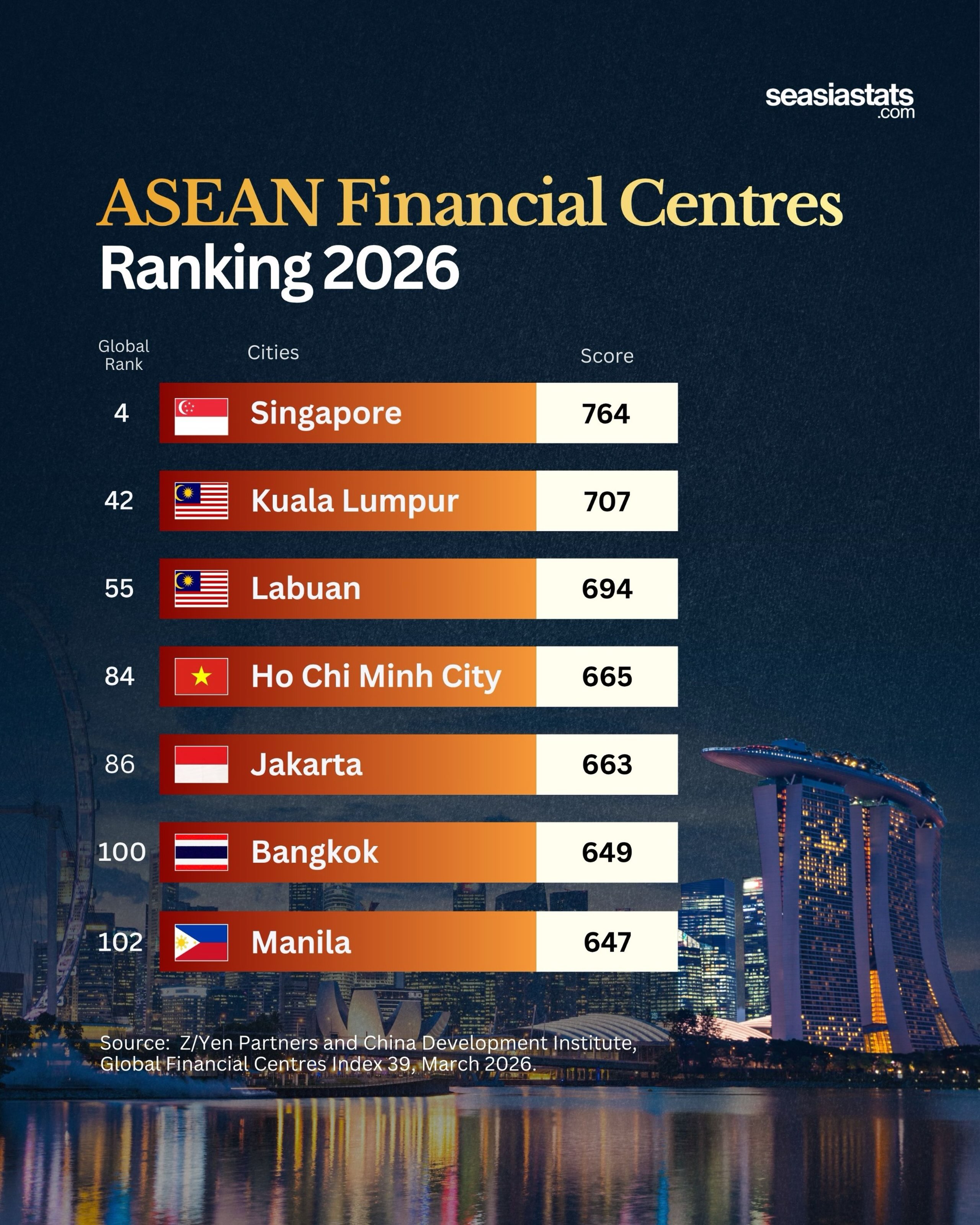
The latest global financial center rankings highlight the growing importance of Southeast Asia as a hub for finance, investment, and economic development.
Among ASEAN members, Singapore continues to dominate the region, while several other cities are steadily strengthening their positions as competitive financial centers.
Singapore remains the region’s undisputed leader, ranking 4th globally with a score of 764. Its strong performance reflects its world-class financial infrastructure, transparent regulatory environment, deep capital markets, and reputation as a leading international business hub.
The city-state continues to attract multinational corporations, global investors, and financial institutions, reinforcing its status as one of the world's premier financial centers.
Malaysia has two financial centers featured in the rankings. Kuala Lumpur ranks 42nd globally with a score of 707, demonstrating its role as the country's primary financial and commercial hub.
Meanwhile, Labuan secures 55th place with a score of 694, highlighting its importance as an international business and financial center specializing in offshore financial services.
Vietnam also makes a notable appearance, with Ho Chi Minh City ranked 84th globally and earning a score of 665. The city's steady economic growth, expanding financial sector, and increasing foreign investment have contributed to its rising profile within the region.
Indonesia's capital, Jakarta, follows closely behind in 86th place with a score of 663. As Southeast Asia's largest economy, Indonesia continues to strengthen its financial ecosystem through ongoing market development, digital innovation, and financial sector reforms.
Jakarta's close proximity to Ho Chi Minh City in the rankings suggests increasing competition among emerging ASEAN financial centers.
Thailand's capital, Bangkok, is ranked 100th globally with a score of 649. As one of the region's major commercial cities, Bangkok remains an important financial gateway supported by a diversified economy and established banking sector.
Meanwhile, the Philippines' capital, Manila, ranks 102nd globally with a score of 647, reflecting its continuing efforts to expand financial services and attract investment despite increasing regional competition.
Overall, the rankings demonstrate ASEAN's growing presence in the global financial landscape. While Singapore continues to set the regional benchmark, other financial centers—including Kuala Lumpur, Labuan, Ho Chi Minh City, Jakarta, Bangkok, and Manila—are steadily enhancing their competitiveness.
As ASEAN economies continue to integrate and modernize their financial systems, the region is expected to play an increasingly significant role in shaping the future of global finance.