

ASEAN's Largest Economies in 2026, Projected by the IMF
Indonesia is projected to have the largest economy in ASEAN in 2026.

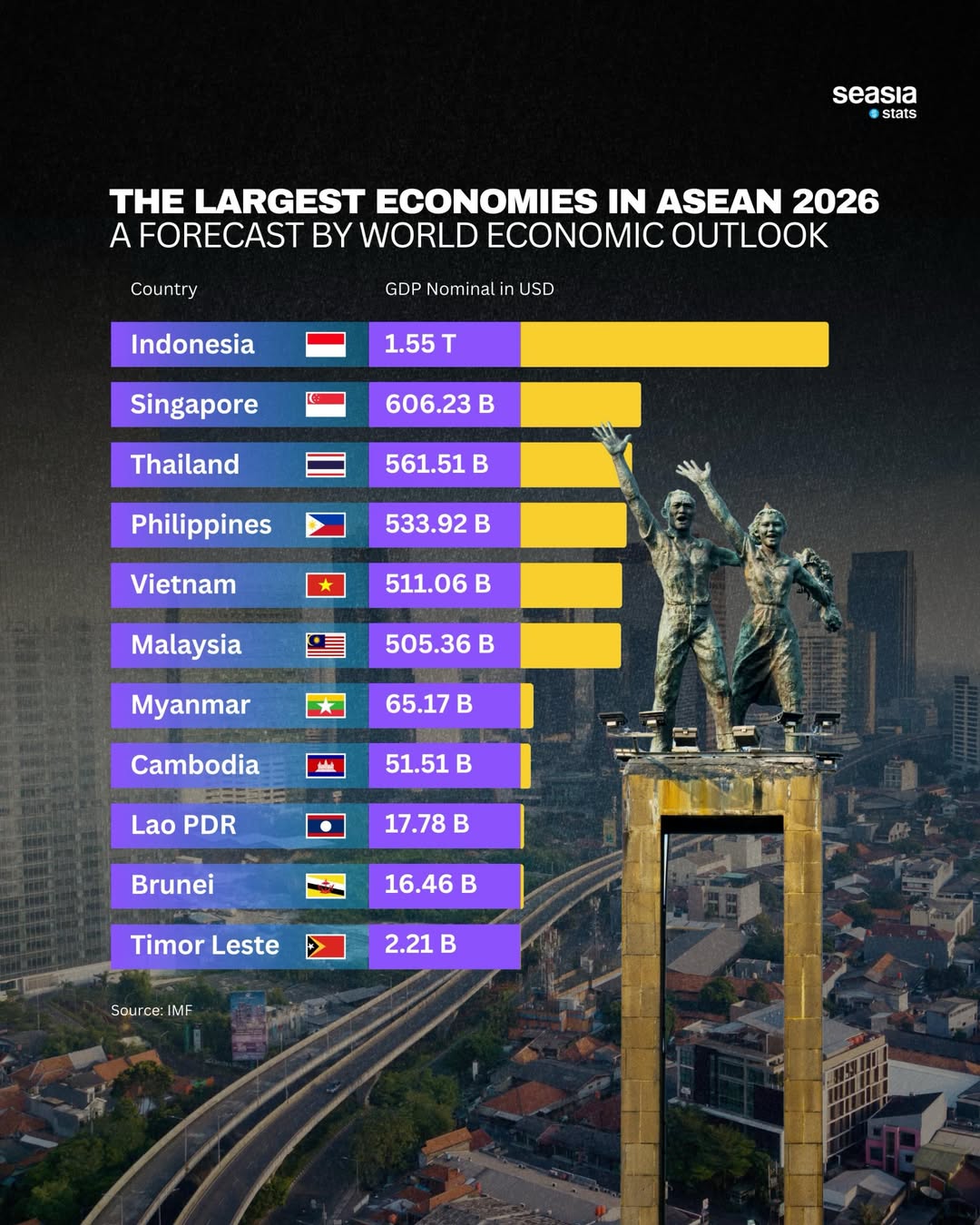
The Association of Southeast Asian Nations (ASEAN) continues to be one of the world's most dynamic economic regions, driven by strong domestic demand, industrial growth, expanding trade networks, and increasing foreign investment.
According to projected 2026 gross domestic product (GDP) figures in current U.S. dollars from the International Monetary Fund (IMF), ASEAN's economies are expected to demonstrate both resilience and diversity in size and development.
Indonesia is projected to remain the largest economy in ASEAN by a considerable margin, with a GDP of US$1.55 trillion.
As the region's most populous country and largest consumer market, Indonesia benefits from a broad economic base that includes manufacturing, natural resources, services, technology, and infrastructure development. Its economic scale places it among the leading emerging markets globally.
Singapore is forecast to be ASEAN's second-largest economy with a GDP of US$606.23 billion. Despite its relatively small population and land area, Singapore's position as a global financial, trade, and logistics hub enables it to generate one of the region's highest levels of economic output.
Thailand is expected to rank third with a GDP of US$561.51 billion. The country's economy is supported by strong manufacturing industries, tourism, agriculture, and exports. Close behind is the Philippines, projected to reach US$533.92 billion.
Continued growth in consumer spending, services, remittances, and infrastructure investment has helped sustain the country's economic expansion.
Vietnam follows with a projected GDP of US$511.06 billion, reflecting its emergence as one of Asia's fastest-growing manufacturing and export centers.
Malaysia is expected to record a GDP of US$505.36 billion, supported by its diversified economy spanning energy, finance, electronics, and services. The close GDP figures of Vietnam and Malaysia highlight the increasing competitiveness among ASEAN's middle-income economies.
Among the region's smaller economies, Myanmar is projected to generate US$65.17 billion in GDP, while Cambodia is expected to reach US$51.51 billion. Both countries continue to develop through investments in manufacturing, agriculture, tourism, and infrastructure.
Laos is projected to achieve a GDP of US$17.78 billion, while Brunei's economy is expected to total US$16.46 billion, supported largely by its energy sector. Timor-Leste, ASEAN's newest member, is projected to record a GDP of US$2.21 billion.
Together, these figures illustrate ASEAN's growing economic importance on the global stage. With a combined GDP exceeding US$4.9 trillion, the region continues to attract international investment and strengthen its role as a major center of economic growth in the 21st century.