

Asia-Pacific's 10 Busiest Airports in 2025
Airports in Asia-Pacific are bustling with travelers with these ten being the busiest.

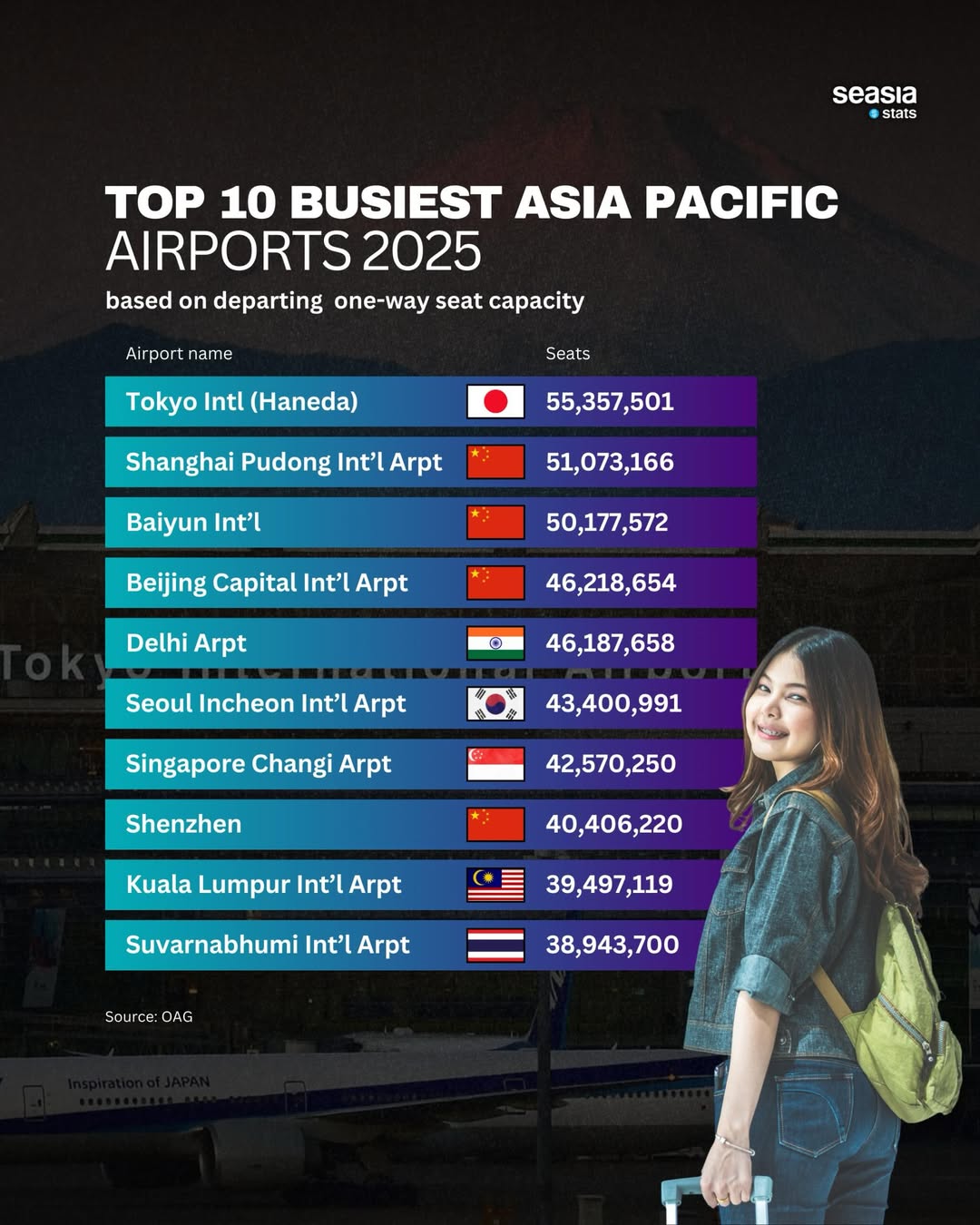
The Asia-Pacific region continues to be one of the world's most dynamic aviation markets, driven by strong economic growth, expanding tourism, and increasing business travel.
According to data from OAG (Official Airline Guide), the region's busiest airports in 2025 were ranked by the number of airline seats available, highlighting the importance of major aviation hubs in connecting millions of passengers across Asia and beyond.
Leading the ranking is Haneda Airport, officially known as Tokyo International Airport, with 55,357,501 seats. Located in Japan's capital, Haneda has strengthened its position as one of the world's premier airports, benefiting from strong domestic demand and extensive international connections.
China dominates much of the list, with Shanghai Pudong International Airport ranking second at 51,073,166 seats. As one of China's primary international gateways, Pudong serves as a crucial hub for global trade, tourism, and business travel.
Guangzhou Baiyun International Airport follows closely in third place with 50,177,572 seats. Its strategic location in southern China makes it a major transit point linking domestic and international destinations.
Beijing Capital International Airport ranks fourth with 46,218,654 seats. Despite competition from Beijing Daxing International Airport, it remains one of China's most important aviation centers.
India's Delhi Airport occupies fifth place with 46,187,658 seats. As the country's busiest airport, Delhi plays a critical role in connecting India's rapidly growing economy to the rest of the world.
South Korea's Incheon International Airport ranks sixth with 43,400,991 seats. Renowned for its efficiency and world-class facilities, Incheon serves as a major gateway between Northeast Asia and global destinations.
Singapore Changi Airport, one of the world's most acclaimed airports, ranks seventh with 42,570,250 seats. Changi continues to be a vital aviation hub for Southeast Asia, facilitating travel between Asia, Europe, Australia, and the Americas.
China's Shenzhen Bao'an International Airport takes eighth place with 40,406,220 seats. The airport supports one of China's most innovative and economically vibrant metropolitan regions.
Ninth on the list is Kuala Lumpur International Airport with 39,497,119 seats. Malaysia's primary aviation gateway remains an important hub for both full-service and low-cost carriers serving the region.
Completing the top ten is Bangkok's Suvarnabhumi International Airport with 38,943,700 seats. As Thailand's principal international gateway, the airport benefits from the country's strong tourism industry and strategic location in Southeast Asia.
Together, these airports handled hundreds of millions of available airline seats in 2025, underscoring the Asia-Pacific region's central role in global aviation. Their continued expansion reflects growing demand for air travel and the increasing connectivity of the world's fastest-growing economies.