

Asia Pacific's Best Airports
Airports are no longer just transit points.

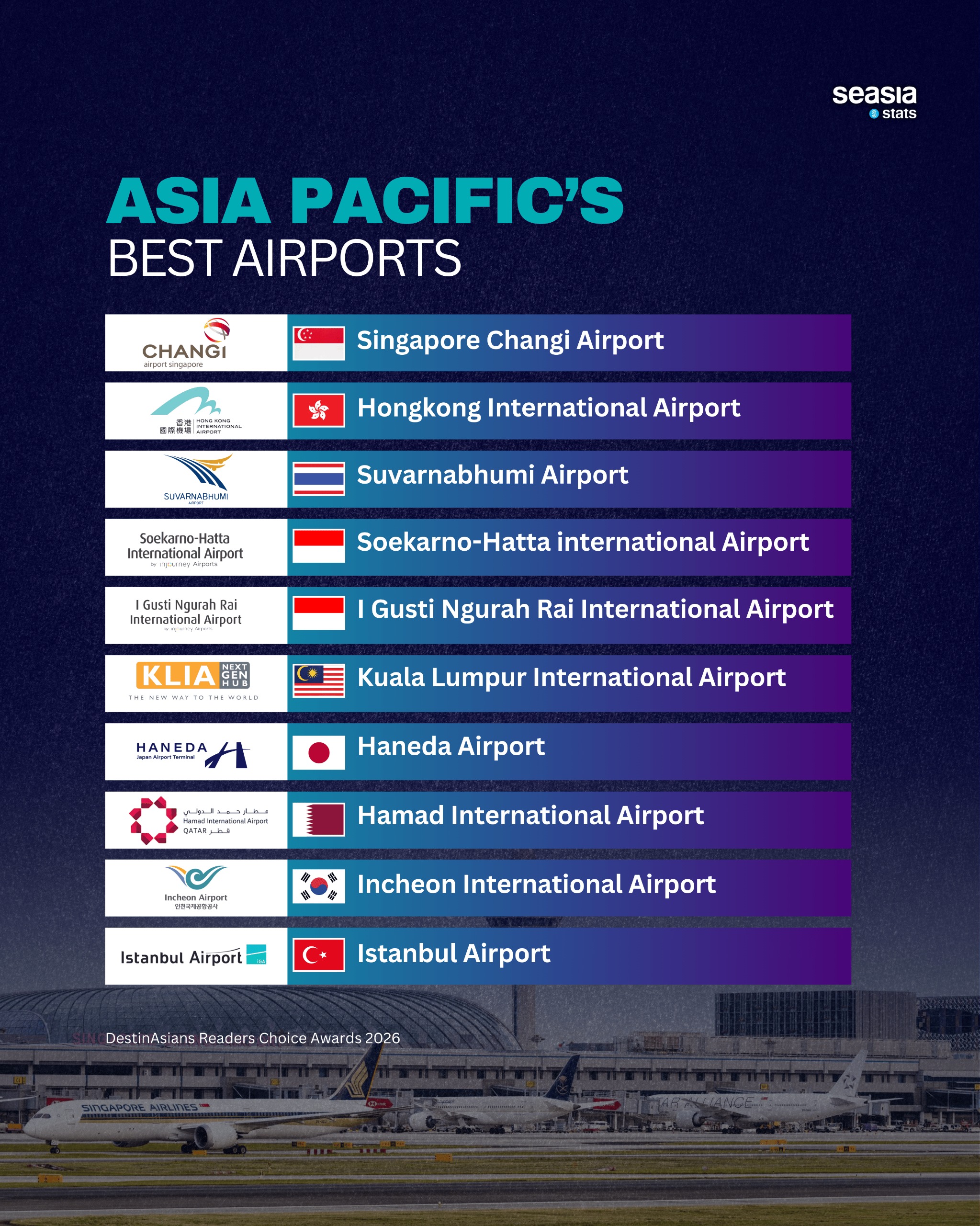
Airports are no longer just transit points. In Asia Pacific, the best ones have become destinations in their own right—places where travelers expect efficiency, comfort, shopping, dining, and increasingly, a sense of national identity. The latest DestinAsian Readers’ Choice Awards 2026 reflects that shift clearly, with Southeast Asia putting in a particularly strong performance across the top ranks.
Changi Still Defines the Gold Standard
At number one once again is Singapore Changi Airport, which continues to function as the region’s benchmark for what a modern airport should feel like. Changi’s reputation has never been built on size alone. What keeps it at the top is its consistency: smooth transfers, strong airline connectivity, thoughtful passenger design, and the rare ability to make long layovers feel almost enjoyable.
That combination has made Singapore’s main gateway more than just an airport—it is part of the country’s global brand. In many ways, Changi captures what Singapore wants to project: efficiency, cleanliness, order, and polish. Its first-place finish in the 2026 ranking suggests that, for many travelers, no other airport in Asia Pacific has quite managed to surpass that formula yet.
Southeast Asia’s Strong Showing Is No Accident
What stands out most in this year’s list is not just Changi’s dominance, but the wider regional story. Suvarnabhumi Airport comes in third, Soekarno–Hatta International Airport ranks fourth, I Gusti Ngurah Rai International Airport takes fifth, and Kuala Lumpur International Airport lands in sixth. That means Southeast Asia occupies fully half of the top ten.
This is not just about airport architecture or duty-free shopping. It reflects a deeper regional reality: Southeast Asia has become one of the world’s most competitive aviation zones. Tourism growth, budget airline expansion, rising middle-class travel, and aggressive hub ambitions have pushed governments and airport operators to treat aviation infrastructure as strategic national infrastructure, not just transport utility.
Indonesia’s Double Presence Signals a Shift
Indonesia’s appearance twice in the top five is especially notable. Soekarno–Hatta is the sprawling gateway to one of Asia’s largest urban and economic centers, while Ngurah Rai in Bali functions as a tourism front door for one of the world’s most recognizable island destinations. Together, they show the two faces of Indonesian aviation: business and leisure, capital city and paradise island.
Their strong ranking also hints at how much Indonesia’s airport image has changed. For years, the country’s aviation reputation was often framed around congestion and strain. Today, the conversation is increasingly about upgrades, passenger experience, and international competitiveness. That is a meaningful shift for a country whose tourism and mobility ambitions continue to grow.
Malaysia and Thailand Are Playing the Long Game
For KLIA, sixth place is part of a bigger story. Malaysian aviation officials have openly discussed the airport’s ambition to become a stronger long-haul transit alternative between Asia Pacific and Europe. As one Malaysian aviation official recently put it, “KLIA has the fundamentals to position itself as a viable long-term alternative” for certain intercontinental transit flows. Recent passenger growth and route expansion suggest that this is not just rhetoric.
Thailand’s Suvarnabhumi, meanwhile, remains one of the region’s most important tourism gateways. Its high ranking reflects Bangkok’s enduring place as one of Asia’s most visited cities, but also Thailand’s ability to combine large-scale volume with a reasonably strong passenger experience. That balance matters in a region where airports are increasingly expected to handle both mass tourism and premium international travel.
More Than Airports, These Are National Statements
The rest of the top ten—Hong Kong International Airport, Haneda Airport, Hamad International Airport, Incheon International Airport, and Istanbul Airport—shows that Asia Pacific airport competition is fierce and deeply symbolic.
Because in 2026, airports are no longer judged only by runways and gates. They are judged by how well they represent the country outside the glass walls. And right now, Southeast Asia is doing that exceptionally well.