

Asia-Pacific’s Tourism Readiness in 2026
In Asia-Pacific, Japan is the most tourism-ready country for 2026.

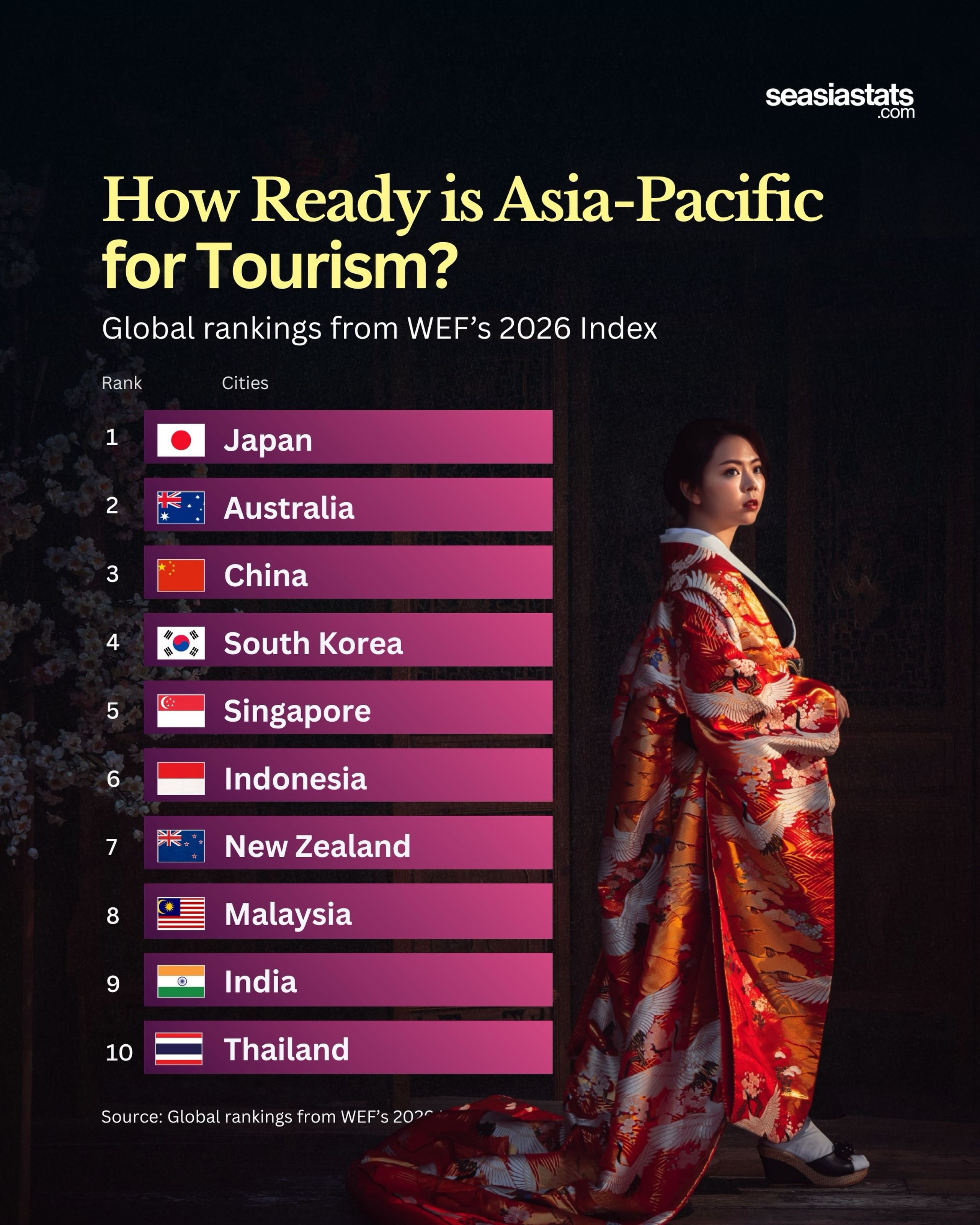
Asia-Pacific is emerging as one of the world’s strongest regions for travel and tourism development, according to the World Economic Forum’s Travel & Tourism Development Index (TTDI) 2026.
The index assesses the conditions that enable sustainable and resilient tourism rather than simply measuring visitor arrivals or tourism revenue. In 2026, Asia-Pacific recorded the strongest regional improvement, with its average TTDI score rising 3.6% between 2024 and 2026.
At the forefront is Japan, which ranked No. 1 globally, making it the world’s most tourism-ready economy in the 2026 index. Japan’s strong infrastructure, connectivity, cultural attractions and overall enabling environment have helped it lead the global ranking.
Australia also performed exceptionally well, ranking fourth worldwide, while China secured eighth place. Together, these three countries demonstrate the strength of Asia-Pacific’s established tourism markets.
South Korea and Singapore are also among the region’s highly prepared destinations. Their advanced transport networks, digital infrastructure, safety standards and strong business environments provide important foundations for international tourism. Singapore, in particular, benefits from its position as a major global aviation and business hub.
Meanwhile, Indonesia, New Zealand, Malaysia, India and Thailand represent different stages of tourism development but demonstrate significant potential. Indonesia has made particularly notable progress in recent years, while Malaysia and Thailand were among the fastest-improving economies between 2024 and 2026.
The WEF highlights Malaysia as one of the region’s strongest recent performers, with its TTDI score increasing 5.8%. Thailand also recorded a substantial 5.6% improvement.
The region’s progress has been supported by improvements in cultural resources, air transport infrastructure and non-leisure resources, reflecting stronger connectivity and growing visitor and business capacity. Emerging economies such as Indonesia, India, Malaysia and Thailand also benefit from competitive prices, rich cultural heritage and natural attractions.
However, the WEF emphasizes that tourism readiness is not simply about attracting more visitors. Developing economies still face gaps in tourism services, infrastructure, workforce capabilities, business conditions and environmental sustainability. Rising travel costs are another challenge, with price competitiveness declining in many economies worldwide.
Overall, Japan, Australia, China, South Korea, Singapore, Indonesia, New Zealand, Malaysia, India and Thailand illustrate the diverse strengths of Asia-Pacific tourism. As the region continues improving connectivity and infrastructure while addressing sustainability and workforce challenges, it is well positioned to remain a major driver of global tourism growth.