

Asian Countries Where Wealth Is Most Concentrated Among the Top 1%
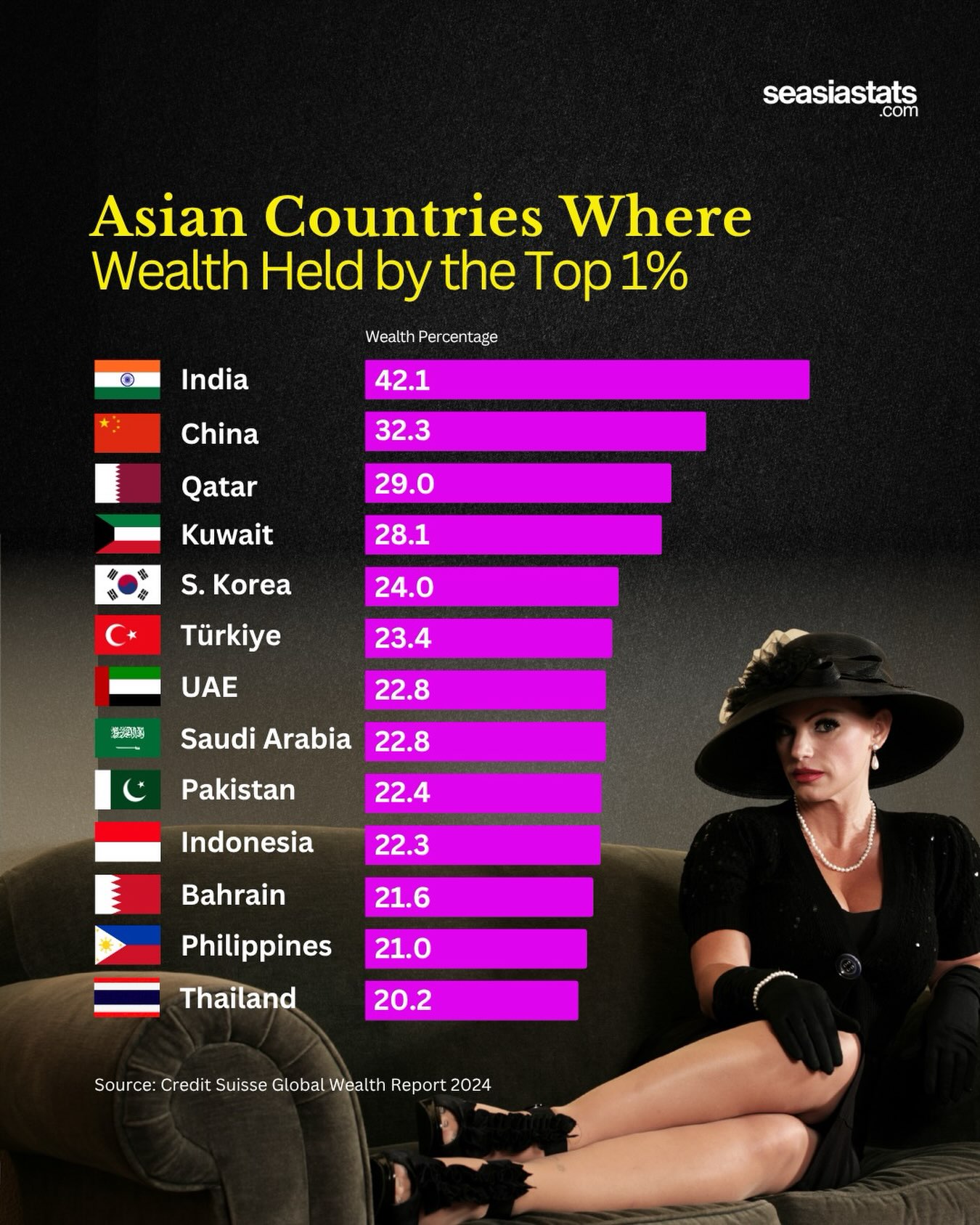
India has the highest wealth inequality in Asia where the top 1% controlling 42.1% of the country's wealth.

Wealth inequality remains a major economic issue across Asia, with a significant share of national wealth concentrated among a small proportion of the population.
Data attributed to the Credit Suisse Global Wealth Report 2024 show substantial differences in how wealth is distributed across Asian countries, with the richest 1% holding sizeable portions of total national wealth.
India records the highest share among the Asian countries listed, with the top 1% controlling 42.1% of the country's wealth. The figure highlights the substantial concentration of assets among India's wealthiest households. China follows with 32.3%, meaning nearly one-third of the country's wealth is held by its richest 1%.
The Gulf states also feature prominently. Qatar ranks next at 29.0%, followed by Kuwait at 28.1%. Both countries have relatively high levels of wealth concentrated among their wealthiest residents. South Korea records 24.0%, while Türkiye stands at 23.4%.
The United Arab Emirates and Saudi Arabia each register 22.8%, placing them alongside other countries where a substantial portion of wealth is held by a small group of individuals. Pakistan follows at 22.4%, while Indonesia records 22.3%. These figures indicate that more than one-fifth of total wealth in each country is concentrated among the richest 1%.
Other Asian economies also show notable levels of concentration. Bahrain records 21.6%, while the Philippines stands at 21.0%. Thailand completes the list at 20.2%.
Together, these figures demonstrate that high wealth concentration is present across a diverse range of Asian economies, from large emerging markets to smaller Gulf states and highly developed economies.
It is important to distinguish wealth concentration from income inequality. Wealth refers to the value of assets such as property and financial holdings after debts are deducted, whereas income measures money received over a period. The Global Wealth Report focuses on household wealth and examines its distribution across populations.
The figures also provide a snapshot rather than a complete picture of economic well-being. Countries can have very different levels of average wealth, economic structures, population sizes, and social policies while recording similar concentrations among their wealthiest citizens.
Overall, the data underline the uneven distribution of wealth across Asia. From India's 42.1% to Thailand's 20.2%, the figures show that the wealthiest 1% account for a significant share of national wealth in each of these countries.
The findings highlight the continuing importance of examining not only economic growth, but also how the benefits and assets generated by that growth are distributed throughout society.