

Asian Countries with the Most Coffee Shops
Indonesia has the most coffee shops in Asia and the world.

Coffee culture has grown rapidly across Asia over the past two decades, transforming cafés into popular destinations for social gatherings, business meetings, and remote work.
While coffee has long been part of daily life in some countries, the expansion of modern coffee shops has created vibrant café industries throughout the region. Several Asian countries now rank among those with the largest numbers of coffee shops.
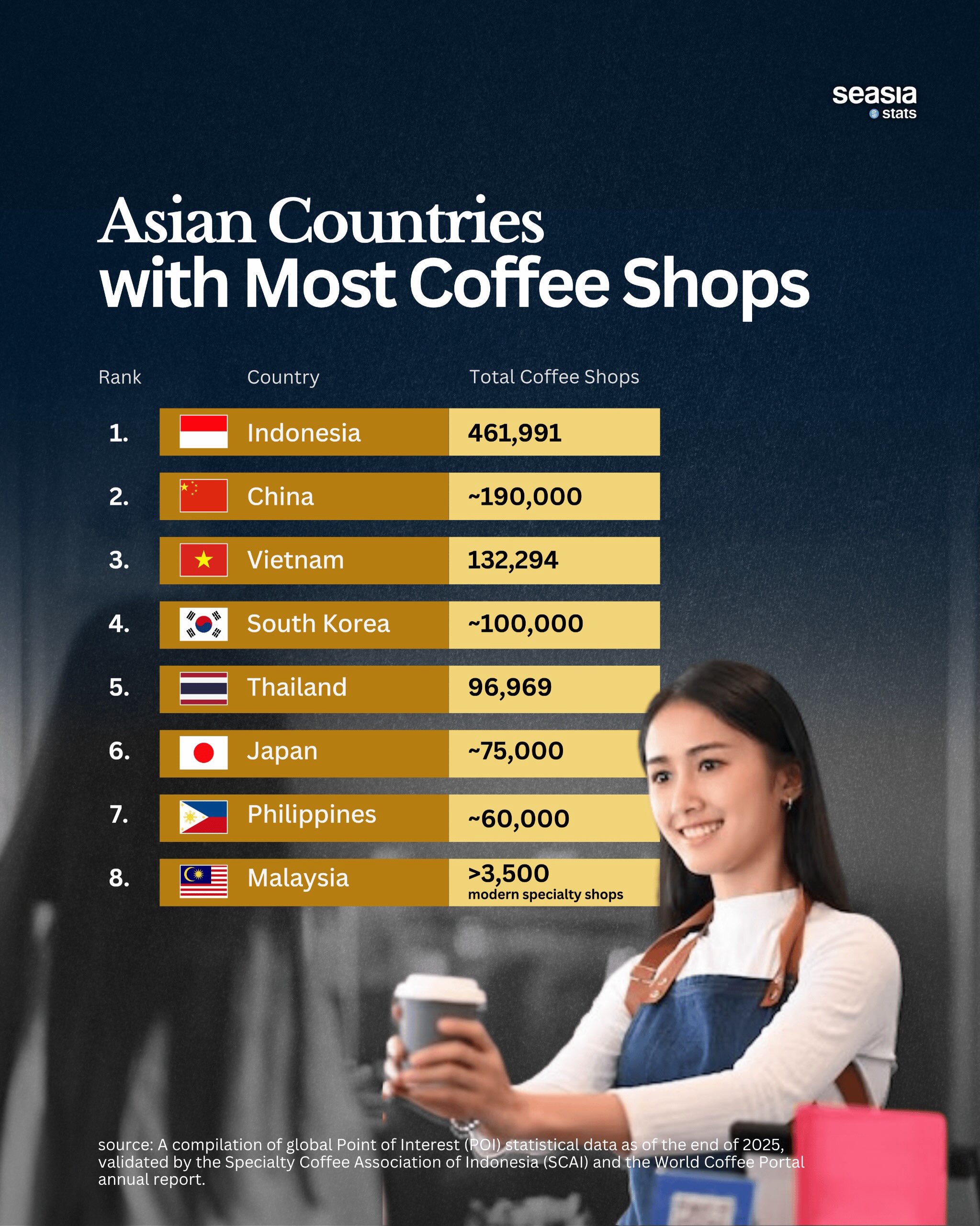
Indonesia leads Asia with approximately 461,991 coffee shops, making it the country with the largest café industry in the region.
As one of the world's leading coffee producers, Indonesia has a rich coffee heritage that includes famous varieties such as Gayo, Toraja, Mandailing, and Java coffee. The rapid growth of independent cafés and specialty coffee businesses has further strengthened the country's coffee culture.
China ranks second with around 190,000 coffee shops. Although tea has traditionally been China's preferred beverage, coffee consumption has increased dramatically in recent years, particularly in major cities such as Shanghai, Beijing, Guangzhou, and Shenzhen. The expansion of both international and domestic coffee chains has contributed to this remarkable growth.
Vietnam follows with 132,294 coffee shops. As the world's second-largest coffee producer, Vietnam has developed a distinctive coffee culture known for beverages such as Vietnamese iced coffee and egg coffee. Coffee shops are an essential part of everyday life and can be found throughout both urban and rural areas.
South Korea has around 100,000 coffee shops, reflecting one of the most vibrant café cultures in Asia. Cafés serve not only as places to enjoy coffee but also as social spaces for studying, working, and relaxing.
Thailand ranks next with 96,969 coffee shops, supported by a growing middle class, domestic coffee production, and increasing demand for specialty coffee.
Japan has around 75,000 coffee shops, combining traditional kissaten cafés with modern specialty coffee chains. Coffee has become an important part of daily life for many Japanese consumers.
The Philippines follows with around 60,000 coffee shops, where both local cafés and international brands continue to expand alongside a growing appreciation for locally produced coffee beans.
Malaysia completes the list with more than 3,500 coffee shops. The country is well known for its traditional kopitiams, which serve local coffee alongside popular Malaysian dishes, as well as an increasing number of contemporary cafés in major cities.
Overall, Asia's café industry reflects changing consumer lifestyles, rising disposable incomes, and a growing appreciation for high-quality coffee.
From Indonesia's vast network of coffee shops to Malaysia's unique kopitiam tradition, the region continues to embrace coffee as both a beverage and a social experience, making café culture an increasingly important part of everyday life across Asia.