

Asian Currencies and their Meanings
The names of various Asian currencies offer fascinating linguistic insights into the region’s historical economic practices. A dominant pattern exists across

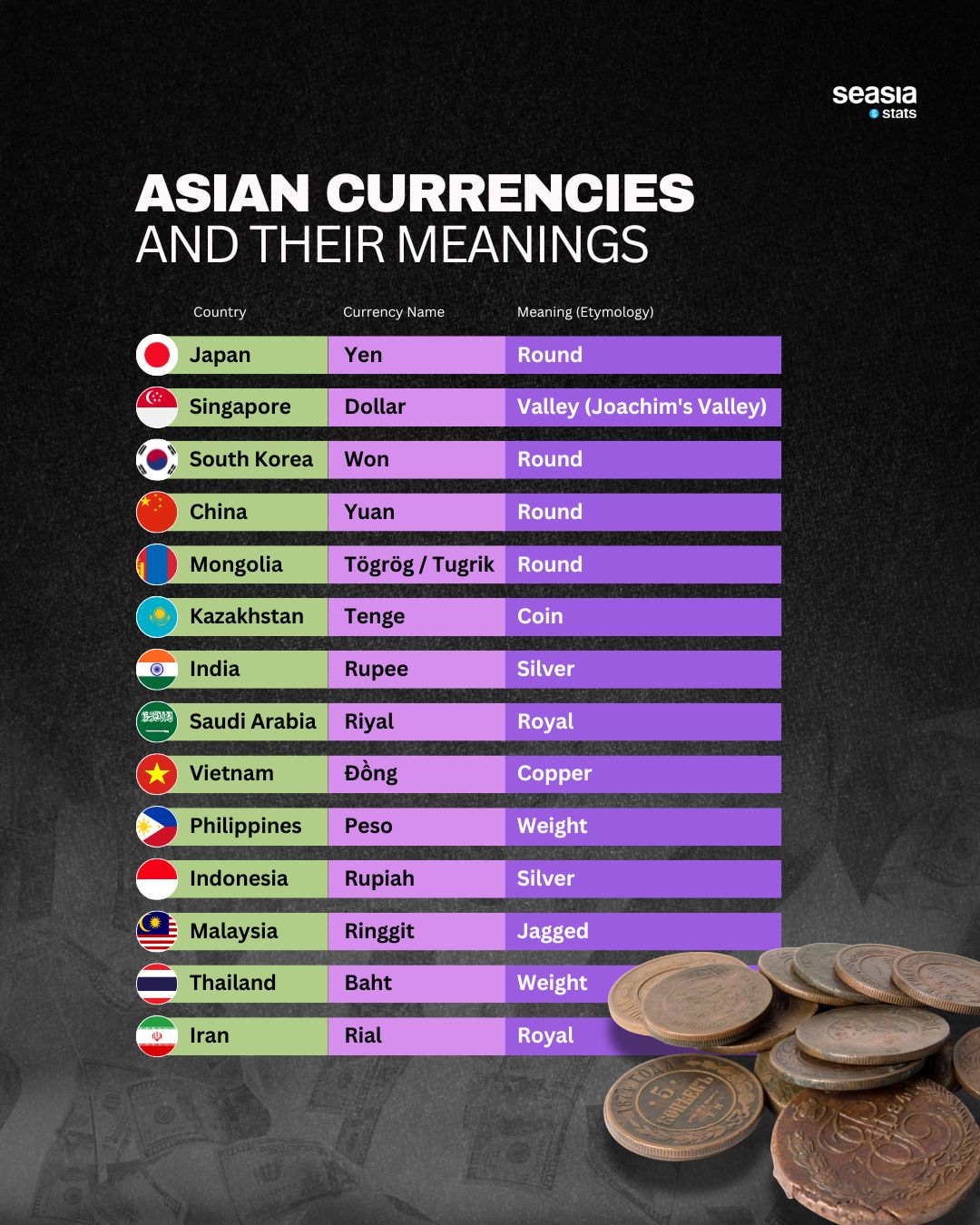
The names of various Asian currencies offer fascinating linguistic insights into the region’s historical economic practices. A dominant pattern exists across East Asia, where several major currencies share the simple etymological meaning of “Round,” likely referring to the shape of traditional coins. This shared identity is evident in Japan’s Yen, China’s Yuan, South Korea’s Won, and Mongolia’s Tögrög.
Beyond mere shape, many other currency titles are rooted in the tangible value of precious metals or specific measurements. India’s Rupee and Indonesia’s Rupiah both translate to “Silver,” reflecting the materials previously used for minting, while Vietnam’s Đồng means “Copper.” Furthermore, the concept of measurement is central to the Philippines’ Peso and Thailand’s Baht, as both names literally mean “Weight.”
Several other Asian currencies possess unique or regal etymological origins that distinguish them from their neighbors. Malaysia’s Ringgit translates to “Jagged,” referring to the edges of historical Spanish coins, whereas Singapore’s Dollar surprisingly traces its roots to a “Valley.” Finally, the concept of sovereignty is highlighted in the Middle East, where both Saudi Arabia’s Riyal and Iran’s Rial share the meaning of “Royal.”