

Asian More Optimistic Than Most for Countries' Future
Across Asia, optimism is not just a sentiment—it is becoming a defining feature of how societies see their future.

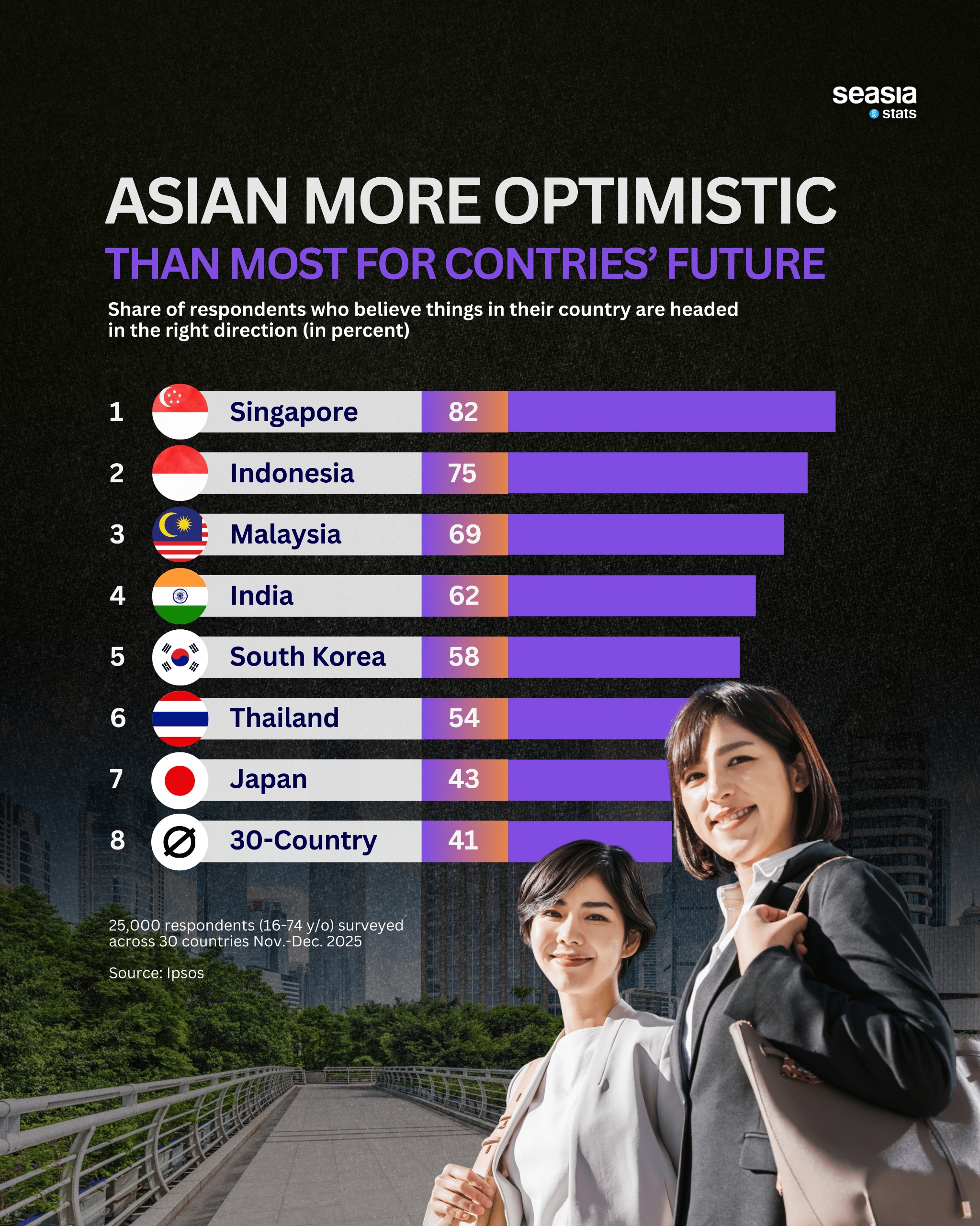
Across Asia, optimism is not just a sentiment—it is becoming a defining feature of how societies see their future. From bustling Southeast Asian cities to rapidly transforming economies, a growing number of people believe their countries are moving in the right direction. The latest Ipsos data, compiled by Seasia Stats, paints a picture of a region where confidence often outpaces global averages.
Southeast Asia Leads with Confidence
At the top of the list is Singapore, where an impressive 82% of respondents say their country is headed in the right direction. It is a figure that reflects not only economic strength, but also trust in governance, infrastructure, and long-term planning. In a highly competitive global environment, Singapore’s ability to maintain both stability and growth continues to reinforce public confidence.
Close behind is Indonesia at 75%, a number that speaks volumes about the country’s current trajectory. As Southeast Asia’s largest economy and population center, Indonesia has undergone significant transformation in recent years—from infrastructure expansion to digital economy growth. Public optimism here often mirrors a broader belief that opportunity is expanding, particularly among younger demographics.
Malaysia, with 69%, rounds out the regional top three. Its position highlights a steady sense of national confidence, supported by a diversified economy and a growing role in regional trade and manufacturing. Together, these three countries illustrate a clear trend: Southeast Asia is one of the most optimistic subregions in the world.
Ipsos itself has observed that “emerging markets tend to be more optimistic about the future than developed ones,” a pattern that is clearly visible across ASEAN.
A Region Riding Momentum
Beyond the top three, optimism remains strong across Asia. Thailand registers 54%, comfortably above the global average of 41%, while India and South Korea stand at 62% and 58% respectively. These numbers reflect different kinds of national narratives—India’s rapid economic ascent, South Korea’s technological leadership, and Thailand’s steady recovery and tourism-driven economy.
What is particularly striking is how Southeast Asia consistently performs above the global benchmark. Even countries that are still developing or navigating structural challenges tend to report relatively high levels of optimism compared to Western counterparts.
This aligns with broader economic trends. According to regional studies by institutions like the Asian Development Bank, Southeast Asia has been one of the fastest-growing regions globally, with expanding middle classes and rising digital connectivity fueling a sense of forward momentum.
Why Southeast Asians Feel Hopeful
The reasons behind this optimism are layered. Economic growth is a major factor, but it is not the only one. Across countries like Indonesia, Vietnam, and the Philippines, there is a strong sense that the future will be better than the past—a powerful psychological driver.
Urbanization plays a role as well. As more people move into cities and gain access to better jobs, education, and services, expectations naturally rise. The rapid adoption of technology—from e-commerce to digital banking—also reinforces the feeling that progress is tangible and immediate.
In many ASEAN countries, demographics add another dimension. Younger populations tend to be more hopeful, more adaptable, and more willing to embrace change. This demographic advantage helps sustain a forward-looking mindset across the region.
A Contrast with Mature Economies
The contrast becomes clearer when looking at Japan, which records 43%, only slightly above the global average. Despite its economic strength and global influence, Japan faces structural challenges such as an aging population and slower growth, which may temper public sentiment.
This gap highlights an important global dynamic: optimism today is less about wealth alone and more about perceived trajectory. Countries that are growing, evolving, and expanding opportunities often feel more hopeful than those that are stable but stagnant.
The Outlook Ahead
Southeast Asia’s optimism is not just a statistic—it is a signal. It reflects how people interpret change, opportunity, and national direction. As economies continue to integrate, digital ecosystems expand, and regional cooperation deepens, this sense of confidence may become one of ASEAN’s most valuable assets.
In a world often marked by uncertainty, Southeast Asia stands out for something increasingly rare: a widespread belief that tomorrow will be better than today.