

Asian Net Migration, Divided by Region
Most regions in Asia recorded negative net migration, except for Western Asia.

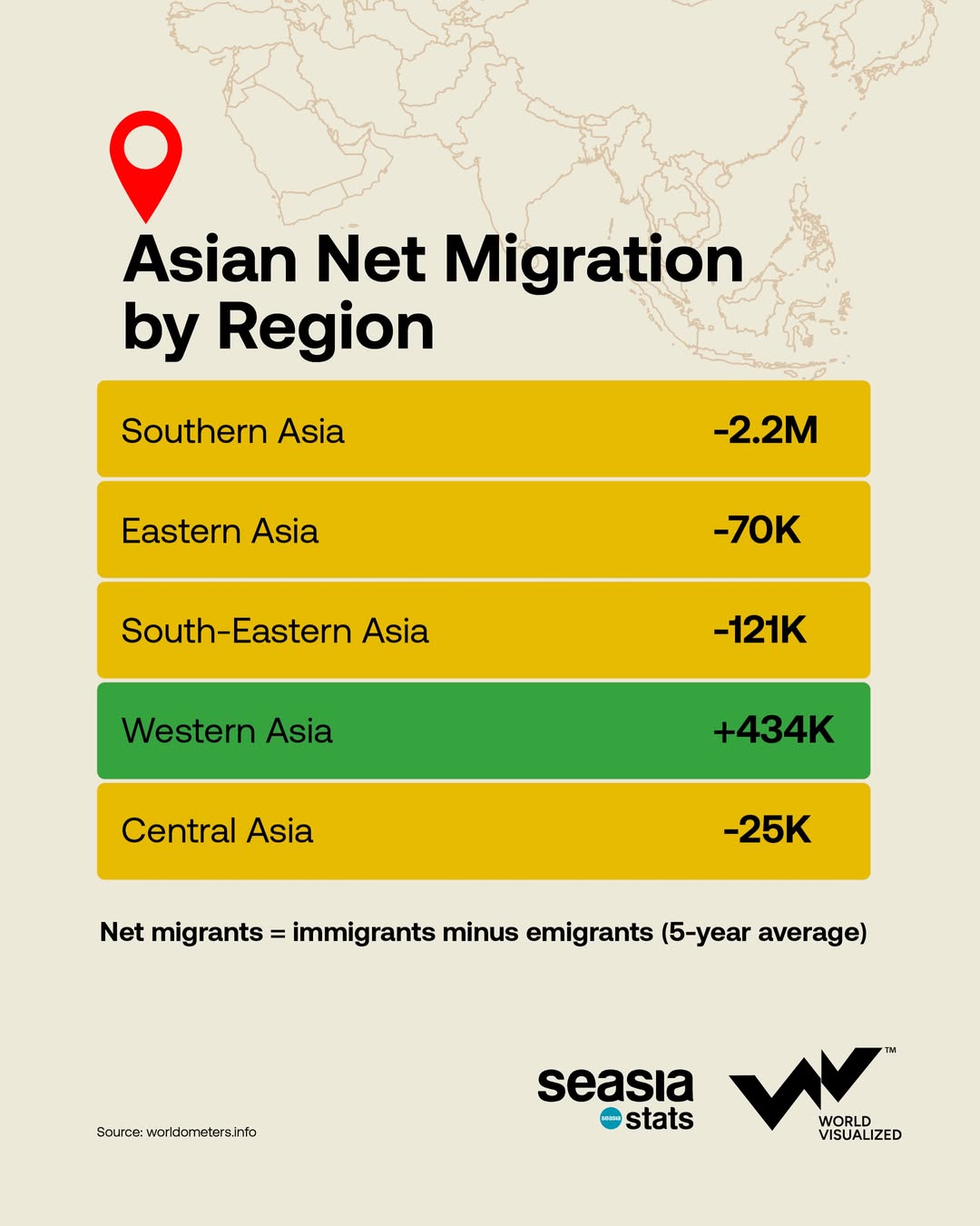
Migration trends across Asia reveal major differences between regions shaped by economic opportunities, political conditions, labor demand, and demographic change. Net migration measures the difference between the number of people entering and leaving a region.
Positive figures indicate more immigrants arriving than emigrants departing, while negative figures show population loss through migration. Recent estimates highlight contrasting migration patterns across Asia’s major subregions.
Southern Asia records the largest net migration loss in the continent, with approximately -2.2 million people. The region, which includes countries such as India, Pakistan, Bangladesh, Nepal, and Sri Lanka, has long experienced large-scale labor migration to the Middle East, Europe, North America, and Southeast Asia.
Economic disparities, employment opportunities abroad, and educational migration continue to drive millions of South Asians overseas each year. Remittances sent home by migrant workers remain a crucial source of income for many households and national economies.
Eastern Asia shows a relatively small net migration decline of around -70 thousand people. This region includes China, Japan, Mongolia, North Korea, South Korea, and Taiwan. Although Eastern Asia is home to some of the world’s largest economies, low birth rates and aging populations are reshaping migration dynamics.
Countries like Japan and South Korea have gradually increased acceptance of foreign workers to address labor shortages, partially offsetting emigration and demographic decline. China, meanwhile, experiences both outward migration and growing numbers of skilled returnees.
South-Eastern Asia experiences a net migration loss of approximately -121 thousand people. Countries such as Indonesia, the Philippines, Vietnam, Myanmar, and Cambodia continue to send large numbers of migrant workers abroad, particularly to wealthier Asian economies and the Gulf states.
However, the region also attracts foreign professionals, investors, and retirees, especially in Singapore, Malaysia, and Thailand. This balance between emigration and immigration creates a relatively moderate regional migration deficit.
In contrast, Western Asia records positive net migration of about +434 thousand people, making it Asia’s strongest migrant-receiving region. Gulf countries such as Saudi Arabia, the United Arab Emirates, Qatar, and Kuwait attract millions of foreign workers from South and Southeast Asia.
High demand for labor in construction, healthcare, technology, and domestic services continues to drive immigration into the region. Despite political instability in some areas, Western Asia remains a major destination for economic migrants.
Central Asia reports a smaller migration loss of roughly -25 thousand people. Countries including Kazakhstan, Uzbekistan, Kyrgyzstan, Tajikistan, and Turkmenistan experience labor migration primarily toward Russia and other neighboring economies. Economic transformation and regional mobility continue to shape migration patterns across the region.
Overall, Asia’s migration landscape reflects deep economic interdependence between regions. While some regions lose population through labor migration, others depend heavily on migrant workers to sustain economic growth and development.