

Asian Presidents without Vice Presidents
The resignation of Gibran Rakabuming Raka makes Indonesia's Prabowo Subianto is currently without a vice president.

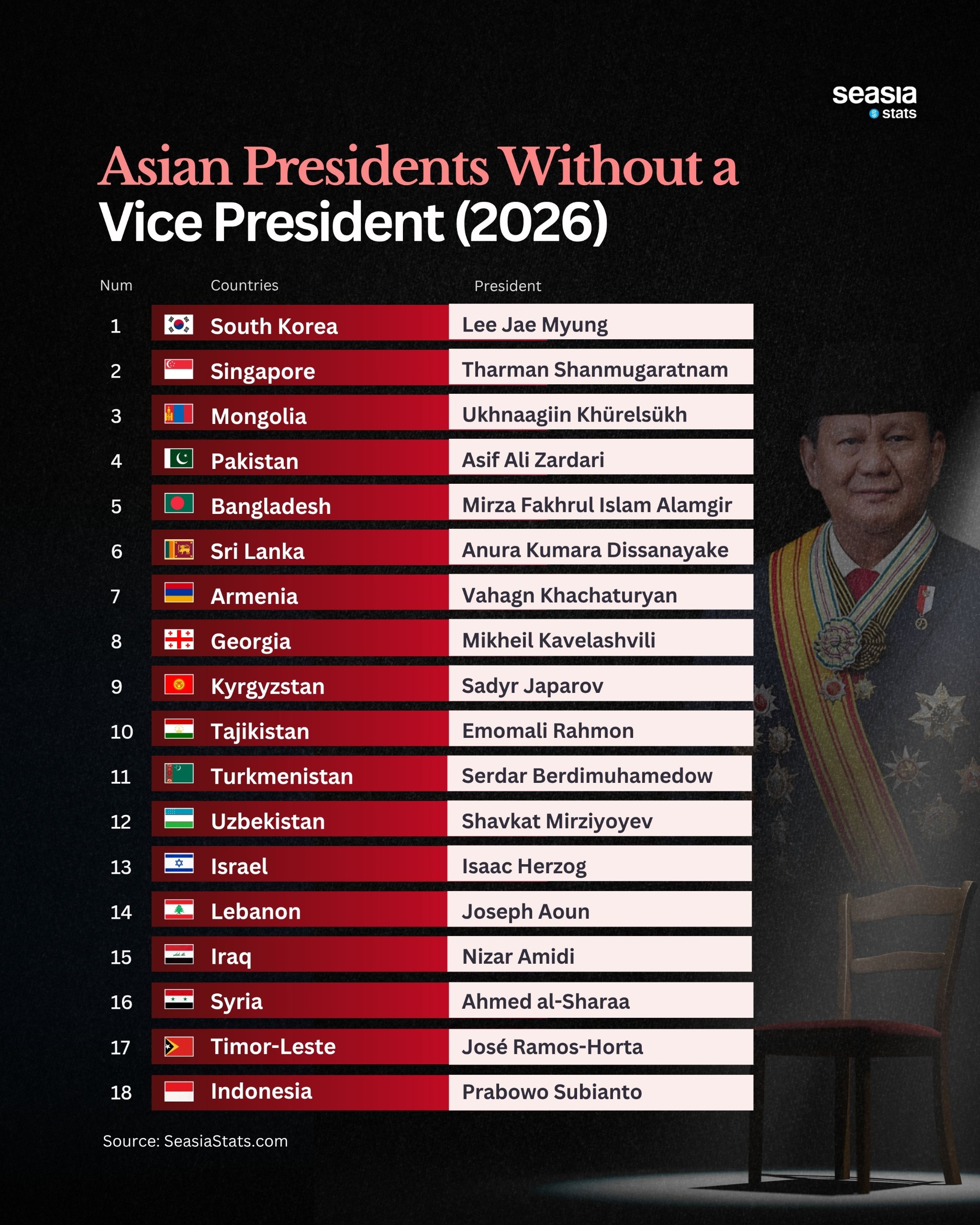
Across Asia, several countries are led by presidents who serve as their nations' heads of state without having a vice president as a constitutional partner. These presidential systems differ in political structure, responsibilities, and levels of executive authority. Some presidents hold substantial governing power, while others perform mainly ceremonial and constitutional duties.
In East Asia, Lee Jae Myung of South Korea, Tharman Shanmugaratnam of Singapore, and Ukhnaagiin Khürelsükh of Mongolia represent three different presidential traditions. Their countries do not have vice-presidential offices.
South Korea's president leads the executive branch, Singapore's president serves primarily as head of state, and Mongolia's president shares executive responsibilities with a prime minister.
In South Asia, Asif Ali Zardari of Pakistan and Mirza Fakhrul Islam Alamgir of Bangladesh occupy presidential positions without vice presidents. Meanwhile, Anura Kumara Dissanayake leads Sri Lanka, where the president also serves as head of government.
In Western Asia, Vahagn Khachaturyan of Armenia and Mikheil Kavelashvili of Georgia serve as presidents without vice-presidential counterparts. Other examples include Isaac Herzog of Israel, Joseph Aoun of Lebanon, Nizar Amidi of Iraq, and Ahmed al-Sharaa of Syria.
Central Asia also has several presidents without vice presidents. They include Sadyr Japarov of Kyrgyzstan, Emomali Rahmon of Tajikistan, Serdar Berdimuhamedow of Turkmenistan, and Shavkat Mirziyoyev of Uzbekistan.
Their governments have different constitutional arrangements, with executive responsibilities distributed among presidents, prime ministers, and other state institutions.
In Southeast Asia, José Ramos-Horta of Timor-Leste is another example of a president serving without a vice president. Indonesia's Prabowo Subianto is a special case: Vice President Gibran Rakabuming Raka resigned on November 12, 2026, leaving the position temporarily vacant while arrangements for a replacement are made.
Overall, these leaders demonstrate the diversity of presidential government across Asia. Although they share the title of president, their powers, political influence, and constitutional responsibilities vary considerably.
The absence of a vice president does not necessarily mean that a president governs alone; prime ministers, cabinets, legislatures, and other institutions continue to play important roles in national leadership.