

Asia's 10 Largest Airports by Land Area
Based on land area, these airports are the largest in Asia.

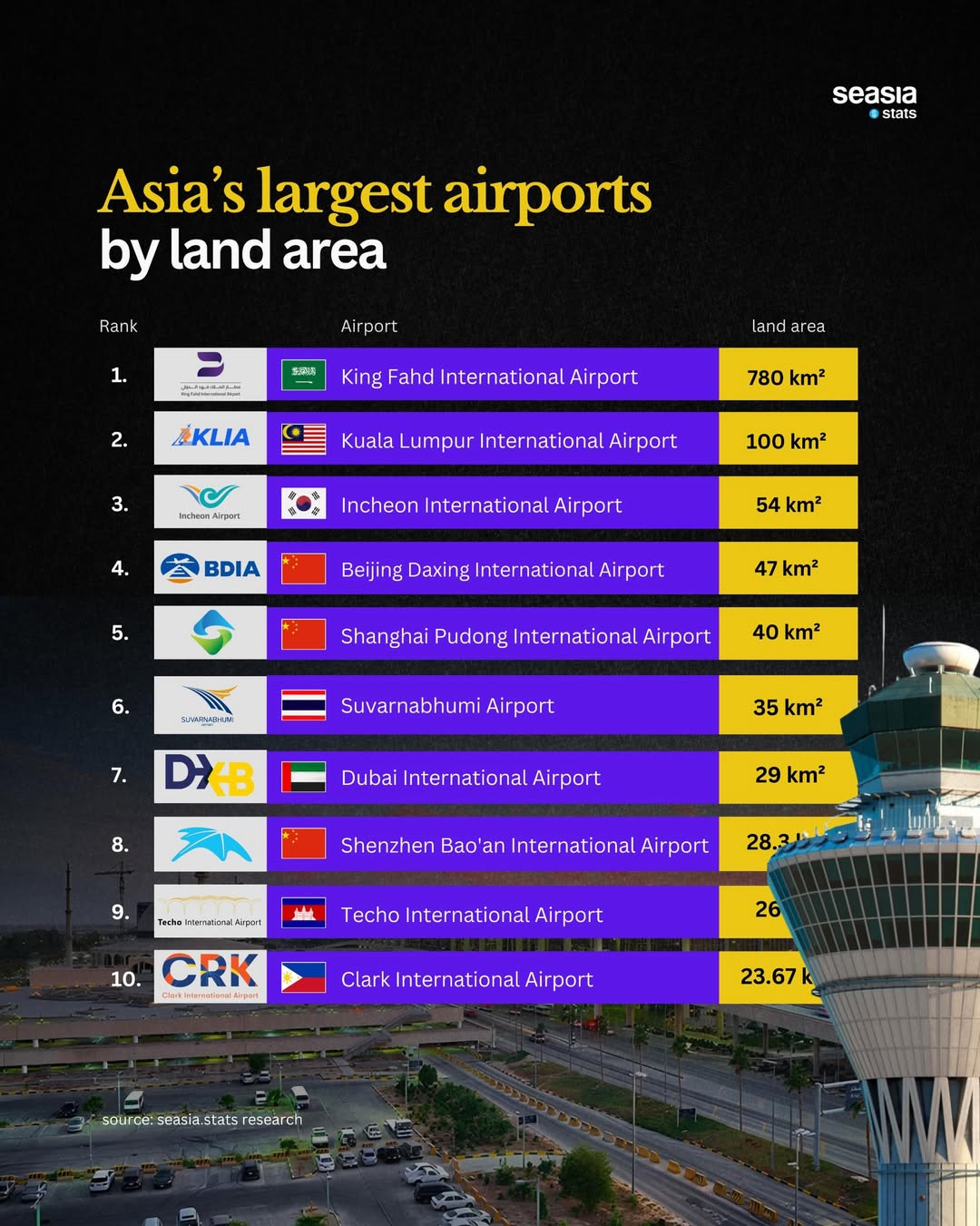
Asia is home to some of the world’s biggest and most advanced airports, many of which occupy enormous land areas to support growing passenger demand, cargo operations, and future expansion. These airports are designed not only as transportation hubs but also as economic centers that stimulate tourism, trade, and regional development.
The largest airport in Asia by land area is King Fahd International Airport, covering an extraordinary 780 square kilometers. Located near Dammam in Saudi Arabia, the airport is also recognized as the largest airport in the world by total land area. Much of its vast territory remains reserved for future development, industrial projects, and aviation infrastructure.
In second place is Kuala Lumpur International Airport with approximately 100 square kilometers. Opened in 1998, KLIA was built with long-term expansion in mind and serves as Malaysia’s primary international gateway. Its spacious design allows room for additional terminals, cargo facilities, and transportation links.
South Korea’s Incheon International Airport occupies around 54 square kilometers. Known for its efficiency and world-class passenger experience, Incheon has become one of East Asia’s leading aviation hubs connecting global travelers to Northeast Asia.
China’s Beijing Daxing International Airport spans about 47 square kilometers. Opened in 2019, the airport quickly became famous for its futuristic starfish-shaped terminal and advanced technology systems designed to handle massive passenger traffic.
Another major Chinese aviation center is Shanghai Pudong International Airport, which covers around 40 square kilometers. Pudong plays a critical role in international trade and is one of Asia’s busiest cargo airports.
Thailand’s Suvarnabhumi Airport ranks next with 35 square kilometers. Since opening in 2006, the airport has served as Thailand’s main international hub and an important gateway for tourism in Southeast Asia.
The Middle East is represented by Dubai International Airport, occupying approximately 29 square kilometers. Despite limited space compared with newer airports, Dubai International remains one of the world’s busiest airports for international passengers.
China’s Shenzhen Bao'an International Airport covers about 28.3 square kilometers and continues expanding alongside the rapid economic growth of southern China.
Newer airports are also emerging in Southeast Asia. Techo International Airport spans 26 square kilometers and is expected to become Cambodia’s primary international gateway. Meanwhile, Clark International Airport covers 23.67 square kilometers and is increasingly important for Philippine aviation development.
Together, these airports highlight Asia’s massive investment in aviation infrastructure to support future economic and transportation growth.