

Asia's 15 Largest Economies, 2025
The economic spotlight continues to shine on Asia, and new projections from the International Monetary Fund (IMF) confirm just how central the region will remai

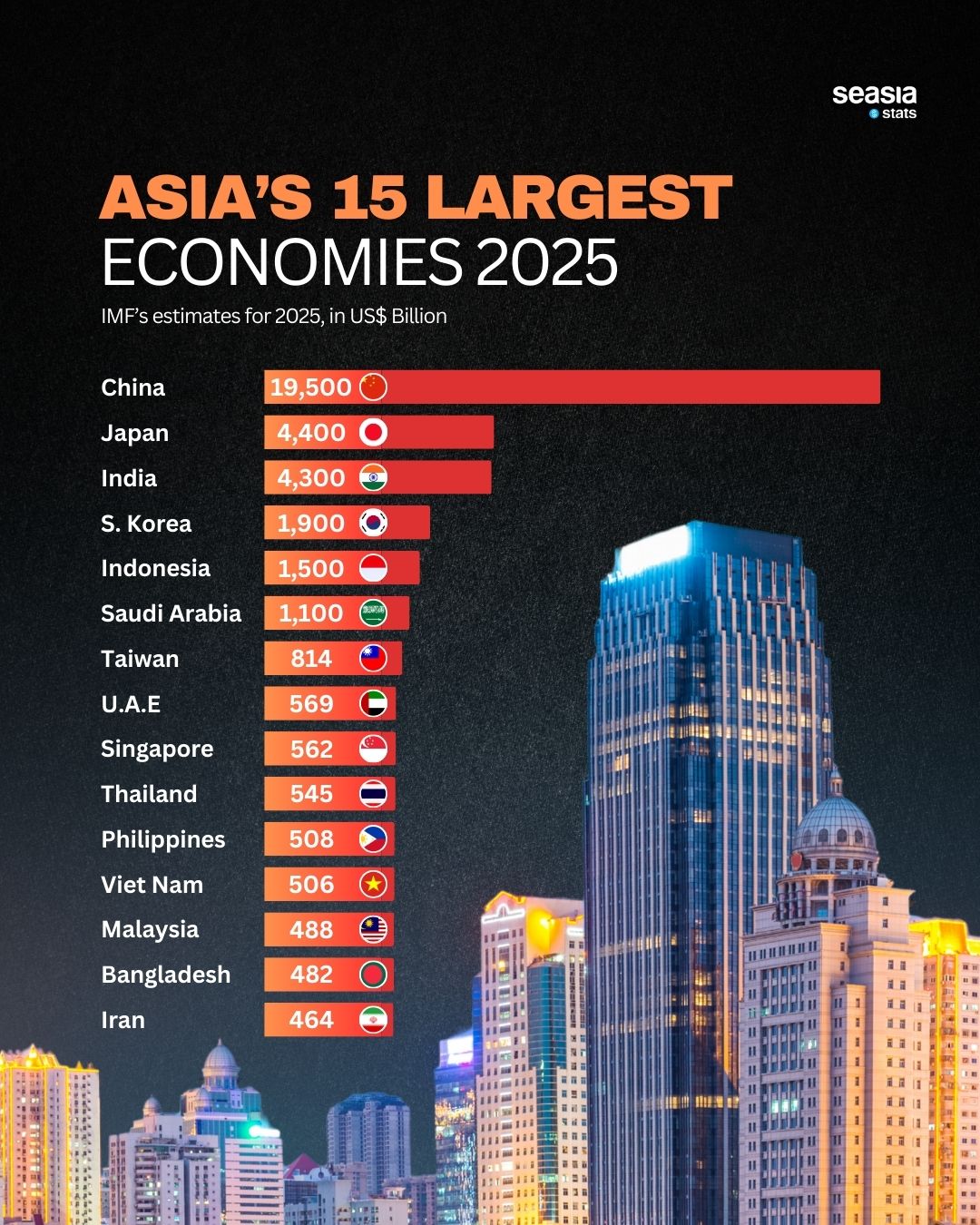
The economic spotlight continues to shine on Asia, and new projections from the International Monetary Fund (IMF) confirm just how central the region will remain in shaping the global financial future. In its latest forecast, the IMF outlines the 15 largest economies in Asia for 2025, based on GDP estimates in US$ billions.
From dominant giants to fast-rising economies, the data reflects a region as diverse as it is dynamic — with several Southeast Asian nations making the list.
China, Japan, and India Dominate the Top Tier
Unsurprisingly, China remains in a league of its own, with a projected GDP of $19,500 billion, reaffirming its role as Asia’s — and the world’s — largest economic engine. The country’s scale, manufacturing strength, and global investment presence keep it well ahead of the pack.
Japan holds second place at $4,400 billion, showcasing enduring economic resilience despite a shrinking population. Meanwhile, India is nipping at its heels with a forecasted GDP of $4,300 billion, signaling the South Asian giant’s expanding influence in global trade, tech, and services.
Southeast Asia on the Rise
Further down the rankings, Southeast Asian countries are gaining serious traction:
-
Indonesia leads the ASEAN pack with $1,500 billion, reflecting its status as a G20 member and the largest economy in the region.
-
Singapore ($562B), Thailand ($545B), Philippines ($508B), Viet Nam ($506B), and Malaysia ($488B) also make the top 15.
-
Even Bangladesh ($482B), often grouped with South Asia, is emerging as a promising growth story due to its strong garment exports and remittance inflows.
These numbers indicate ASEAN’s growing importance in global supply chains and investment flows, especially as companies look to diversify beyond China.
The Gulf and East Asia Maintain Strong Positions
South Korea maintains a strong fourth-place position with a projected GDP of $1,900 billion, thanks to its tech leadership and export-driven economy. Saudi Arabia ($1,100B) continues to capitalize on energy revenues and diversification strategies under its Vision 2030 plan.
Taiwan ($814B), known for semiconductor dominance, remains a tech heavyweight. Meanwhile, U.A.E. ($569B) represents the Arab Gulf’s innovation and business pivot beyond oil.
Iran, rounding out the top 15 at $464 billion, reflects potential economic scale despite geopolitical and sanction-related constraints.
Asia’s Future: Diversified, Decisive, and Defining
From legacy leaders like Japan to fast-accelerating economies like Viet Nam and the Philippines, Asia’s economic future isn’t shaped by a single narrative. Instead, it’s a mosaic of fast-developing markets, technological innovation, resource strength, and strategic policy shifts.
These projections reinforce one truth: Asia will remain a central pillar in the global economy — not just in 2025, but well beyond.