

Asia's Biggest Music Festivals
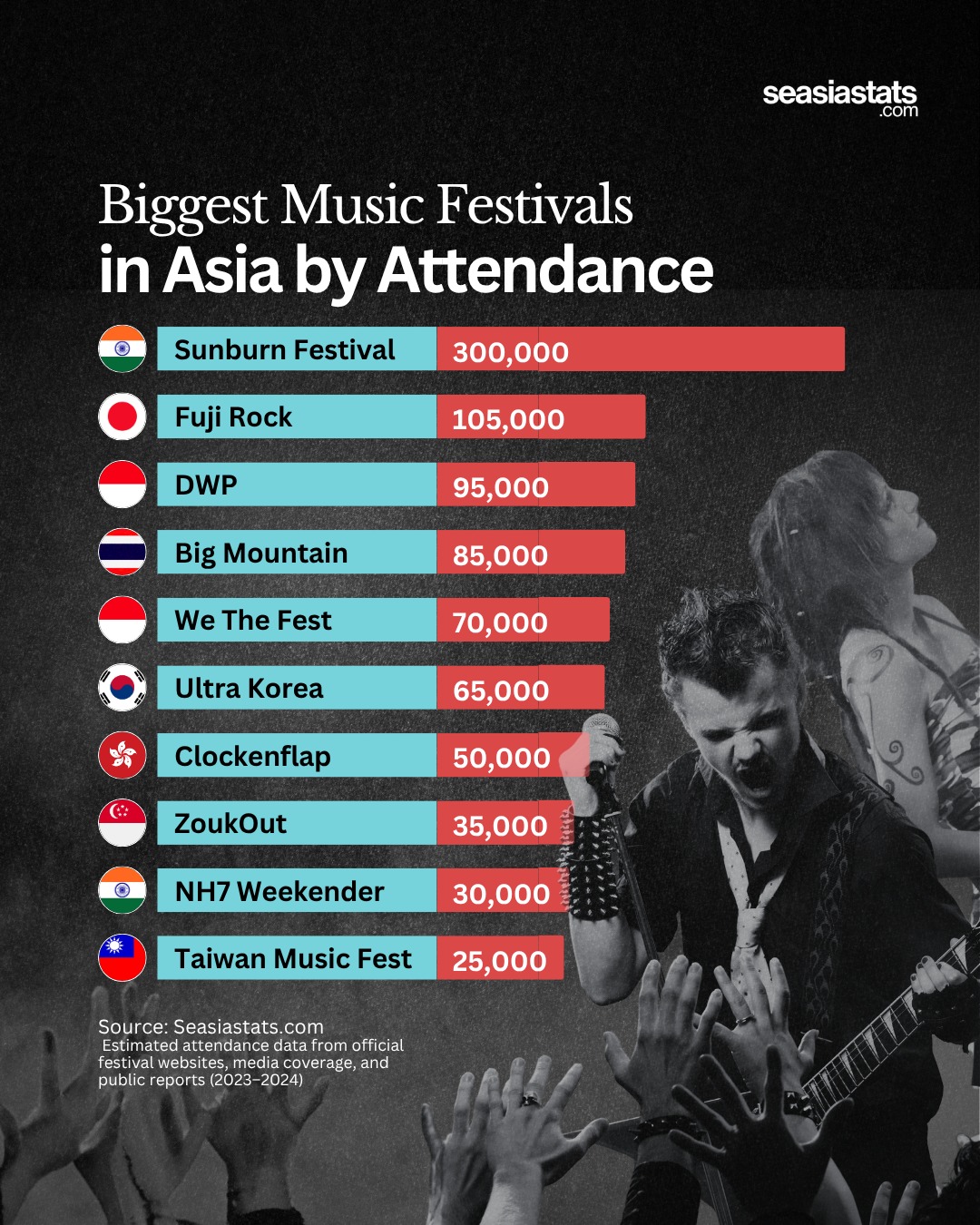
India's Sunburn Festival is by far the largest music festival in Asia by attendance.

Asia has become one of the world's most vibrant destinations for large-scale music festivals, bringing together millions of fans through electronic dance music, rock, pop and alternative sounds.
From massive EDM celebrations in India to internationally recognized festivals in Japan, Indonesia and South Korea, the region offers a remarkable variety of musical experiences. Based on the attendance figures provided for festivals in 2023–2024, Sunburn Festival in India stands at the top with an estimated 300,000 attendees.
Held in India, Sunburn Festival has grown into a major destination for electronic dance music fans, attracting audiences with international DJs, large-scale stages and immersive festival experiences. The festival describes itself as Asia's largest dance music festival, reflecting its enormous scale and international profile.
Japan's Fuji Rock Festival comes next, with the figures in this comparison putting its attendance at around 105,000.
Held at the Naeba Ski Resort in Niigata Prefecture, Fuji Rock is known for combining major international and Japanese artists with a spectacular mountain and forest setting. Its recent attendance has also been substantial, with 122,000 visitors reported for 2025 and 123,500 for 2026, showing the festival's continuing popularity.
Indonesia makes a strong appearance with two festivals. Djakarta Warehouse Project, commonly known as DWP, attracts approximately 95,000 people, while We The Fest draws around 70,000. These events demonstrate Indonesia's growing importance in Asia's live-music and festival scene.
Thailand's Big Mountain Festival follows with about 85,000 attendees, adding another major destination for music fans in Southeast Asia.
South Korea's Ultra Korea attracts approximately 65,000 visitors, continuing the country's connection with the global electronic music scene. Hong Kong's Clockenflap follows with 50,000 attendees and is known for bringing together international and regional artists in a major urban festival environment.
Further down the list, Singapore's ZoukOut attracts around 35,000 people, while India's NH7 Weekender records approximately 30,000. Taiwan Music Fest completes the group with about 25,000 attendees.
Together, these figures illustrate the extraordinary diversity of Asia's festival culture. The biggest events are not concentrated in one country or musical style. Instead, they span EDM, rock, pop and alternative music, while attracting both local audiences and international visitors.
From India's enormous Sunburn crowds to Fuji Rock's mountain setting and Indonesia's energetic electronic festivals, Asia's music scene continues to provide experiences on an impressive scale.