

Asia's Divorce Rates
The Maldives lead the number of divorces in all of Asia.

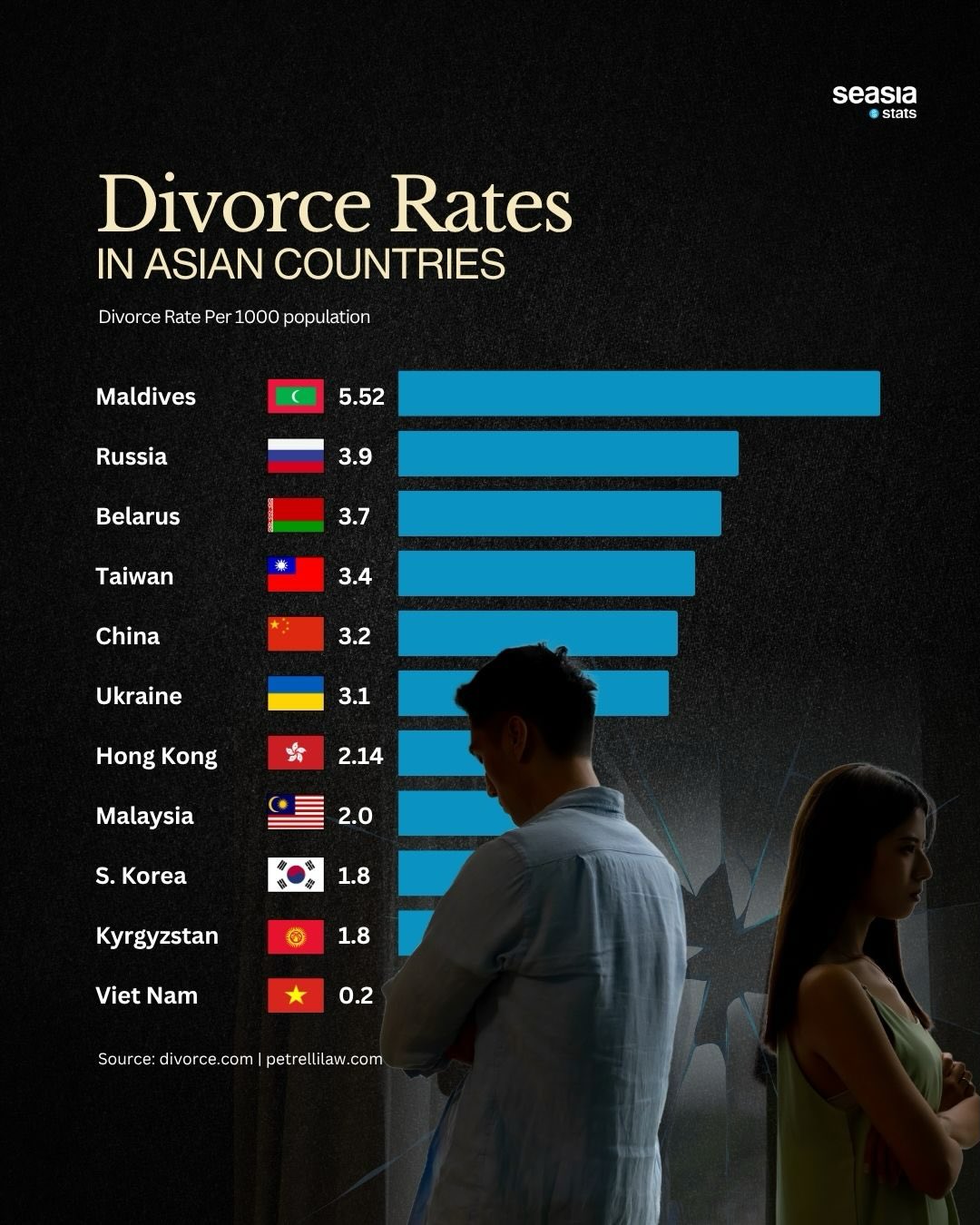
Divorce rates are often used as an indicator of changing social norms, economic conditions, and family dynamics within a society. Across Asia and neighboring Eurasian countries, significant differences can be observed in the number of divorces per 1,000 populations. These variations reflect diverse cultural traditions, legal frameworks, and levels of social development.
Among the countries listed, the Maldives records the highest divorce rate at 5.52 divorces per 1,000 populations. The country has long been known for its relatively high marriage and divorce frequency, influenced by social customs and legal procedures that make divorce more accessible compared to many other nations.
Russia follows with a divorce rate of 3.9, while Belarus records 3.7. Both countries have experienced substantial social and economic transformations since the dissolution of the Soviet Union, which have contributed to changing family structures and marital stability.
Taiwan ranks fourth with a divorce rate of 3.4, closely followed by China at 3.2 and Ukraine at 3.1. Rapid urbanization, increased financial independence, and shifting attitudes toward marriage have been cited as factors influencing divorce trends in these societies.
In China, particularly, economic modernization and migration have altered traditional family relationships.
Hong Kong reports a divorce rate of 2.14 per 1,000 populations, while Malaysia records 2.0. Although both societies maintain strong family-oriented cultural values, changing lifestyles, economic pressures, and evolving expectations within marriage have contributed to rising divorce rates over recent decades.
South Korea and Kyrgyzstan each have a divorce rate of 1.8. In South Korea, increasing individualism and changing gender roles have influenced marriage patterns. Meanwhile, Kyrgyzstan’s divorce rate reflects a combination of traditional family values and modern social changes.
At the opposite end of the spectrum, Vietnam reports a remarkably low divorce rate of just 0.2 per 1,000 populations. Strong family ties, cultural expectations regarding marriage, and social attitudes toward divorce are often cited as reasons for the country's comparatively low figure.
Overall, divorce rates across these countries demonstrate how family institutions evolve in response to economic development, cultural change, and societal modernization. While higher divorce rates may indicate greater personal freedom and legal accessibility, lower rates often reflect stronger social norms supporting marital permanence.
Understanding these differences provides valuable insight into the diverse family landscapes that exist across Asia and neighboring regions.