

Asia's English Proficiency Rankings
Malaysians are the best in English in all of Asia, followed by the Filipinos.

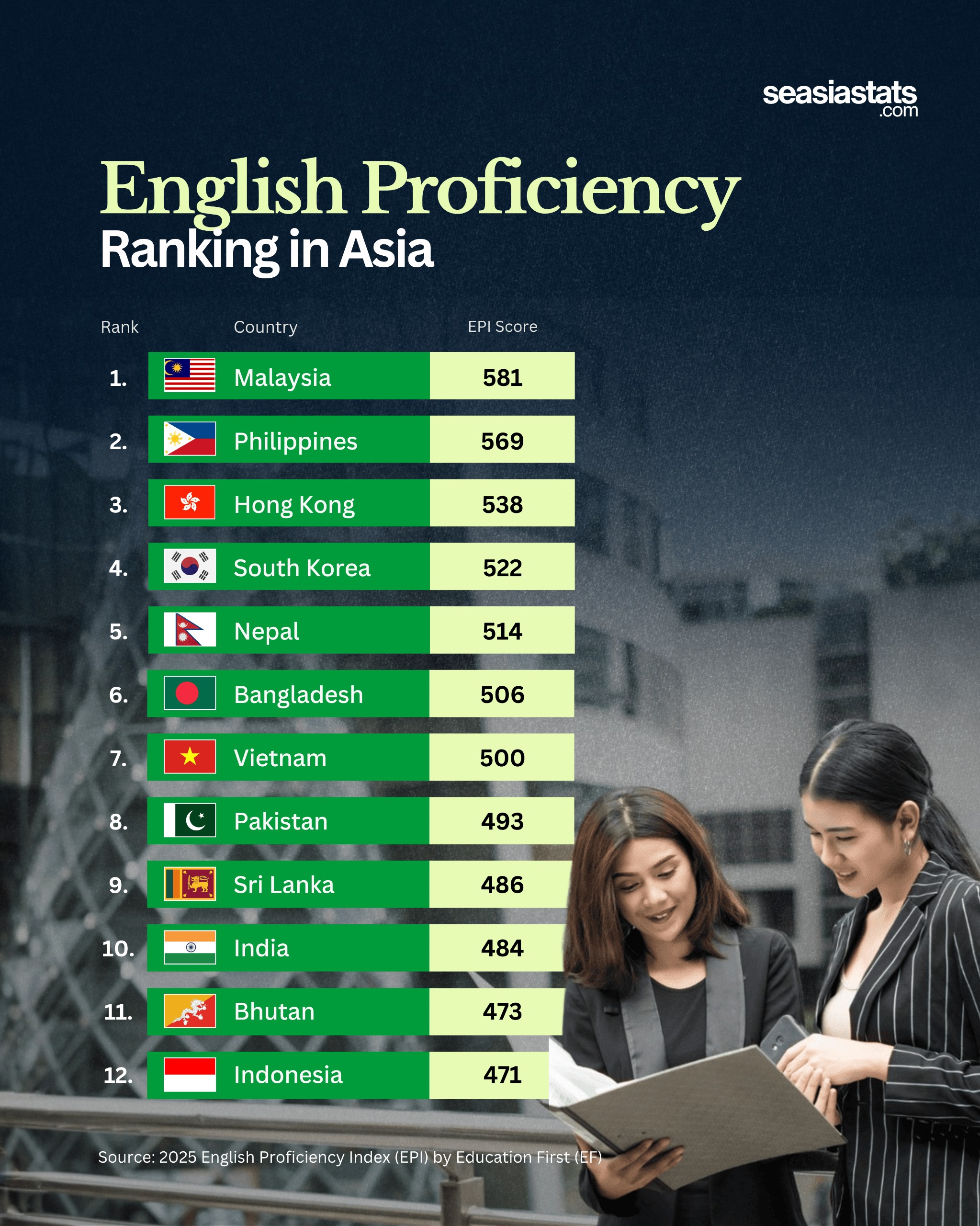
The 2025 English Proficiency Index (EF EPI), published by Education First (EF), highlights the varying levels of English proficiency across Asia. Based on test results from more than 2.2 million adults in 123 countries and regions, the report provides valuable insights into the English skills of non-native speakers worldwide.
Among the Asian economies listed, Malaysia ranked first with a score of 581, demonstrating a high level of English proficiency.
The country was followed by the Philippines, which scored 569, reflecting its long-standing reputation as one of Asia's strongest English-speaking nations. Hong Kong placed third with 538, while South Korea recorded 522, maintaining a solid position among the region's better-performing economies.
The middle tier of the rankings includes Nepal with 514, Bangladesh with 506, and Vietnam with 500. These countries continue to strengthen English education as international communication, higher education, and global business increasingly require strong English skills.
Although their scores are lower than the regional leaders, they remain competitive and show the growing importance of English across South and Southeast Asia.
The remaining countries in the list recorded more moderate scores. Pakistan achieved 493, followed by Sri Lanka with 486, India with 484, Bhutan with 473, and Indonesia with 471. While these scores suggest room for improvement, they also reflect the diverse educational systems, language policies, and levels of English exposure across the region.
Countries continue to invest in English language education to enhance workforce competitiveness and improve access to international opportunities.
Overall, the 2025 EF English Proficiency Index illustrates that Asia remains highly diverse in English language proficiency. Malaysia and the Philippines continue to set the regional benchmark, while several other countries are steadily improving their performance.
As globalization, digital communication, and cross-border collaboration continue to expand, English proficiency remains a valuable skill for economic development, international trade, education, and career advancement.
The EF EPI serves as an important reference for policymakers, educators, and businesses seeking to understand language trends and identify areas where further investment in English education can help prepare citizens for an increasingly interconnected world.