

Asia's Largest Economies by Purchasing Power Parity (PPP) in 2026
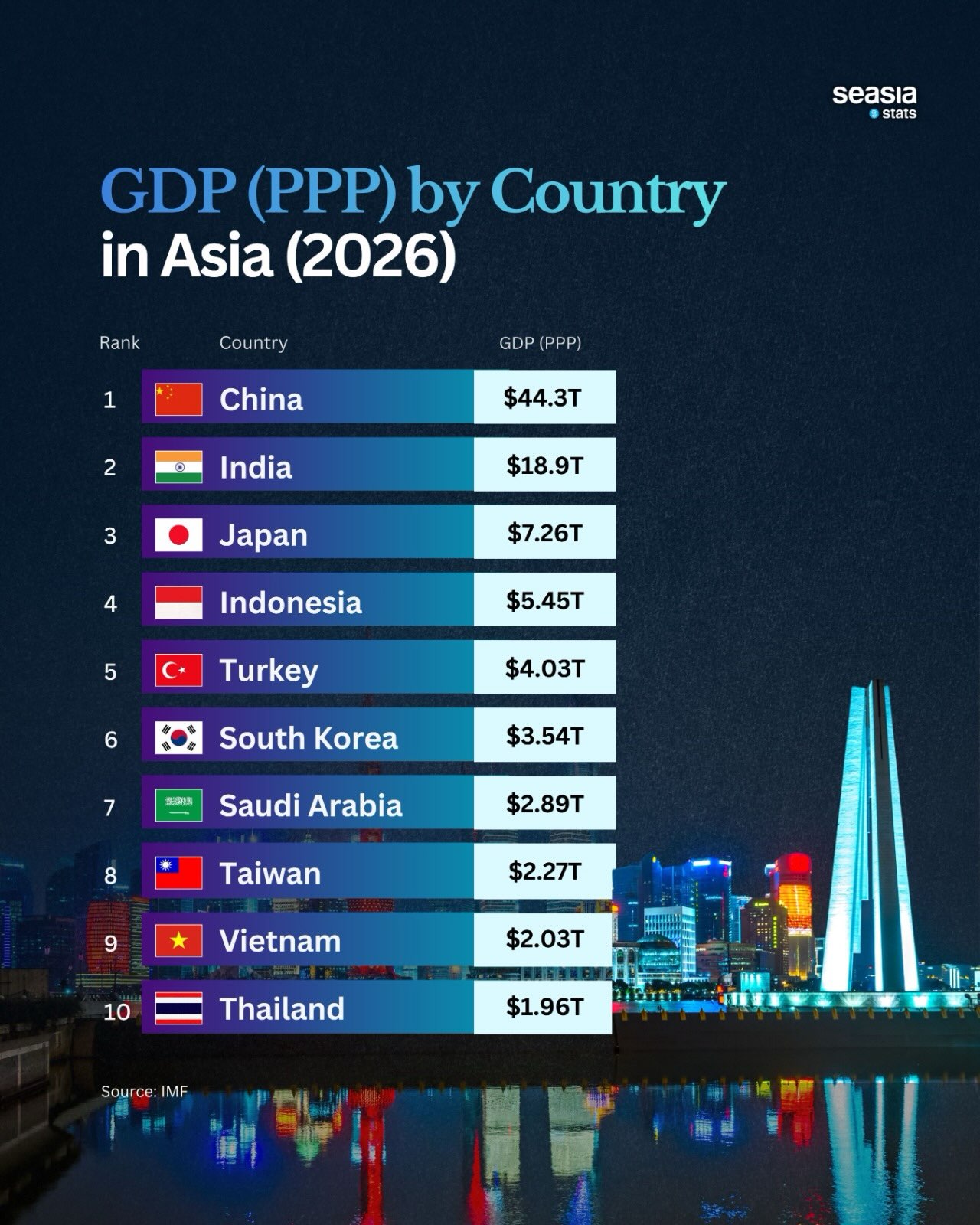
China's GDP (PPP) is still unmatched with $44.3 trillion, which is the largest in Asia and the world.

Asia remains the world's economic powerhouse, home to some of the largest and fastest-growing economies on the planet.
According to the International Monetary Fund (IMF), the region dominates global rankings when measured by Gross Domestic Product (GDP) based on Purchasing Power Parity (PPP), a metric that compares the value of goods and services across countries by accounting for differences in living costs and price levels.
The IMF's 2026 estimates highlight the remarkable scale and diversity of Asia's leading economies.
At the top of the list is China, with a GDP (PPP) of $44.3 trillion, making it not only Asia's largest economy by this measure but also the world's biggest.
India follows in second place with $18.9 trillion, reflecting its rapid economic expansion, growing population, and increasing domestic consumption. Japan remains a major economic force in third place, recording $7.26 trillion despite its mature economy and slower population growth.
Indonesia ranks fourth with a GDP (PPP) of $5.45 trillion, underscoring its position as Southeast Asia's largest economy. Benefiting from a large consumer market, abundant natural resources, and expanding manufacturing sector, Indonesia continues to strengthen its economic influence.
Turkey follows with $4.03 trillion, supported by its strategic location connecting Europe and Asia as well as its diverse industrial base.
In sixth place is South Korea, whose $3.54 trillion economy is driven by advanced manufacturing, technology, and global exports. Saudi Arabia ranks seventh with $2.89 trillion, reflecting its significant energy resources while continuing efforts to diversify its economy beyond oil through Vision 2030 initiatives.
Taiwan claims eighth place with a GDP (PPP) of $2.27 trillion. The island plays a vital role in the global technology industry, particularly in semiconductor manufacturing. Vietnam follows closely in ninth with $2.03 trillion, demonstrating one of Asia's fastest economic growth stories through export-oriented manufacturing, foreign investment, and a young workforce.
Rounding out the top ten is Thailand, with a GDP (PPP) of $1.96 trillion. The country's economy remains supported by manufacturing, tourism, agriculture, and an expanding services sector.
Together, these ten economies showcase Asia's extraordinary economic diversity, ranging from global manufacturing giants and technology leaders to resource-rich nations and rapidly developing markets.
As investment, innovation, and regional trade continue to expand, Asia is expected to remain a central driver of global economic growth. The IMF's 2026 PPP rankings highlight not only the region's immense economic scale but also its growing influence in shaping the future of the world economy.